ABSTRACT Likkutei Sichos on Avrohom and Yitzchak’s Missions
Ben Chamesh L'Mikra | November 28, 2024
Print This Article
View Original PDF

ABSTRACT Likkutei Sichos on Avrohom and Yitzchak’s Missions

Ben Chamesh L'Mikra | June 27, 2025

Those involved in worldly pursuits need to also learn Torah; and those who solely learn Torah also must do so in a way to affect those that are involved with the world. Avrohom’s mission involved reaching out to the entire world; Yitzchak’s mission was more internal and only in Eretz Yisrael. Nevertheless, Yitzchak continued the mission of Avrohom, since he also bought people closer to G-d (but stayed in his place).

תולדות

We say Parsha Akeida each day to remind us that even when involved in the outside world, one’s ashes (one’s physicality) must remain near the Altar of holiness (a true bitul). יצחק – עולה תמימה. כל ארץ ישראל כמו העזרה. In a sense the ashes of Yitzchak were gathered together to remain near the Altar, as if the Akeida and its merits are continuing to take place even now.

גור בארץ הזאת

Yitzchak’s spiritual service of awe served as a prelude to the true, unlimited joy of closeness to G-d; although the spiritual service of Avrohom and Yitzchak were externally dissimilar, they were similar in the end, a coming closer to G-d.

הוליד את יצחק

Intention that Eisav (and all of us) overcome the bad inclination that is our nature in order to achieve a higher level. Rivkah gave birth at nine months (and not seven like Tamar) since her twins were lacking (חסר וא"ו) in the womb, Eisav needed more time to mature.

וימלאו ימי'

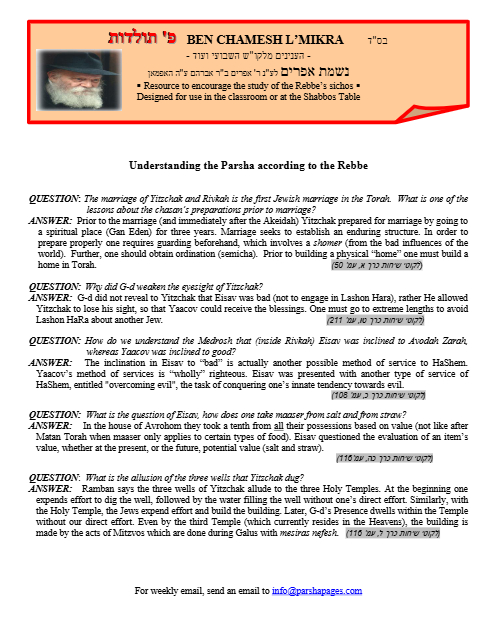
Ramban says the three wells of Yitzchak allude to the three Holy Temples. At the beginning one expends effort to dig the well, followed by filling of the water without one’s direct effort; so too with the Holy Temple, we build the building, and G-d’s Presence dwells without our direct effort. Even by the third Temple (which resides in the Heavens), the building is made by the acts of Mitzvos which are done during Galus with mesiras nefesh.
Those involved in worldly pursuits need to also learn Torah; and those who solely learn Torah also must do so in a way to affect those that are involved with the world. Avrohom’s mission involved reaching out to the entire world; Yitzchak’s mission was more internal and only in Eretz Yisrael. Nevertheless, Yitzchak continued the mission of Avrohom, since he also bought people closer to G-d (but stayed in his place).

תולדות

We say Parsha Akeida each day to remind us that even when involved in the outside world, one’s ashes (one’s physicality) must remain near the Altar of holiness (a true bitul). יצחק – עולה תמימה. כל ארץ ישראל כמו העזרה. In a sense the ashes of Yitzchak were gathered together to remain near the Altar, as if the Akeida and its merits are continuing to take place even now.

גור בארץ הזאת

Yitzchak’s spiritual service of awe served as a prelude to the true, unlimited joy of closeness to G-d; although the spiritual service of Avrohom and Yitzchak were externally dissimilar, they were similar in the end, a coming closer to G-d.

הוליד את יצחק

Intention that Eisav (and all of us) overcome the bad inclination that is our nature in order to achieve a higher level. Rivkah gave birth at nine months (and not seven like Tamar) since her twins were lacking (חסר וא"ו) in the womb, Eisav needed more time to mature.

וימלאו ימי'

Ramban says the three wells of Yitzchak allude to the three Holy Temples. At the beginning one expends effort to dig the well, followed by filling of the water without one’s direct effort; so too with the Holy Temple, we build the building, and G-d’s Presence dwells without our direct effort. Even by the third Temple (which resides in the Heavens), the building is made by the acts of Mitzvos which are done during Galus with mesiras nefesh.

PDF Preview