Do Not Plow with an Ox and a Donkey Together
Shvilei Pinchas | November 16, 2023
Print This Article
View Original PDF

Do Not Plow with an Ox and a Donkey Together

Shvilei Pinchas | December 31, 2025

Do Not Plow with an Ox and a Donkey Together

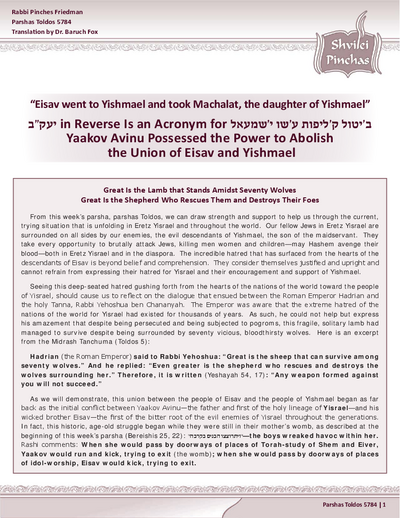
We will begin by focusing on a mitzvas “lo ta’aseh” that appears in parshas Ki Seitzei (Devarim 22, 10): "לא תחרוש בשור ובחמור יחדיו"—you shall not plow with an ox and a donkey together. According to the Zohar hakadosh (Beshalach 64b), there is a deeper meaning to this mitzvas “lo ta’aseh.” It aims to prohibit the union of the two forces of tumah that all the nations of the world are affiliated with—namely the ox and the donkey. When they unite, the world is doomed.

The Megaleh Amukos explains the matter based on a teaching in the Zohar hakadosh (Pinchas 246b). Yishmael, who was fathered by Avraham, is the corrupted version of Avraham’s midah of chesed; he is the chesed of the klipah, the refuse and impurities of the chesed of kedushah. He is the klipah of the donkey. Eisav, on the other hand, who was fathered by Yitzchak, is the corrupted version of Yitzchak’s midah of gevurah; he is the gevurah of the klipah, the refuse and impurities of the gevurah of kedushah. He is the klipah of the ox.

Now, at the Bris bein HaBesarim—the Covenant of the Parts—it is written (Bereishis 15, 10): "ויקח לו את כל אלה ויבתר אותם בתוך"—he took all of these to Him, and he split them in the center. In parshas Lech Lecha, the Megaleh Amukos teaches us that the seventy nations of the world are divided into two groups. Thirty-five are on the left side of kedushah led by סמא"ל, the guardian angel of Eisav; they represent the klipah of gevurah. Opposite them, there are thirty-five on the right side of kedushah, led by רה"ב, the guardian angel of Yishmael; they represent the klipah of chesed.

Thus, we have seventy nations, אל"ה opposite אל"ה. In other words, we have ל"ה, thirty-five nations on the right led by their leader, their א' (the guardian angel of Yishmael), opposite ל"ה, thirty-five nations on the left led by their leader, their א' (the guardian angel of Eisav). The holy people of Yisrael stand in the middle, between the two groups of אל"ה . This is the allusion in the passuk cited above: "ויקח לו את כל אלה"—he took the two sets of אל"ה, comprising the seventy nations and their leaders—"ויבתר אותם בתוך"—he split them into two halves and placed Yisrael between them. This is also alluded to in the passuk (Tehillim 20, 28): "אלה ברכב ואלה בסוסים". Here, too, the passuk refers to the two corresponding sets of אל"ה representing the seventy nations of the world led by Eisav and Yishmael; "ואנחנו בשם ה' אלקינו נזכיר״—refers to Yisrael, the people devoted to Hashem.

We can now explain the teaching in the Zohar hakadosh apropos the “lo ta’aseh” of: "לא תחרוש בשור ובחמור יחדיו". The union of these two forces of tumah—the klipah of Eisav, the ox, and the klipah of Yishmael, the donkey—poses a grave danger. For, they are the source of all the forces of tumah of the seventy guardian angels of the nations of the world. In relation to this fact, we are taught in the Mishnah (Sanhedrin 71b): "פיזור לרשעים הנאה להן והנאה לעולם ולצדיקים רע להן ורע לעולם, כינוס לרשעים רע להן ורע לעולם ולצדיקים הנאה להן והנאה לעולם." Dispersal for the wicked is beneficial to them and beneficial to the world, but for the tzaddikim, it is detrimental to them and detrimental to the world. Assembly for the wicked is detrimental to them and detrimental to the world, but for the tzaddikim, it is beneficial to them and beneficial to the world.
Do Not Plow with an Ox and a Donkey Together

We will begin by focusing on a mitzvas “lo ta’aseh” that appears in parshas Ki Seitzei (Devarim 22, 10): "לא תחרוש בשור ובחמור יחדיו"—you shall not plow with an ox and a donkey together. According to the Zohar hakadosh (Beshalach 64b), there is a deeper meaning to this mitzvas “lo ta’aseh.” It aims to prohibit the union of the two forces of tumah that all the nations of the world are affiliated with—namely the ox and the donkey. When they unite, the world is doomed.

The Megaleh Amukos explains the matter based on a teaching in the Zohar hakadosh (Pinchas 246b). Yishmael, who was fathered by Avraham, is the corrupted version of Avraham’s midah of chesed; he is the chesed of the klipah, the refuse and impurities of the chesed of kedushah. He is the klipah of the donkey. Eisav, on the other hand, who was fathered by Yitzchak, is the corrupted version of Yitzchak’s midah of gevurah; he is the gevurah of the klipah, the refuse and impurities of the gevurah of kedushah. He is the klipah of the ox.

Now, at the Bris bein HaBesarim—the Covenant of the Parts—it is written (Bereishis 15, 10): "ויקח לו את כל אלה ויבתר אותם בתוך"—he took all of these to Him, and he split them in the center. In parshas Lech Lecha, the Megaleh Amukos teaches us that the seventy nations of the world are divided into two groups. Thirty-five are on the left side of kedushah led by סמא"ל, the guardian angel of Eisav; they represent the klipah of gevurah. Opposite them, there are thirty-five on the right side of kedushah, led by רה"ב, the guardian angel of Yishmael; they represent the klipah of chesed.

Thus, we have seventy nations, אל"ה opposite אל"ה. In other words, we have ל"ה, thirty-five nations on the right led by their leader, their א' (the guardian angel of Yishmael), opposite ל"ה, thirty-five nations on the left led by their leader, their א' (the guardian angel of Eisav). The holy people of Yisrael stand in the middle, between the two groups of אל"ה . This is the allusion in the passuk cited above: "ויקח לו את כל אלה"—he took the two sets of אל"ה, comprising the seventy nations and their leaders—"ויבתר אותם בתוך"—he split them into two halves and placed Yisrael between them. This is also alluded to in the passuk (Tehillim 20, 28): "אלה ברכב ואלה בסוסים". Here, too, the passuk refers to the two corresponding sets of אל"ה representing the seventy nations of the world led by Eisav and Yishmael; "ואנחנו בשם ה' אלקינו נזכיר״—refers to Yisrael, the people devoted to Hashem.

We can now explain the teaching in the Zohar hakadosh apropos the “lo ta’aseh” of: "לא תחרוש בשור ובחמור יחדיו". The union of these two forces of tumah—the klipah of Eisav, the ox, and the klipah of Yishmael, the donkey—poses a grave danger. For, they are the source of all the forces of tumah of the seventy guardian angels of the nations of the world. In relation to this fact, we are taught in the Mishnah (Sanhedrin 71b): "פיזור לרשעים הנאה להן והנאה לעולם ולצדיקים רע להן ורע לעולם, כינוס לרשעים רע להן ורע לעולם ולצדיקים הנאה להן והנאה לעולם." Dispersal for the wicked is beneficial to them and beneficial to the world, but for the tzaddikim, it is detrimental to them and detrimental to the world. Assembly for the wicked is detrimental to them and detrimental to the world, but for the tzaddikim, it is beneficial to them and beneficial to the world.

PDF Preview