Haftarah Toldos
BET Journal | November 19, 2023
Print This Article
View Original PDF

Haftarah Toldos

BET Journal | December 31, 2025

The navi Malachi quotes Hashem saying how much he loves Am Yisrael, even though we are brothers with Eisav. Hashem hates Eisav, our eternal enemy, and he made his mountains desolate and his portion a desert. If the day will come and Edom will say let’s rebuild, Hashem will say “I will destroy and I will call their land, the land of the wicked.”

Malachi continues and rebukes the Am Yisrael. Hashem expresses his love for us with actions of love, yet Am Yisrael does not do the same. We took everything that is holy and we destroyed it. The Kohanim in the second Bais Hamikdash violated the kedusha of the Bais Hamikdash and the korbanos.

The way of the world is that as we get used to something we become very relaxed and casual about it. Somehow when we become accustomed to things, we lose the proper respect for them, both spiritual and physical. For example, we buy a new car and after a short while it loses its freshness. It becomes not good enough. The navi Malachi explains that although the Jewish people enjoy a special closeness with Hashem, they are reminded to approach Him with reverence. The prophet Malachi addressed them shortly after their return from Babylonia and admonished them for their lack of respect in the Bais Hamikdash. He said in Hashem's name, "I love you...but if I am your father, where is my honor? The kohanim disgrace my name by referring to my altar with disrespect."

How do we keep things in our life fresh and exciting? How can we avoid being bored with what we have and do? How can we obtain the attitude of Hashem of constantly reliving the creation? המחדש בכל יום תמיד מעשה בראשית

I think the answer lies in one’s perspective in life; is it about the here and now, or the accumulated success of time? If we live in the here and now, we are concerned about instant gratification of our actions. We desecrated the Bais Hamikdash because we needed instant gratification from the eating of the korbanot, and we didn’t take care to do it b’kedusha. However, if we understand that we are working towards a goal that takes a lifetime to accomplish, then every day is a new opportunity to grow. Every day we can face our challenges with a new vigor and try to renew and improve ourselves. This way we can never be bored with ourselves and our repetitive actions.

May we keep our eyes on the goal, and experience a constant renewal in our lives. Good Shabbos.
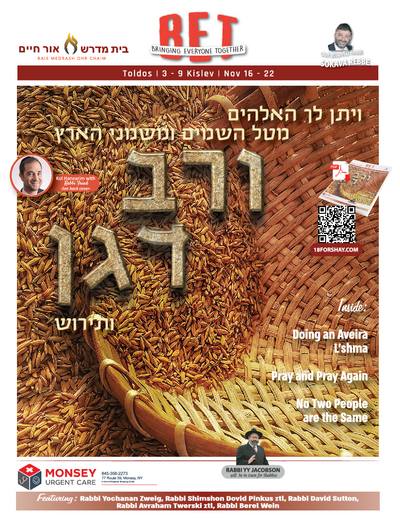
The navi Malachi quotes Hashem saying how much he loves Am Yisrael, even though we are brothers with Eisav. Hashem hates Eisav, our eternal enemy, and he made his mountains desolate and his portion a desert. If the day will come and Edom will say let’s rebuild, Hashem will say “I will destroy and I will call their land, the land of the wicked.”

Malachi continues and rebukes the Am Yisrael. Hashem expresses his love for us with actions of love, yet Am Yisrael does not do the same. We took everything that is holy and we destroyed it. The Kohanim in the second Bais Hamikdash violated the kedusha of the Bais Hamikdash and the korbanos.

The way of the world is that as we get used to something we become very relaxed and casual about it. Somehow when we become accustomed to things, we lose the proper respect for them, both spiritual and physical. For example, we buy a new car and after a short while it loses its freshness. It becomes not good enough. The navi Malachi explains that although the Jewish people enjoy a special closeness with Hashem, they are reminded to approach Him with reverence. The prophet Malachi addressed them shortly after their return from Babylonia and admonished them for their lack of respect in the Bais Hamikdash. He said in Hashem's name, "I love you...but if I am your father, where is my honor? The kohanim disgrace my name by referring to my altar with disrespect."

How do we keep things in our life fresh and exciting? How can we avoid being bored with what we have and do? How can we obtain the attitude of Hashem of constantly reliving the creation? המחדש בכל יום תמיד מעשה בראשית

I think the answer lies in one’s perspective in life; is it about the here and now, or the accumulated success of time? If we live in the here and now, we are concerned about instant gratification of our actions. We desecrated the Bais Hamikdash because we needed instant gratification from the eating of the korbanot, and we didn’t take care to do it b’kedusha. However, if we understand that we are working towards a goal that takes a lifetime to accomplish, then every day is a new opportunity to grow. Every day we can face our challenges with a new vigor and try to renew and improve ourselves. This way we can never be bored with ourselves and our repetitive actions.

May we keep our eyes on the goal, and experience a constant renewal in our lives. Good Shabbos.

PDF Preview