In the Pathways of Education
טיב הקהילה English | November 19, 2025
Print This Article
View Original PDF

In the Pathways of Education

טיב הקהילה English | December 07, 2025

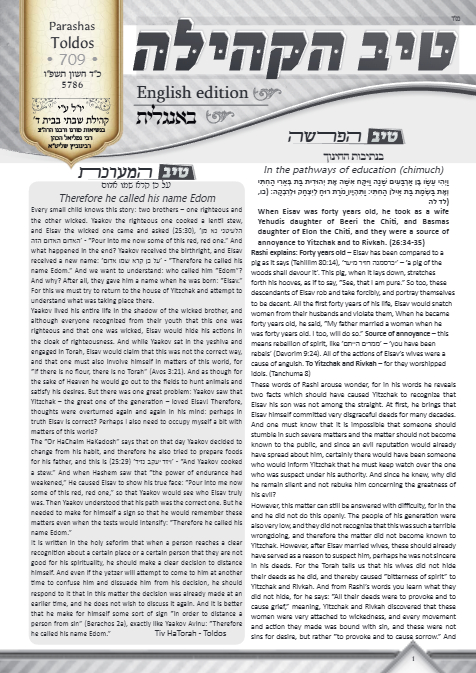
In the pathways of education (chinuch)

וַיְהִי עֵשָׂו בֶּן אַרְבָּעִים שָׁנָה וַיִּקַּח אִשָּׁה אֶת יְהוּדִית בַּת בְּאֵרִי הַחִתִּי וְאֶת בָּשְׂמַת בַּת אֵילֹן הַחִתִּי: וַתִּהְיֶיןָ מֹרַת רוּחַ לְיִצְחָק וּלְרִבְקָה: (כו, לד לה)

When Eisav was forty years old, he took as a wife Yehudis daughter of Beeri the Chiti, and Basmas daughter of Elon the Chiti, and they were a source of annoyance to Yitzchak and to Rivkah. (26:34-35)

Rashi explains: Forty years old – Eisav has been compared to a pig as it says (Tehillim 80:14), ’יכרסמנה חזיר מיער‘ – ‘a pig of the woods shall devour it’. This pig, when it lays down, stretches forth his hooves, as if to say, “See, that I am pure.” So too, these descendants of Eisav rob and take forcibly, and portray themselves to be decent. All the first forty years of his life, Eisav would snatch women from their husbands and violate them, When he became forty years old, he said, “My father married a woman when he was forty years old. I too, will do so.” Source of annoyance – this means rebellion of spirit, like ’ממרים הייתם‘ – ‘you have been rebels’ (Devorim 9:24). All of the actions of Eisav’s wives were a cause of anguish. To Yitzchak and Rivkah – for they worshipped idols. (Tanchuma 8)

These words of Rashi arouse wonder, for in his words he reveals two facts which should have caused Yitzchak to recognize that Eisav his son was not among the straight. At first, he brings that Eisav himself committed very disgraceful deeds for many decades. And one must know that it is impossible that someone should stumble in such severe matters and the matter should not become known to the public, and since an evil reputation would already have spread about him, certainly there would have been someone who would inform Yitzchak that he must keep watch over the one who was suspect under his authority. And since he knew, why did he remain silent and not rebuke him concerning the greatness of his evil?

However, this matter can still be answered with difficulty, for in the end he did not do this openly. The people of his generation were also very low, and they did not recognize that this was such a terrible wrongdoing, and therefore the matter did not become known to Yitzchak. However, after Eisav married wives, these should already have served as a reason to suspect him, perhaps he was not sincere in his deeds. For the Torah tells us that his wives did not hide their deeds as he did, and thereby caused “bitterness of spirit” to Yitzchak and Rivkah. And from Rashi’s words you learn what they did not hide, for he says: “All their deeds were to provoke and to cause grief,” meaning, Yitzchak and Rivkah discovered that these women were very attached to wickedness, and every movement and action they made was bound with sin, and these were not sins for desire, but rather “to provoke and to cause sorrow.”

And later we see in Rashi that they descended to the lowest level and even transgressed the sin of idolatry, the most severe of all sins. And their sin was not like most idol worshippers who were drawn after the inclination of idolatry and acted only out of desire, for concerning these Rashi testifies that all their deeds were done “to provoke.” And since none of this was hidden from Yitzchak’s knowledge, the question is asked: how could it be that he still did not suspect that perhaps Eisav was “righteous” like his wives? For it is impossible that a righteous man should cause wrongdoing to dwell in his house, especially such women whose entire essence cried out “wickedness.” And certainly their idols were kept in their home, that is, in the home of their husband Eisav. And are these matters not cause for astonishment?! It is true that Eisav was “a man who knew trapping,” and he had the ability to ensnare his father’s understanding and deceive him, yet nevertheless wives such as these should have aroused “suspicion.” Yet from the fact that we see that even twenty-three years after the marriage of Eisav, Yitzchak sought to bless him, this is a sign that no suspicion arose in his mind at all. For if he had suspected him, certainly he would have examined his ways more carefully in order to know if there was a need to rebuke him and return him to the correct path. And there is no doubt that had Yitzchak followed after him he would have recognized his wickedness, and he would not have desired to grant him the blessings until he would see that he had returned to the correct path.

And it is possible that this is why Yitzchak did not suspect Eisav, because there was no need at all to suspect. Yitzchak recognized Eisav very well. As we see later in our parashah, that when Yaakov entered to receive the blessings from Yitzchak, Yitzchak wondered and said (27:21): ’גשה נא ואמושך בני האתה זה בני עֵשָׂו?‘ - “Come close now and I will feel you, my son, are you indeed my son Eisav?” And Rashi comments: “Yitzchak said in his heart, it is not the way of Eisav to have the name of Heaven fluent in his mouth, and this one said, ‘Because Hashem your God caused it to happen’...” Also in the following posuk (22) it is said: ’הקול קול יעקב והידים ידי עֵשָׂו‘ - “The voice is the voice of Yaakov, and the hands are the hands of Eisav.” And Rashi explains: “‘The voice is the voice of Yaakov’ – for he speaks in a language of supplication, ‘Please rise.’ But Eisav spoke in a language of harshness, ‘Let my father rise.’” Behold from this that Yitzchak knew very well the nature of Eisav and of Yaakov.

And if indeed he knew, why did he refrain from rebuking him? The answer to this is stated at the beginning of our parashah: ’ויהי עֵשָׂו איש יודע ציד‘ - “And Eisav was a man who knew trapping.” Yitzchak also grasped Rashi’s interpretation on this posuk. And when Eisav began to ask him, “How does one tithe straw?” he immediately perceived the depth of his thought and understood that he was seeking to conceal his true identity. Then Yitzchak said in his heart: If this wicked one seeks to find favor in my eyes, there is still hope for him. With the condition that indeed I will draw him close and show him signs of affection, for then he will rejoice to dwell in my presence, and in this way I will be able to speak with him words of Torah and to arouse him to straighten the crookedness in his heart without his knowing that I recognize his defect. And with the passing of days he will indeed listen to me and improve his way. And even if I will not succeed in planting fear of Heaven within him, nevertheless at least he will desire to be worthy of finding favor in my eyes, and this desire will make an impression upon his deeds. But if I rebuke him to his face, and he will understand that in place of favor he has disgrace, he will be very ashamed to be close to me, and he will find himself shelter outside my home, and then there will no longer be a barrier to his wickedness...

These matters are a great lesson in the area of education (chinuch). For behold, at times the heart of a youth is aroused to do an undesirable act, but he knows that these deeds will not find favor in the eyes of his parents and educators, and therefore he seeks to do it in a place where their eyes do not rule. But at times the youth does not succeed in his plans, and his parents or educators notice his fault. In such a case, sometimes the anger of the educators is greatly aroused, and they desire very much to inform the offending student that he has been caught in his wrongdoing, and to punish him severely for it, saying: from now on the youth will fear to do things even in private. However, the truth is that only sometimes is justice with them, and this is when they know well the spirit of the youth and know that he is not ashamed to do negative deeds, and he hid his actions only to protect himself from punishment. And in such a case there is no reason to hide their knowledge, and on the contrary, it is fitting to reveal the matter and punish him for it so that he will not return again to his fault.

However, at times we are dealing with a youth who hid his deeds only because of his desire not to lose his favor in the eyes of his parents. In such a case it is preferable not to reveal that he has been caught in his wrongdoing, for as long as the youth understands that he is appreciated, he will strive to increase Torah and good deeds, and even this sin he will correct ultimately when he awakens through the conversations of his educators. But when it becomes known to him that he is despised by his educators, he will no longer desire to improve his deeds, and who knows what his end will be.

Therefore, it is incumbent upon educators to weigh very carefully what the nature of the youth is and what caused him to conceal his deeds. May Hashem be our help to raise children and students who walk in the ways of Hashem and arouse satisfaction before Him.

In the pathways of education (chinuch)

וַיְהִי עֵשָׂו בֶּן אַרְבָּעִים שָׁנָה וַיִּקַּח אִשָּׁה אֶת יְהוּדִית בַּת בְּאֵרִי הַחִתִּי וְאֶת בָּשְׂמַת בַּת אֵילֹן הַחִתִּי: וַתִּהְיֶיןָ מֹרַת רוּחַ לְיִצְחָק וּלְרִבְקָה: (כו, לד לה)

When Eisav was forty years old, he took as a wife Yehudis daughter of Beeri the Chiti, and Basmas daughter of Elon the Chiti, and they were a source of annoyance to Yitzchak and to Rivkah. (26:34-35)

Rashi explains: Forty years old – Eisav has been compared to a pig as it says (Tehillim 80:14), ’יכרסמנה חזיר מיער‘ – ‘a pig of the woods shall devour it’. This pig, when it lays down, stretches forth his hooves, as if to say, “See, that I am pure.” So too, these descendants of Eisav rob and take forcibly, and portray themselves to be decent. All the first forty years of his life, Eisav would snatch women from their husbands and violate them, When he became forty years old, he said, “My father married a woman when he was forty years old. I too, will do so.” Source of annoyance – this means rebellion of spirit, like ’ממרים הייתם‘ – ‘you have been rebels’ (Devorim 9:24). All of the actions of Eisav’s wives were a cause of anguish. To Yitzchak and Rivkah – for they worshipped idols. (Tanchuma 8)

These words of Rashi arouse wonder, for in his words he reveals two facts which should have caused Yitzchak to recognize that Eisav his son was not among the straight. At first, he brings that Eisav himself committed very disgraceful deeds for many decades. And one must know that it is impossible that someone should stumble in such severe matters and the matter should not become known to the public, and since an evil reputation would already have spread about him, certainly there would have been someone who would inform Yitzchak that he must keep watch over the one who was suspect under his authority. And since he knew, why did he remain silent and not rebuke him concerning the greatness of his evil?

However, this matter can still be answered with difficulty, for in the end he did not do this openly. The people of his generation were also very low, and they did not recognize that this was such a terrible wrongdoing, and therefore the matter did not become known to Yitzchak. However, after Eisav married wives, these should already have served as a reason to suspect him, perhaps he was not sincere in his deeds. For the Torah tells us that his wives did not hide their deeds as he did, and thereby caused “bitterness of spirit” to Yitzchak and Rivkah. And from Rashi’s words you learn what they did not hide, for he says: “All their deeds were to provoke and to cause grief,” meaning, Yitzchak and Rivkah discovered that these women were very attached to wickedness, and every movement and action they made was bound with sin, and these were not sins for desire, but rather “to provoke and to cause sorrow.”

And later we see in Rashi that they descended to the lowest level and even transgressed the sin of idolatry, the most severe of all sins. And their sin was not like most idol worshippers who were drawn after the inclination of idolatry and acted only out of desire, for concerning these Rashi testifies that all their deeds were done “to provoke.” And since none of this was hidden from Yitzchak’s knowledge, the question is asked: how could it be that he still did not suspect that perhaps Eisav was “righteous” like his wives? For it is impossible that a righteous man should cause wrongdoing to dwell in his house, especially such women whose entire essence cried out “wickedness.” And certainly their idols were kept in their home, that is, in the home of their husband Eisav. And are these matters not cause for astonishment?! It is true that Eisav was “a man who knew trapping,” and he had the ability to ensnare his father’s understanding and deceive him, yet nevertheless wives such as these should have aroused “suspicion.” Yet from the fact that we see that even twenty-three years after the marriage of Eisav, Yitzchak sought to bless him, this is a sign that no suspicion arose in his mind at all. For if he had suspected him, certainly he would have examined his ways more carefully in order to know if there was a need to rebuke him and return him to the correct path. And there is no doubt that had Yitzchak followed after him he would have recognized his wickedness, and he would not have desired to grant him the blessings until he would see that he had returned to the correct path.

And it is possible that this is why Yitzchak did not suspect Eisav, because there was no need at all to suspect. Yitzchak recognized Eisav very well. As we see later in our parashah, that when Yaakov entered to receive the blessings from Yitzchak, Yitzchak wondered and said (27:21): ’גשה נא ואמושך בני האתה זה בני עֵשָׂו?‘ - “Come close now and I will feel you, my son, are you indeed my son Eisav?” And Rashi comments: “Yitzchak said in his heart, it is not the way of Eisav to have the name of Heaven fluent in his mouth, and this one said, ‘Because Hashem your God caused it to happen’...” Also in the following posuk (22) it is said: ’הקול קול יעקב והידים ידי עֵשָׂו‘ - “The voice is the voice of Yaakov, and the hands are the hands of Eisav.” And Rashi explains: “‘The voice is the voice of Yaakov’ – for he speaks in a language of supplication, ‘Please rise.’ But Eisav spoke in a language of harshness, ‘Let my father rise.’” Behold from this that Yitzchak knew very well the nature of Eisav and of Yaakov.

And if indeed he knew, why did he refrain from rebuking him? The answer to this is stated at the beginning of our parashah: ’ויהי עֵשָׂו איש יודע ציד‘ - “And Eisav was a man who knew trapping.” Yitzchak also grasped Rashi’s interpretation on this posuk. And when Eisav began to ask him, “How does one tithe straw?” he immediately perceived the depth of his thought and understood that he was seeking to conceal his true identity. Then Yitzchak said in his heart: If this wicked one seeks to find favor in my eyes, there is still hope for him. With the condition that indeed I will draw him close and show him signs of affection, for then he will rejoice to dwell in my presence, and in this way I will be able to speak with him words of Torah and to arouse him to straighten the crookedness in his heart without his knowing that I recognize his defect. And with the passing of days he will indeed listen to me and improve his way. And even if I will not succeed in planting fear of Heaven within him, nevertheless at least he will desire to be worthy of finding favor in my eyes, and this desire will make an impression upon his deeds. But if I rebuke him to his face, and he will understand that in place of favor he has disgrace, he will be very ashamed to be close to me, and he will find himself shelter outside my home, and then there will no longer be a barrier to his wickedness...

These matters are a great lesson in the area of education (chinuch). For behold, at times the heart of a youth is aroused to do an undesirable act, but he knows that these deeds will not find favor in the eyes of his parents and educators, and therefore he seeks to do it in a place where their eyes do not rule. But at times the youth does not succeed in his plans, and his parents or educators notice his fault. In such a case, sometimes the anger of the educators is greatly aroused, and they desire very much to inform the offending student that he has been caught in his wrongdoing, and to punish him severely for it, saying: from now on the youth will fear to do things even in private. However, the truth is that only sometimes is justice with them, and this is when they know well the spirit of the youth and know that he is not ashamed to do negative deeds, and he hid his actions only to protect himself from punishment. And in such a case there is no reason to hide their knowledge, and on the contrary, it is fitting to reveal the matter and punish him for it so that he will not return again to his fault.

However, at times we are dealing with a youth who hid his deeds only because of his desire not to lose his favor in the eyes of his parents. In such a case it is preferable not to reveal that he has been caught in his wrongdoing, for as long as the youth understands that he is appreciated, he will strive to increase Torah and good deeds, and even this sin he will correct ultimately when he awakens through the conversations of his educators. But when it becomes known to him that he is despised by his educators, he will no longer desire to improve his deeds, and who knows what his end will be.

Therefore, it is incumbent upon educators to weigh very carefully what the nature of the youth is and what caused him to conceal his deeds. May Hashem be our help to raise children and students who walk in the ways of Hashem and arouse satisfaction before Him.

PDF Preview