Tefilah Child
Nefesh Shimshon | November 29, 2024
Print This Article
View Original PDF

Tefilah Child

Nefesh Shimshon | June 27, 2025

Yitzchak prayed copiously to Hashem, across from his wife, because she was barren. (Bereishis 25:21)

Chazal say that the Imahos were barren at first because Hashem desires the prayers of tzaddikim.

On a simple level this means Hashem made them barren so they would pray more intensely. On a deeper level, that fact that Hashem desires the prayers of tzaddikim caused their children to be born by means of tefilah. There is something especially precious about a child whose birth was the result of prolonged prayers.

We see this also from the story of Channah and her son Shmuel. It says in the Gemara that Eli Hakohen offered to Channah, Shmuel’s mother, that he will pray to Hashem for her to have a son even greater than Shmuel. Channah declined the offer, saying, “I prayed for this child.” She received this child through tefilah. She prayed for him over the course of many long, childless years. This child meant more to her than another possibly could.

It is written: “Hashem will grant wisdom; from His mouth come knowledge and understanding.” The Midrash explains this with a parable about a wealthy man whose son came home from school and found his father sitting with a pot of food in front of him. The father took a piece and gave it to him. The son said, “I want only what is in your mouth,” and the father gave it to him. Because the father loved the son so much, he gave him what was in his own mouth. Similarly, “Hashem will grant wisdom,” however, to the person that Hashem loves especially, “From His mouth come knowledge and understanding.”

This parable is about Torah, which was given from Hashem’s mouth. But the Ramchal writes that the same applies to parnassah and other needs. There is regular parnassah, which, of course, comes from Hashem, but there is a special kind of parnassah that results from tefilah. If it comes through tefilah, it is truly from Hashem’s hand, and is especially precious.
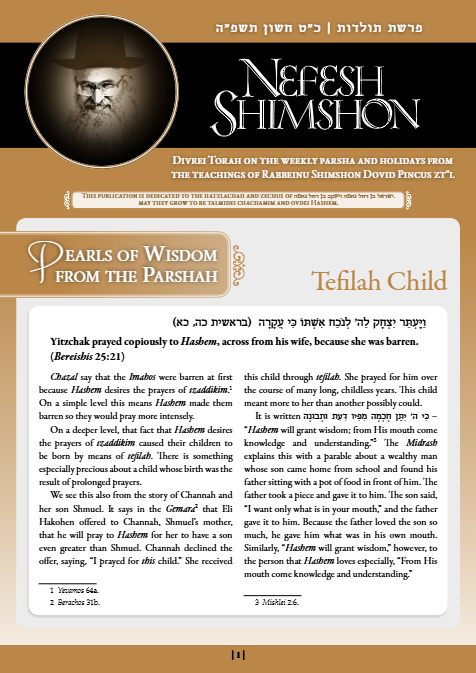

Yitzchak prayed copiously to Hashem, across from his wife, because she was barren. (Bereishis 25:21)

Chazal say that the Imahos were barren at first because Hashem desires the prayers of tzaddikim.

On a simple level this means Hashem made them barren so they would pray more intensely. On a deeper level, that fact that Hashem desires the prayers of tzaddikim caused their children to be born by means of tefilah. There is something especially precious about a child whose birth was the result of prolonged prayers.

We see this also from the story of Channah and her son Shmuel. It says in the Gemara that Eli Hakohen offered to Channah, Shmuel’s mother, that he will pray to Hashem for her to have a son even greater than Shmuel. Channah declined the offer, saying, “I prayed for this child.” She received this child through tefilah. She prayed for him over the course of many long, childless years. This child meant more to her than another possibly could.

It is written: “Hashem will grant wisdom; from His mouth come knowledge and understanding.” The Midrash explains this with a parable about a wealthy man whose son came home from school and found his father sitting with a pot of food in front of him. The father took a piece and gave it to him. The son said, “I want only what is in your mouth,” and the father gave it to him. Because the father loved the son so much, he gave him what was in his own mouth. Similarly, “Hashem will grant wisdom,” however, to the person that Hashem loves especially, “From His mouth come knowledge and understanding.”

This parable is about Torah, which was given from Hashem’s mouth. But the Ramchal writes that the same applies to parnassah and other needs. There is regular parnassah, which, of course, comes from Hashem, but there is a special kind of parnassah that results from tefilah. If it comes through tefilah, it is truly from Hashem’s hand, and is especially precious.

PDF Preview