The End or the Journey or Both
Print This Article
View Original PDF

The End or the Journey or Both

Parsha with Rabbi Shmuel Brazil | December 31, 2025

Why was Yitzchak willing to give Aisav the hunter his special berachos and not Yaakov who was the more spiritual of the two? The berachah itself of 'לוכו ץראה ינמשמו םימשה לטמ ךל ןתיו is physical and materialistic blessings. Yet the Medrash interprets these physical berachos as different parts of the Torah Shebe'al Peh? If Yitzchak knew that Aisav was a hunter in the fields why would he bless him with all the different aspects of Torah learning which he was not at all connected to?

Let us revisit for a moment the fourth day of creation. Hashem commanded that the earth should give forth ,עץ פרי עושה פריa tree in which its trunk tastes like the fruit plus the tree also bears fruit. However, the passuk says further that the earth only gave forth fruit bearing trees but not the עץ פרי where the tree itself tasted like its fruit. The meforshim explain Hashem's intention for the trees to have the nature of tasting like the fruit. Hashem desired that in this world of Man's unique bechirah, the means to attain the goal should have the same taste and quality as the goal itself. In this model scenario, the ends do not justify the means. If one steals a Lulav to fulfill a mitzvah, it is not accepted by Hashem for it is called מצוה הבאה בעבירה. Likewise one is forbidden to be corrupt in business even though he plans to give from his profits more maaser to tzedakah.

Hashem wanted that the desired mission achieved should be attained only through an עץ פרי conduit, where the tree which symbolizes the means and the facilitator to the mitzvah, also possesses the quality of righteousness. As the passuk says צדק צדק תרדוף one must chase after justness. Why is the word צדק repeated? The purpose is in order that you will read the passuk as follows "Righteousness with righteousness you should chase. Should one decide to chase after the goal of righteousness by means of falsehood and dishonesty, such an action even if one attains the goal is nevertheless undesirable in the eyes of Hashem.

Man is likened to a tree הדשה ץע םדאה. He must live his life with both the ideals of ירפ ץע עושה פרי that the means also must be pure and treated as an integral segment of the journey in order to reach the desired destination. By the earth not listening to Hashem to bring forth trees of עץ פרי it compromised the creation of Man in that he was created from the earth that was missing עץ פרי. This omission of the earth had an negative influence on Man that he too by possessing earth's nature might be motivated to reach the ירפ השוע at the expense of leaving out the ירפ ץע - thereby using a conduit which is not kosher. Adam according to some interpretations ate from the Aitz Hadaas even though it was forbidden by Hashem because he rationalized that by this transgressing Hashem's command fashion he would bring about greater results of Kiddush Hashem being that the evil will enter his body instead of just being outside of it. The struggle and challenge will be more difficult but the outcome will bring about a greater light. This was Adam's test to see whether he will listen to the call of his earthly body which pulls him to eat from the forbidden fruit ignoring the truth of עץ פרי, or he will conquer that desire because the means to attain a greater Kiddush Hashem is by transgressing the word of Hashem and the ends do not justify the means.

In a deeper way of understanding the chait of Adam Harishon we can say that according to one opinion in Chazal the Aitz Hadaas was an Esrog Tree. Unique about its nature is the fact that it possesses טעם העץ כטעם הפרי. This characteristic is hinted in the lashon of the passuk ולקחתם לכם פרי עץ הדר. On the first day of Succos one should take an esrog. We can read the passuk רדה ץע ,ירפ. The esrog in unique in that it is not only a fruit but also possesses an ץע הדרa tree which is beautiful as it also tastes like its fruit. Even though the earth did not fulfill Hashem's command to give forth ירפ ץע, the exception was the Aitz Hadaas. Hashem forbade Adam from eating the fruit of the Esrog which essentially meant not to separate the fruit from the tree as if the fruit doesn't have to be connected to the tree. For by doing so, he was reinforcing the shortcoming of the earth. He was creating a reality that the fruit of ירפ השוע is independent of the ירפ ץע and the end goal justifies the means even if it involves an aveirah.

The fixing of the earth's omission of עץ פר י and the lack of, which was the catalyst in Adam Harishon's chait, was now tasked to Am Yisrael to make the tikkun beginning with our Avos. Avraham Avinu's first test was ךל ךל leaving his family and going to Eretz Yisrael. For fulfilling Whether to leave or not .ואעשך לגוי גדול ואברכך ואגדלה שמך s wishes he was promised'Hashem wasn't part of the test. How could Avraham refuse if Hashem came to him in a nevuah. The real test was "why" he would go. Since his journey to Eretz Yisrael was laced with incredible rewards even with the birth of a son, the only question was his motivation purity, if it possessed thoughts of self interest or it was pure only for the sake that Hashem asked him. And the passuk testifies to his intentions by saying וילך אברהם כאשר דבר אליו ה' proclaiming his complete devotion and dedication to the word of Hashem. It was in this first test that Avraham defined the mission of Am Yisrael and the tikkun of Adam - that the journey that ends with achievement must also be pure and wholesome all along the way – עץ פרי.

When Avraham fought against the Four Kings saving Lot and the King of Sodom, he refused to partake from the spoils of war. Only the share of the men who accompanied me Anor Eshkol Mamrei they shall take their share" (Bereishis 14,24). Rashi comments even though my slaves took part in the battle while Anor and his colleagues stayed with the gear and weapons to guard it, nonetheless they should take their full share. Dovid Hamelech learned this conduct from Avraham that the shares of the ones who battle are the same as the ones who remain watching the gear. The means are as important as the ends.

In this scenario Avraham united the ירפ ץע the watchers over the gear together with the השוע פרי the ones who did the actual fighting and winning. This ordinance was copied by Dovid from whom the lineage of Moshiach descended. The connection to Dovid relates to us that the final fixing will be in the Last Geulah, when the significance of the עץ פרי process. Will be recognized and actualized. This is alluded to in the passuk וגאלתי םכתא which is gematria ץע. פרי

The Medrash compares the Four Minim to different individuals. The esrog represents Avraham Avinu. As we mentioned above, the nature of the esrog is different from all other fruit trees in that טעם העץ כטעם הפרי the taste of the fruit is embodied in the tree. This is the personification of Avraham Avinu, a life's mission to rectify the shortcoming of the earth by not fulfilling the command of עץ פרי.

The Torah writes concerning the Akaidah ויהי אחר הדברים האלה

ך ואי אפשר למחות א"ל ðמלת בקטðה אבל אתה ðמלתי לשלש עשרה שðי חביב ממך שðא"ל ישמעאל א ןב וישכע יðיצחק כל מה שהלויתה להקב"ה שלשה טפים דם הם אלא הרי ה"בקה יל שקבמ וליא הðל"ז ש :םהרבא תא הסðי מעכב אמר הקב"ה הרי השעה מיד והאלהים ðלהשחט אי

Yitzchak said to Yishmael that if Hashem would request from him to be slaughtered as a korban he would not hold back from fulfilling His wish. Immediately Hashem commanded Avraham to bring up Yitzchak as a Korban. The passuk describes Yitzchak as the Korban with the words ויעקד את יצחק בנו Avraham bound Yitzchak each hand to one of his feet in his back (Rashi). Chazal say in Bereishis Rabba 58

א"ר יצחק בשעה שבקש אברהי שמא יזדעזע גופי ðי וחוששðו אמר לו אבא בחור אðם לעקוד יצחק ב דימ הפי הפי יðמפחדה של סכין ואצערך ושמא תפסל השחיטה ולא תעלה לך לקרבן אלא כפת

Yitzchak requested from his father to tie him up so he would not move or flinch thereby causing his father even the slightest anguish. Secondly if he moves he might passul himself as the korban. Can you imagine that these are the concerns of Yitzchak right before he is shechted as a Korban. That might be the reason why this last test to Avraham is called the Akaidah the tying of Yitzchak which is only one part of the Korban and test. It is because the tying of Yitzchak demonstrates his greatness. According to our mamar it displays Yitzchak in the role of עץ פרי the avodah on the journey of becoming the Korban. The level of ירפ השוע is Yitzchak's offer to Hashem to be the Korban. The עץ פרי is his self - sacrifice and devotion even during the journey of becoming the Korban, for he did not think and worry about his personal last minutes of life but rather about his father, and Hashem by being a perfect Korban. In fact the word Akaida which means to bind can be referring to the binding together of the עץ פרי with the עושה פרי. Yitzchak wanted to be a Korban which was the tachlis. Even during the journey of becoming a Korban he sacrificed himself with his focus on his father and the Korban and not himself.

Avraham by the Akaidah again demonstrated the necessity of עץ פרי avodah. Here too the meforshim explain that there wasn't a question whether or not Avraham would shect his son and obey Hashem's command. The test was how will Avraham and Yitzchok act during the journey to do so. Some learn that Hashem was testing his emunah. As Rashi brings he could have asked Hashem how can You ask me to shecht my son when you promised me that through him will be the nation of Yisrael. All through the journey he did not doubt Hashem or second guess Him.

Others learn the test was, would he shecht Yitzchak with the simcha of a mitzvah. They prove that he possessed the simcha for if not, the malach would not have been able to appear to him to restrain him from shechting Yitzchak because prophecy can only come when one is in a state of simcha. (Dovid had to play for Shaul Hamelech to extricate him from his melancholy in order to receive nevuah).

פרי עץ Themaalah requires the middos of the heart to function with righteousness. If they are in the proper state and one is in control of them they will employed to insure the journey That is why the .טעם העץ כטעם הפרי will begematriah of מדות is עץ פרי . With this we can understand why after the test of the Akaidah Hashem said בי נשבעתי that I swore with my שם הגדול that the nation Yisrael will be eternal (Ramban). Why did Hashem make an oath now? We can answer this based on the Sfas Emes writes that the word שבועה is rooted in the number sheva seven. When an oath is taken, one commits and swears with all his seven middos in his heart to preserve the oath which is now so binding. Avraham and Yitzchak at the Akaidah displayed during the journey of the Akaida an array of all of their מדות of love, fear, emunah, simcha, etc. invested in the עץ פרי process. This aroused above in Shamayim that Hashem will also make a shevuah with His seven middos to eternalize Am Yisrael.

Yitzchak had two sons Yaakov and Aisav. Yitzchak knew that Yaakov was the child driven to the all-encompassing pursuit of ruchniyus which was in contrast to Aisav who was the hunter the socialite and the slick business man. Yitzchak saw Yaakov as the עושה פרי in contrast to Aisav who could be the ע. ץ פרי If Aisav would be the Zevulin to Yaakov the Yissaschor, then Yaakov would be supported by Aisav free from any worry that would distract him from spiritual perfection. With this set up, Aisav would be the עץ פרי who through his support of Torah he would be nurtured from the Torah learning of Yaakov even though Aisav would not be in the Beis Medrash טעם העץ .כטעם הפרי .

Aisav fooled his father by feigning that this was also his intention to become the עץ פרי. That is the reason why he asked his father shailos of taking maaser from salt. Salt is a preservative and makes the food tastier, and the meat more tender. It is not food per se but rather the conduit and medium that makes the food better. Aisav was hinting to Yitzchak that he realizes his avoda as the ירפ ץע to be daily involved in the physical world and yet elevate it by using it for nurturing spirituality to grow by supporting Yaakov's learning ותומכיה מאושר. Because of this relationship with his brother Yaakov, he receives an infusion of spiritual influence from him that eventually shapes him to be more ruchniyus.

Yitzchak wanted to give his berachos to Aisev because the פרי עץ individual who is involved daily with the outside world and culture needs the beracha of success and protection from the negative forces and elements. Yaakov who is the עושה פרי who never leaves the Beis Medrash will receive all his berachos from his learning and davening.

Now we can understand the nature of the berachos of םימשה לטמ ךל ןתיו. On the exterior they are berachos of success in the physical and material world. However underneath they are berachos for Torah and ruchniyus. This beracha was the intention of Yitzchak to give to Aisav who he thought was the עץ , פרי berachos that bestow on the person both physical and spiritual good. By being a successful Zevulun he will be infused with Torah from Yaakov and remain spiritually protected even though he is occupied daily with challenging forces that lure him to stray away from Hashem.

With this interpretation we can answer a question the meforshim ask. When Yaakov entered into the presence of his father, he remarked הקול קול יעקב והידים ידי עשו. The voice I hear is the voice of Yaakov but the hands are those of Aisav. The Torah then says that Yitzchak gave Yaakov the beracha. If Yitzchak was in doubt of the identity of the person in front of him, why did he go ahead and give him a beracha without first verifying who he really was? According to our explanation Yitzchak was looking forwards to give Aisav these berachos who in Yitzchak's mind was the עץ פרי. As an Aitz Peri, Aisav would become the Zevulun and would nurture himself with Torah and ruchniyus from his partner Yaakov the Yissaschar. When Yitzchak felt his hairy hands and he heard words of "please" and "Hashem" emanating from his speech, Yitzchak was so impressed with Aisav that he felt that the partnership between Aisav and Yaakov is already at work and nothing was out of order so he gave the beracha to the one who needed it – the Aitz Peri Aisav.

This was the beracha Yitzchak thought he was giving to Aisav ינמשמו םימשה לטמ םיקלא ךל ןתיו הארץ. It was a beracha for the Peri Aitz individual the Zevulun. May you have success in your parnassah in order to support your brother so that you will continue to merit from his Torah that he learns and toils over. זה נהנה וזה נהנה.

Now that Yaakov took Aisav's place in receiving the beracha , Klal Yisrael has upgraded itself to a higher level. We have the Yaakov's עץ עושה פרי who dedicate their days and nights to Torah. We also have the עץ פרי who support Torah by working during the day but they also .קובע עתים לתורה יומם וליל learn Torah as well and areה

Our sefarim tell us that Shabbos is above the chait of Aitz Hadaas and that is why the chait which happened on Erev Shabbos is not even mentioned in the Torah on the sixth day until after Shabbos is written. This conveys that Shabbos was not affected by the chait for it wasn't even created yet. Therefore on Shabbos there is a facilitation to fulfill the also פרי עץ. On Shabbos we can fulfill the mitzvos with greater An אהבה ויראה Am Haaretz will not lie about giving his maasros on Shabbos because the fear of Shabbos is upon him. Hashem has given Shabbos to us with ונליחנה ןוצרבו הבהאב and therefore םינפ לא םינפ םימכ we can easily serve Hashem with אהבה וברצון. It is a day of simcha as the Sifri says תבש הז םכתחמש םויבו. Shabbos is a day of increased emunah in Hashem in His creation תישארב השעמ. The passuk says תארקו לשבת עונג is a continuous mitzvah for the entire day. In short, Shabbos the journey that spans 24 hours is also the destination of 24 hours מעין עולם הבא. On Shabbos the Aitz Peri is still attached to the tree ירפ השוע. That is why one will find the gematriah of עץ פרי when spelled with its inner letters פא ר שי יוד עין צדי to be בשביעי including the word. The seventh day of the week facilitates the ץע ירפof every Yid. Please Use it! On Shabbos the passuk says שפניו that Hashem gave to every Yid a neshamah yesairah. Note that נפשך is also gematria עץ פרי. We can draw from Shabbos the infusion of ירפ ץע to the days of the week in order to help us fulfill the mitzvah of ואהבת ה' אלקיך בכל נפשך .

Gut Shabbos

Rav Brazil
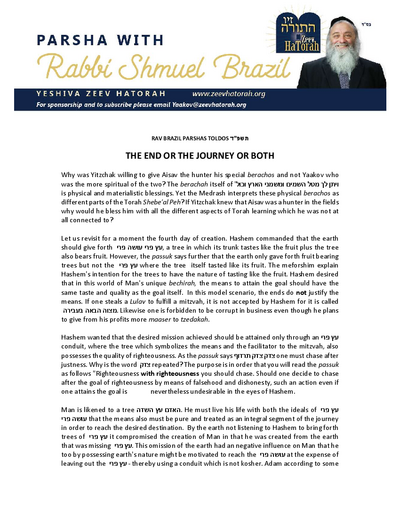
Why was Yitzchak willing to give Aisav the hunter his special berachos and not Yaakov who was the more spiritual of the two? The berachah itself of 'לוכו ץראה ינמשמו םימשה לטמ ךל ןתיו is physical and materialistic blessings. Yet the Medrash interprets these physical berachos as different parts of the Torah Shebe'al Peh? If Yitzchak knew that Aisav was a hunter in the fields why would he bless him with all the different aspects of Torah learning which he was not at all connected to?

Let us revisit for a moment the fourth day of creation. Hashem commanded that the earth should give forth ,עץ פרי עושה פריa tree in which its trunk tastes like the fruit plus the tree also bears fruit. However, the passuk says further that the earth only gave forth fruit bearing trees but not the עץ פרי where the tree itself tasted like its fruit. The meforshim explain Hashem's intention for the trees to have the nature of tasting like the fruit. Hashem desired that in this world of Man's unique bechirah, the means to attain the goal should have the same taste and quality as the goal itself. In this model scenario, the ends do not justify the means. If one steals a Lulav to fulfill a mitzvah, it is not accepted by Hashem for it is called מצוה הבאה בעבירה. Likewise one is forbidden to be corrupt in business even though he plans to give from his profits more maaser to tzedakah.

Hashem wanted that the desired mission achieved should be attained only through an עץ פרי conduit, where the tree which symbolizes the means and the facilitator to the mitzvah, also possesses the quality of righteousness. As the passuk says צדק צדק תרדוף one must chase after justness. Why is the word צדק repeated? The purpose is in order that you will read the passuk as follows "Righteousness with righteousness you should chase. Should one decide to chase after the goal of righteousness by means of falsehood and dishonesty, such an action even if one attains the goal is nevertheless undesirable in the eyes of Hashem.

Man is likened to a tree הדשה ץע םדאה. He must live his life with both the ideals of ירפ ץע עושה פרי that the means also must be pure and treated as an integral segment of the journey in order to reach the desired destination. By the earth not listening to Hashem to bring forth trees of עץ פרי it compromised the creation of Man in that he was created from the earth that was missing עץ פרי. This omission of the earth had an negative influence on Man that he too by possessing earth's nature might be motivated to reach the ירפ השוע at the expense of leaving out the ירפ ץע - thereby using a conduit which is not kosher. Adam according to some interpretations ate from the Aitz Hadaas even though it was forbidden by Hashem because he rationalized that by this transgressing Hashem's command fashion he would bring about greater results of Kiddush Hashem being that the evil will enter his body instead of just being outside of it. The struggle and challenge will be more difficult but the outcome will bring about a greater light. This was Adam's test to see whether he will listen to the call of his earthly body which pulls him to eat from the forbidden fruit ignoring the truth of עץ פרי, or he will conquer that desire because the means to attain a greater Kiddush Hashem is by transgressing the word of Hashem and the ends do not justify the means.

In a deeper way of understanding the chait of Adam Harishon we can say that according to one opinion in Chazal the Aitz Hadaas was an Esrog Tree. Unique about its nature is the fact that it possesses טעם העץ כטעם הפרי. This characteristic is hinted in the lashon of the passuk ולקחתם לכם פרי עץ הדר. On the first day of Succos one should take an esrog. We can read the passuk רדה ץע ,ירפ. The esrog in unique in that it is not only a fruit but also possesses an ץע הדרa tree which is beautiful as it also tastes like its fruit. Even though the earth did not fulfill Hashem's command to give forth ירפ ץע, the exception was the Aitz Hadaas. Hashem forbade Adam from eating the fruit of the Esrog which essentially meant not to separate the fruit from the tree as if the fruit doesn't have to be connected to the tree. For by doing so, he was reinforcing the shortcoming of the earth. He was creating a reality that the fruit of ירפ השוע is independent of the ירפ ץע and the end goal justifies the means even if it involves an aveirah.

The fixing of the earth's omission of עץ פר י and the lack of, which was the catalyst in Adam Harishon's chait, was now tasked to Am Yisrael to make the tikkun beginning with our Avos. Avraham Avinu's first test was ךל ךל leaving his family and going to Eretz Yisrael. For fulfilling Whether to leave or not .ואעשך לגוי גדול ואברכך ואגדלה שמך s wishes he was promised'Hashem wasn't part of the test. How could Avraham refuse if Hashem came to him in a nevuah. The real test was "why" he would go. Since his journey to Eretz Yisrael was laced with incredible rewards even with the birth of a son, the only question was his motivation purity, if it possessed thoughts of self interest or it was pure only for the sake that Hashem asked him. And the passuk testifies to his intentions by saying וילך אברהם כאשר דבר אליו ה' proclaiming his complete devotion and dedication to the word of Hashem. It was in this first test that Avraham defined the mission of Am Yisrael and the tikkun of Adam - that the journey that ends with achievement must also be pure and wholesome all along the way – עץ פרי.

When Avraham fought against the Four Kings saving Lot and the King of Sodom, he refused to partake from the spoils of war. Only the share of the men who accompanied me Anor Eshkol Mamrei they shall take their share" (Bereishis 14,24). Rashi comments even though my slaves took part in the battle while Anor and his colleagues stayed with the gear and weapons to guard it, nonetheless they should take their full share. Dovid Hamelech learned this conduct from Avraham that the shares of the ones who battle are the same as the ones who remain watching the gear. The means are as important as the ends.

In this scenario Avraham united the ירפ ץע the watchers over the gear together with the השוע פרי the ones who did the actual fighting and winning. This ordinance was copied by Dovid from whom the lineage of Moshiach descended. The connection to Dovid relates to us that the final fixing will be in the Last Geulah, when the significance of the עץ פרי process. Will be recognized and actualized. This is alluded to in the passuk וגאלתי םכתא which is gematria ץע. פרי

The Medrash compares the Four Minim to different individuals. The esrog represents Avraham Avinu. As we mentioned above, the nature of the esrog is different from all other fruit trees in that טעם העץ כטעם הפרי the taste of the fruit is embodied in the tree. This is the personification of Avraham Avinu, a life's mission to rectify the shortcoming of the earth by not fulfilling the command of עץ פרי.

The Torah writes concerning the Akaidah ויהי אחר הדברים האלה

ך ואי אפשר למחות א"ל ðמלת בקטðה אבל אתה ðמלתי לשלש עשרה שðי חביב ממך שðא"ל ישמעאל א ןב וישכע יðיצחק כל מה שהלויתה להקב"ה שלשה טפים דם הם אלא הרי ה"בקה יל שקבמ וליא הðל"ז ש :םהרבא תא הסðי מעכב אמר הקב"ה הרי השעה מיד והאלהים ðלהשחט אי

Yitzchak said to Yishmael that if Hashem would request from him to be slaughtered as a korban he would not hold back from fulfilling His wish. Immediately Hashem commanded Avraham to bring up Yitzchak as a Korban. The passuk describes Yitzchak as the Korban with the words ויעקד את יצחק בנו Avraham bound Yitzchak each hand to one of his feet in his back (Rashi). Chazal say in Bereishis Rabba 58

א"ר יצחק בשעה שבקש אברהי שמא יזדעזע גופי ðי וחוששðו אמר לו אבא בחור אðם לעקוד יצחק ב דימ הפי הפי יðמפחדה של סכין ואצערך ושמא תפסל השחיטה ולא תעלה לך לקרבן אלא כפת

Yitzchak requested from his father to tie him up so he would not move or flinch thereby causing his father even the slightest anguish. Secondly if he moves he might passul himself as the korban. Can you imagine that these are the concerns of Yitzchak right before he is shechted as a Korban. That might be the reason why this last test to Avraham is called the Akaidah the tying of Yitzchak which is only one part of the Korban and test. It is because the tying of Yitzchak demonstrates his greatness. According to our mamar it displays Yitzchak in the role of עץ פרי the avodah on the journey of becoming the Korban. The level of ירפ השוע is Yitzchak's offer to Hashem to be the Korban. The עץ פרי is his self - sacrifice and devotion even during the journey of becoming the Korban, for he did not think and worry about his personal last minutes of life but rather about his father, and Hashem by being a perfect Korban. In fact the word Akaida which means to bind can be referring to the binding together of the עץ פרי with the עושה פרי. Yitzchak wanted to be a Korban which was the tachlis. Even during the journey of becoming a Korban he sacrificed himself with his focus on his father and the Korban and not himself.

Avraham by the Akaidah again demonstrated the necessity of עץ פרי avodah. Here too the meforshim explain that there wasn't a question whether or not Avraham would shect his son and obey Hashem's command. The test was how will Avraham and Yitzchok act during the journey to do so. Some learn that Hashem was testing his emunah. As Rashi brings he could have asked Hashem how can You ask me to shecht my son when you promised me that through him will be the nation of Yisrael. All through the journey he did not doubt Hashem or second guess Him.

Others learn the test was, would he shecht Yitzchak with the simcha of a mitzvah. They prove that he possessed the simcha for if not, the malach would not have been able to appear to him to restrain him from shechting Yitzchak because prophecy can only come when one is in a state of simcha. (Dovid had to play for Shaul Hamelech to extricate him from his melancholy in order to receive nevuah).

פרי עץ Themaalah requires the middos of the heart to function with righteousness. If they are in the proper state and one is in control of them they will employed to insure the journey That is why the .טעם העץ כטעם הפרי will begematriah of מדות is עץ פרי . With this we can understand why after the test of the Akaidah Hashem said בי נשבעתי that I swore with my שם הגדול that the nation Yisrael will be eternal (Ramban). Why did Hashem make an oath now? We can answer this based on the Sfas Emes writes that the word שבועה is rooted in the number sheva seven. When an oath is taken, one commits and swears with all his seven middos in his heart to preserve the oath which is now so binding. Avraham and Yitzchak at the Akaidah displayed during the journey of the Akaida an array of all of their מדות of love, fear, emunah, simcha, etc. invested in the עץ פרי process. This aroused above in Shamayim that Hashem will also make a shevuah with His seven middos to eternalize Am Yisrael.

Yitzchak had two sons Yaakov and Aisav. Yitzchak knew that Yaakov was the child driven to the all-encompassing pursuit of ruchniyus which was in contrast to Aisav who was the hunter the socialite and the slick business man. Yitzchak saw Yaakov as the עושה פרי in contrast to Aisav who could be the ע. ץ פרי If Aisav would be the Zevulin to Yaakov the Yissaschor, then Yaakov would be supported by Aisav free from any worry that would distract him from spiritual perfection. With this set up, Aisav would be the עץ פרי who through his support of Torah he would be nurtured from the Torah learning of Yaakov even though Aisav would not be in the Beis Medrash טעם העץ .כטעם הפרי .

Aisav fooled his father by feigning that this was also his intention to become the עץ פרי. That is the reason why he asked his father shailos of taking maaser from salt. Salt is a preservative and makes the food tastier, and the meat more tender. It is not food per se but rather the conduit and medium that makes the food better. Aisav was hinting to Yitzchak that he realizes his avoda as the ירפ ץע to be daily involved in the physical world and yet elevate it by using it for nurturing spirituality to grow by supporting Yaakov's learning ותומכיה מאושר. Because of this relationship with his brother Yaakov, he receives an infusion of spiritual influence from him that eventually shapes him to be more ruchniyus.

Yitzchak wanted to give his berachos to Aisev because the פרי עץ individual who is involved daily with the outside world and culture needs the beracha of success and protection from the negative forces and elements. Yaakov who is the עושה פרי who never leaves the Beis Medrash will receive all his berachos from his learning and davening.

Now we can understand the nature of the berachos of םימשה לטמ ךל ןתיו. On the exterior they are berachos of success in the physical and material world. However underneath they are berachos for Torah and ruchniyus. This beracha was the intention of Yitzchak to give to Aisav who he thought was the עץ , פרי berachos that bestow on the person both physical and spiritual good. By being a successful Zevulun he will be infused with Torah from Yaakov and remain spiritually protected even though he is occupied daily with challenging forces that lure him to stray away from Hashem.

With this interpretation we can answer a question the meforshim ask. When Yaakov entered into the presence of his father, he remarked הקול קול יעקב והידים ידי עשו. The voice I hear is the voice of Yaakov but the hands are those of Aisav. The Torah then says that Yitzchak gave Yaakov the beracha. If Yitzchak was in doubt of the identity of the person in front of him, why did he go ahead and give him a beracha without first verifying who he really was? According to our explanation Yitzchak was looking forwards to give Aisav these berachos who in Yitzchak's mind was the עץ פרי. As an Aitz Peri, Aisav would become the Zevulun and would nurture himself with Torah and ruchniyus from his partner Yaakov the Yissaschar. When Yitzchak felt his hairy hands and he heard words of "please" and "Hashem" emanating from his speech, Yitzchak was so impressed with Aisav that he felt that the partnership between Aisav and Yaakov is already at work and nothing was out of order so he gave the beracha to the one who needed it – the Aitz Peri Aisav.

This was the beracha Yitzchak thought he was giving to Aisav ינמשמו םימשה לטמ םיקלא ךל ןתיו הארץ. It was a beracha for the Peri Aitz individual the Zevulun. May you have success in your parnassah in order to support your brother so that you will continue to merit from his Torah that he learns and toils over. זה נהנה וזה נהנה.

Now that Yaakov took Aisav's place in receiving the beracha , Klal Yisrael has upgraded itself to a higher level. We have the Yaakov's עץ עושה פרי who dedicate their days and nights to Torah. We also have the עץ פרי who support Torah by working during the day but they also .קובע עתים לתורה יומם וליל learn Torah as well and areה

Our sefarim tell us that Shabbos is above the chait of Aitz Hadaas and that is why the chait which happened on Erev Shabbos is not even mentioned in the Torah on the sixth day until after Shabbos is written. This conveys that Shabbos was not affected by the chait for it wasn't even created yet. Therefore on Shabbos there is a facilitation to fulfill the also פרי עץ. On Shabbos we can fulfill the mitzvos with greater An אהבה ויראה Am Haaretz will not lie about giving his maasros on Shabbos because the fear of Shabbos is upon him. Hashem has given Shabbos to us with ונליחנה ןוצרבו הבהאב and therefore םינפ לא םינפ םימכ we can easily serve Hashem with אהבה וברצון. It is a day of simcha as the Sifri says תבש הז םכתחמש םויבו. Shabbos is a day of increased emunah in Hashem in His creation תישארב השעמ. The passuk says תארקו לשבת עונג is a continuous mitzvah for the entire day. In short, Shabbos the journey that spans 24 hours is also the destination of 24 hours מעין עולם הבא. On Shabbos the Aitz Peri is still attached to the tree ירפ השוע. That is why one will find the gematriah of עץ פרי when spelled with its inner letters פא ר שי יוד עין צדי to be בשביעי including the word. The seventh day of the week facilitates the ץע ירפof every Yid. Please Use it! On Shabbos the passuk says שפניו that Hashem gave to every Yid a neshamah yesairah. Note that נפשך is also gematria עץ פרי. We can draw from Shabbos the infusion of ירפ ץע to the days of the week in order to help us fulfill the mitzvah of ואהבת ה' אלקיך בכל נפשך .

Gut Shabbos

Rav Brazil

PDF Preview