The Kedushah Hidden Within the Physical
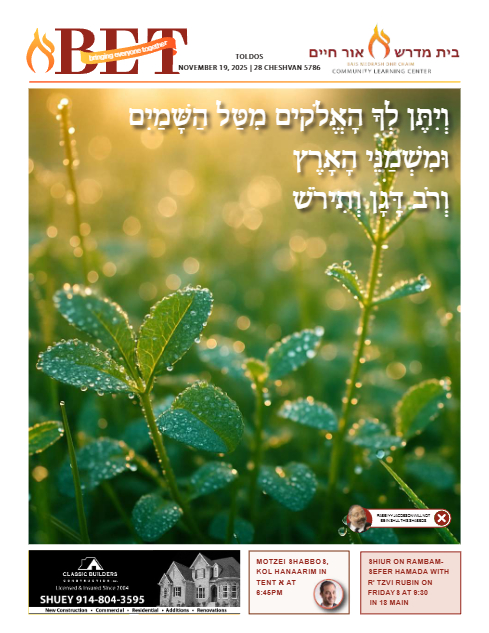
In this week’s parsha, we read about the great struggle between Yaakov and Eisav — who will receive the brachos from Yitzchak Avinu. At first glance, these brachos seem entirely physical: “מִ טַל הַשָ ּׁמַיִם וּמִ שְ ׁמַנֵּי הָאָרֶ ץ” — blessings of dew, grain, and abundance. This seems puzzling. After all, wasn’t it already determined before their birth that Yaakov would inherit the ruchniyus — the spiritual dimension of the world — while Eisav would receive the gashmiyus, the physical?
The answer is that physical blessing, when used as a vehicle for kedushah, is not a contradiction to Yaakov’s mission — it is, in fact, its fulfillment. The material world was never meant to be rejected; it was meant to be transformed. The role of Klal Yisrael is to reveal the Divine energy hidden within the physical, elevating matter into spirit.
The sefer Nishmasin Chadetin records a striking story about the Chasam Sofer. One Pesach, he hosted the daughter of the Divrei Chaim of Sanz. She was childless and asked the Chasam Sofer for a brachah. Just as the soup was being served, the Chasam Sofer said, “As many kneidlach as you eat, that’s how many children you’ll have.“ The woman hesitated — her father’s custom was not to eat gebrokts — but she decided to eat one kneidel. Indeed, she was later blessed with one child.
This story captures a profound truth: tzaddikim often channel brachah through physical means. The Divine light is concealed within the material — a spoonful of soup, a coin of tzedakah, a loaf of challah. The test is whether we can see past the surface and connect it to ruchniyus.
This concept applies most powerfully to money, the force that drives all gashmiyus. As we discussed last week, Avraham Avinu’s 400-shekel transaction with Ephron was not a random number — it was part of a spiritual chain leading to the 600 shekel Dovid HaMelech used to purchase the site of the Beis HaMikdash from Aravna HaYevusi. Money can trace the arc of holiness through generations.
Shlomo HaMelech said in Koheles: “הַכֶּסֶף יַעֲנֶה אֶת הַכֹּל” — “Money answers everything.“ When used properly, money can create immense good; when misused, it becomes the root of terrible destruction. It is, in a sense, the most concentrated form of human energy — neutral by itself, but transformative depending on the intent behind it.
This message connects directly to Chanukah. The Poskim (see Kitzur Shulchan Aruch and Mishnah Berurah) emphasize the special importance of tzedakah during this time, as it rectifies the soul’s blemishes. The Rambam teaches that the Greeks not only defiled the oil and the Mikdash — “pash’etu yedeihem b’mamonom shel Yisrael,“ they defiled the Jewish people’s money. The Greeks understood the power of the physical and sought to corrupt it — to disconnect material success from spiritual purpose.
As we approach Chanukah, we are challenged to reclaim that connection — to ensure our wealth, our possessions, and even our daily comforts are infused with kedushah. The miracle of Chanukah teaches us that even a small jar of oil, seemingly ordinary and physical, can become a vessel for infinite light when used for the right purpose.
Let us take this week’s parsha as a call to introspection: How much of our money and material success is being used for Hashem, and how much remains trapped in the hands of the Greeks — used for the self rather than for sanctity? When we align our physical blessings with spiritual intention, we not only live as the children of Yaakov — we bring light into the darkest corners of the world.
RABBI DANIEL COREN
Related Articles