The Legacy of Descendants and the Purity of Lineage
Torah Papers | November 17, 2023
Print This Article
View Original PDF

The Legacy of Descendants and the Purity of Lineage

Torah Papers | December 31, 2025

The Gemara interprets the verses: If one marries a non-Jew and he is a Torah scholar, he will not have one among his descendants nor one capable of answering questions of the Sages. If he is a priest, he will not have among his descendants a son who sacrifices korbanot. He will lose it all, and only bad will stem from it.

Shemen Rosh takes the above Gemara and asks how it was that Pinchas was given permission, as a zealot, to kill Zimri and Casbi. As per this Gemara and its supporting pesukim, the penalty for taking a non-Jew as a wife is not death. A zealot doesn’t gain the right to fire bullets at someone they catch driving a car on Shabbat, and similarly here, it would appear Pinchas had no such right. Shemen Rosh says, when a Beit Din judges, there are no sentiments or emotions involved. Testimony is testimony, evidence is evidence, and rulings are rulings. If someone is subject to death, they are put to death, regardless of who they are or who their children might be. But when someone acts on their own, according to what is permissible for them to do, they must first consider these other factors. If righteous children will descend from the perpetrator, they may not proceed with execution.

Pinchas first looked to see who would descend from the transgressors, just as Moshe Rabbeinu did before executing Egyptian – Our Parsha, in examining the laughter at Sarah and the questions posed by cynics, also looks forward at descendants. The Parsha opens with:

And these are the descendants of Yitzchak son of Avraham. Avraham was the father of Yitzchak.

If we were to go with the premise that Avimelech was the father of Sarah’s child, there is no way Yitzchak Avinu could be the descendent. Nothing pure could possibly descend from such a relationship. The midah of Gevurah could not possibly come from Avimelech.

And now that we have wrapped up our introduction, we’re ready to move on to the Parsha! Our third pasuk reads:

And Yitzchak prayed to the Lord for his wife, because she was barren: and the Lord was entreated of him, and Rivka his wife conceived.

Yitzchak prayed before Hashem across from [opposite] his wife, for she was barren. Hashem granted his prayer and his wife, Rivkah, conceived.

Twenty years after their wedding, she conceived. But there was a tumult in her womb. Twins, with each pulling in a different direction. How did Rivka respond? She went to Shem and Ever, to ask Hakadosh Baruch Hu what this was all about. It seems odd she’d choose that destination though. Why did she not approach her husband, Yitzchak, with the question? Was he not a prophet and had he not just played a key role in the prayers leading to her conceiving? She could have also asked her father-in-law, Avraham! The answer is, she did not want to approach either of them, to spare them the pain of learning that the child was partially drawn to Avoda Zarah, or as it turned out, one of the twins completely down that path.

And the children struggled together within her; and she said, If it be so, why am I thus? And she inquired of the Lord.

What is it that Rivka wanted? Rav Osher Weiss shlit”a, in Minchat Asher, says the Mishna in Eduyot (2:9) teaches us a father transmits to the son beauty (נּוֹי), strength (כֹּחַ), and wisdom (חָכְמָה). We bring children into this world not to create younger bodies that will act as our servants and take care of us as we grow old, but to produce offspring that will sanctify the name of Hakadosh Baruch Hu and serve a higher purpose. The Midrash tell us that Rivka said, “If these children are not going to follow that path, I’d rather not have any.” This is the same as Avraham Avinu expressed, as well as David HaMelech. Note: they all did so in the form of Tefilla, and not through action like Chizkiyahu, who did not marry as a result.

Rivka prayed for all three elements to be present in her child – נֹכַח, which stands for נּ'וֹי כֹּ'חַ חָ'כְמָה. If there is wisdom, it signals that there is also Torah, but if that one element is removed, the remaining attributes are כֹּ'חַ נּ'וֹי, represented in her expression of אִם כֵּן. If only beauty and strength were present, she didn’t want any part in such descendants.

To better explain this idea, I’ll briefly summarize what we learned last week. Sefer Amudeha Shiva explains the piyut Eshet Chayil, with emphasis on the first stanza.

Who can find a woman of worth? for her price is far above rubies. The heart of her husband safely trusts in her, and he shall have no lack of gain. She will do him good and not evil all the days of her life. She seeks wool, and flax, and works willingly with her hands.

Sarah Imeinu said to Avraham, “We are here to correct the sin of Adam HaRishon. Just as they had two sons, I am to have two sons. But if they are to be produced together, the same result will occur, with one rising up to kill the other.” Sarah presented a new plan to Avraham. He would take another woman and have his first child through her. It would be an Egyptian woman, because Cain is associated with Egypt – pishtan (flax) grows at the Nile and that was the sacrifice he (unsuccessfully) brought, given his motives were for Pharoah and Egypt to prevail over Bnei Yisrael. Hevel, on the other hand, brought the essence of Bnei Yisrael as his offering. Avraham would take Hagar, produce Yishmael, and all the zuhama – impurity – originating at the time of Adam HaRishon’s sin would be discarded through that son. Avraham could then cast him away, leaving them to focus on Yitzchak, a clean and pure descendent, without any flaw whatsoever. Sarah’s plan would result in a son, pure from all psolet and imperfection, more valuable than gold, silver, and the finest of jewels.

Rivka’s Shock and the Purpose of Twins

Rivka went to house of Avraham, knowing Sarah had already died, and learned the deep meaning behind that hesped given for her. She was told her husband – Yitzchak – was pure, and walked away believing all her children would follow in his footsteps and be without imperfection. There was not a doubt in her mind there’d be no psolet in her offspring. Then, after davening for twenty years – ִתְרֹצְצוּ הַבָּנִים בְּקִרְבָּהּ. It was an absolute shock! It was a sign that there was indeed psolet present. Why wasn’t she told? Had only she known, she, too, would have proceeded with Sarah’s plan, and brought a second wife to Yitzchak, allowing the zuhama to escape through that avenue.

לָמָּה זֶּה אָנֹכִי – Why me, she asked. She would have brought in a maidservant to give birth to Eisav had she known. But Yitzchak could not go down that path, as he was an Olah Temima – his purity did not allow for it. Rivka then asked why both sons had to be delivered at the same time. Why could it not be one after the next, with a slight delay in between allowing for one to be cast away. Why did they have to arrive at the same time like Cain and Hevel, setting up a scenario that might end the same way. Hakadosh Baruch Hu said to her:

וּשְׁנֵי לְאֻמִּים מִמֵּעַיִךְ יִפָּרֵדוּ – both of the sons were to be carried together and born at the same time. That is the way Hakadosh Baruch Hu wanted it.

Why? Why did it have to play out in that manner? The Chida says (Chomat Anakh), with the manner in which Sarah brought Hagar into the picture, and from her came Yishmael who was then cast away, there will never be any converts that come from his descendants. The level of psolet is 100%, and nothing can be salvaged there, not from Hamas, not from the Taliban, and not from Hezbollah, yimach shemam v’zichram. But from Eisav, Hakadosh Baruch Hu wanted there to come converts. That is why He connected Eisav to Yaacov. In order to connect תּוֹרָה שֶׁבִּכְתָב and תּוֹרָה שֶׁבְּעַל־פֶּה.

Wait- excuse me? Did the Chida say that our two parts of our Torah would be connected through Yaacov and Eisav? The answer is yes! תִּתֵּן אֱמֶת לְיַעֲקֹב – the Written Torah is through Yaacov Avinu. וַיֶּאֱהַב יִצְחָק אֶת־עֵשָׂו כִּי צַיִד בְּפִיו – The Arizal says Yitzchak loved Eisav because צַיִד בְּפִיו, he’d ask tremendous questions. Yitzchak saw that the entire Oral Torah would come from the mouth of Eisav. Rabbi Akiva was a descendant of Eisav! Rabbi Meir too! Shamaya and Avtalyon! Ben Bag Bag and Ben Heh Heh as well! And there are many more on that list! Had Rivka enacted a plan to discard Eisav, the track of the Oral Torah would not have developed as it did.

The Rebbe of Komarov says, when it says וְאֵלֶּה תֹּלְדֹת יִשְׁמָעֵאל, it does so with two vav’s missing in the word תֹּלְדֹת. Why is this? Because Yishmael has nothing before and nothing after. Gornisht mit gornisht. There is nothing to look for there.

The Ba’al HaTanya, as brought down in Megadim Chadashim, clarifies slightly, adding that it does not mean there are no converts whatsoever. What it means is that only once every shmittah (seven years), and by sheer chance, it will happen. Someone tried to tell me that this is why during the Shmitah year, we turn to the produce of Bnei Yishmael. But needless to say, I don’t think so.

The Chida adds (Penei David, Vezot Haberacha 4), ה' מִסִּינַי בָּא – G-d came from Sinai. וְזָרַח מִשֵּׂעִיר לָמוֹ – from Se’ir (Edom / Eisav) it began dark as they refused the Torah, but then sprouted forth some light as righteous scholars emerged. הוֹפִיעַ מֵהַר פָּארָן – from Paran though, the wilderness of Yishmael, it began with a small amount of light but then quickly went dark, with nothing ever coming from that direction.

The Gemara says (Succah 52b), there are four creations that Hakadosh Baruch Hu created but regretted, as they do more harm than good: גָלוּת (exile), כַּשְׂדִּים (Chaldeans), יִשְׁמְעֵאלִים (Ishmaelites), and יֵצֶר הָרָע (evil inclination). Why the Ishmaelites? The Mareh says (Yerushalmi Ta’anit), because from Edom came scholars, but nothing ever came from Yishmael.

Let’s add one more nice idea from Megadim Chadashim. The Gemara (Bava Batra 73b) recounts how Rabba bar bar Hana once took a Sinai tour with an Ishmaelite, who offered to show him some highlights. The first stop was at the מֵתֵי מִדְבָּר – those who died in the wilderness. They were lying on their backs, and Rabba bar bar Hana cut one corner of the techelet garment (tzitzit) to take home with him as proof of an opinion. Suddenly though, the camel couldn’t walk. The Arab camel driver asked if anything was touched and promptly instructed his passenger to return everything to its original place. The camel was miraculously healed. From there they went to the spot at which Korach and his entourage were swallowed. The camel driver told Rabba bar bar Hana to put his ear to the ground, where he heard a distinct sound – the chanting of מֹשֶׁה וְתוֹרָתוֹ אֱמֶת. The Maharsha asks, how is it that this Arab driver clearly knew of these places, and witnessed these vivid miracles, yet never converted to Judaism? Megaim Chadashim says it is simple. Yishmael, even if they saw Ma’amad Har Sinai, would not convert. They came from psolet and their destiny remains as such.

Eisav on the other hand, when combined with and connected to Yaacov, produces Rebbi and Antoninus. The Gemara relates many stories of the great friendship between Rabbi Yehuda HaNasi and the Roman Emperor, Antoninus, who’d secretly visit Rebbi's house in order to learn Torah from him, and eventually converting. The Megaleh Amukot says, Rebbi was actually a gilgul of Yaacov Avinu, and Antoninus a gilgul of Eisav.

Sarah and Avraham: The Debate Over Inheritance

Avraham Avinu heard from Sarah Imeinu that Yishmael was מְצַחֵק – mocking, and he was instructed by her to cast them away. He did not feel good about that plan, however, but was told by Hakadosh Baruch Hu to listen to his wife. Why did he need Sarah’s direction? Were Yishmael’s sins not grave enough for Avraham to act on his own? The Chatam Sofer says, he heard from his father, that inheritance should not be passed from son to son. Not even from an evil son to a good one, as the evil son may himself have sons who are good in their ways. This was the argument between Sarah and Avraham. Sarah did not want to give any inheritance to Yishmael, but Avraham thought perhaps good sons would descend from him and therefore inheritance should be given. “Listen to Sarah” – Hakadosh Baruch Hu confirmed Sarah’s position, which was derived from Ruach Hakodesh. Sarah brought Hagar into the picture because she saw clearly that no good descendants would sprout. It was their opportunity to cast away all the impurity from the sin of Adam HaRishon and ensure their son Yitzchak remained pure without imperfection. If nothing good would ever come from him, there was no need to give Yishmael any inheritance. The debate between Sarah and Avraham was whether any righteous converts would descend from Yishmael. And the debate was settled.

Faith, Emunah, and the Power of Tefillah

I’d like to draw one conclusion from this entire shiur. When Avraham was asked by Hakadosh Baruch Hu why Sarah laughed, the Ramban asks, what is the exact question or challenge here?

והקב"ה האשים אותה לאברהם למה היה הדבר נמנע בעיניה וראוי לה שתאמין או שתאמר "אמן כן יעשה ה'"

And Hakadosh Baruch Hu accused her to Avraham, why should the thing be impossible in her eyes, and it would be fitting that she believe or say "Amen, let G-d do so."

The case against Sarah was that she didn’t buy in. Rav Yerucham Mi'Mir (Da’at Torah) adds an analogy. Picture for yourself that a poor person shows up at someone’s door, and after being fed properly, the elderly woman of the house comes with an envelope of cash for them to have. The poor person responds with a bracha, “You should be blessed in the coming year to have a beautiful child!” The woman knows full well that her time has come and passed, but if she does not respond “Amen, so should Hashem do,” her verdict is that of a koferet – one who denies Hakadosh Baruch Hu and His powers. Sarah didn’t say Amen, and there should be no difference in reaction regardless of one’s age or state.

Is that really a lack of faith? One would not think so, but what it demonstrates to us is just how much Hakadosh Baruch Hu wishes for us to believe in Him, even when there is not a shred of logic or reason in the matter. Everything is possible with Hakadosh Baruch Hu. That is what we must believe! Just like Bnei Yisrael, who were stuck between the water on one side and the armed Egyptian army on the other. They needed to believe in order to see redemption.

In this month of Kislev we must strengthen our Emunah. The sign (mazal) of this month is the keshet – the bow. Do you know whose sign the bow is? Yishmael! The Midrash says he was born with a bow and lives with a bow! We, Am Yisrael, don’t rely on the bow. We know how to use it, Baruch Hashem, but our true keshet is found in our mouths. It is our Tefillah! That is our power!

We’re in a month fit for miracles, a month where Hakadosh Baruch Hu delivered the mighty into the hands of the weak, the many into the hands of the few, the impure into the hands of the holy, the wicked into the hands of the righteous, and the insolent into the hands of those who cling to Torah. Thirteen against an army and we were victorious!

May the power of Tefillah assist us once more, and may we witness the lighting of the Menorah in the rebuilt Beit Hamikdash this coming Chanuka! And may the light of simcha shine in every home of Bnei Yisrael! ◊
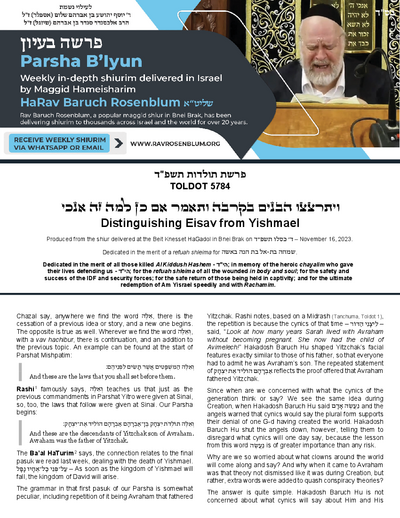

The Gemara interprets the verses: If one marries a non-Jew and he is a Torah scholar, he will not have one among his descendants nor one capable of answering questions of the Sages. If he is a priest, he will not have among his descendants a son who sacrifices korbanot. He will lose it all, and only bad will stem from it.

Shemen Rosh takes the above Gemara and asks how it was that Pinchas was given permission, as a zealot, to kill Zimri and Casbi. As per this Gemara and its supporting pesukim, the penalty for taking a non-Jew as a wife is not death. A zealot doesn’t gain the right to fire bullets at someone they catch driving a car on Shabbat, and similarly here, it would appear Pinchas had no such right. Shemen Rosh says, when a Beit Din judges, there are no sentiments or emotions involved. Testimony is testimony, evidence is evidence, and rulings are rulings. If someone is subject to death, they are put to death, regardless of who they are or who their children might be. But when someone acts on their own, according to what is permissible for them to do, they must first consider these other factors. If righteous children will descend from the perpetrator, they may not proceed with execution.

Pinchas first looked to see who would descend from the transgressors, just as Moshe Rabbeinu did before executing Egyptian – Our Parsha, in examining the laughter at Sarah and the questions posed by cynics, also looks forward at descendants. The Parsha opens with:

And these are the descendants of Yitzchak son of Avraham. Avraham was the father of Yitzchak.

If we were to go with the premise that Avimelech was the father of Sarah’s child, there is no way Yitzchak Avinu could be the descendent. Nothing pure could possibly descend from such a relationship. The midah of Gevurah could not possibly come from Avimelech.

And now that we have wrapped up our introduction, we’re ready to move on to the Parsha! Our third pasuk reads:

And Yitzchak prayed to the Lord for his wife, because she was barren: and the Lord was entreated of him, and Rivka his wife conceived.

Yitzchak prayed before Hashem across from [opposite] his wife, for she was barren. Hashem granted his prayer and his wife, Rivkah, conceived.

Twenty years after their wedding, she conceived. But there was a tumult in her womb. Twins, with each pulling in a different direction. How did Rivka respond? She went to Shem and Ever, to ask Hakadosh Baruch Hu what this was all about. It seems odd she’d choose that destination though. Why did she not approach her husband, Yitzchak, with the question? Was he not a prophet and had he not just played a key role in the prayers leading to her conceiving? She could have also asked her father-in-law, Avraham! The answer is, she did not want to approach either of them, to spare them the pain of learning that the child was partially drawn to Avoda Zarah, or as it turned out, one of the twins completely down that path.

And the children struggled together within her; and she said, If it be so, why am I thus? And she inquired of the Lord.

What is it that Rivka wanted? Rav Osher Weiss shlit”a, in Minchat Asher, says the Mishna in Eduyot (2:9) teaches us a father transmits to the son beauty (נּוֹי), strength (כֹּחַ), and wisdom (חָכְמָה). We bring children into this world not to create younger bodies that will act as our servants and take care of us as we grow old, but to produce offspring that will sanctify the name of Hakadosh Baruch Hu and serve a higher purpose. The Midrash tell us that Rivka said, “If these children are not going to follow that path, I’d rather not have any.” This is the same as Avraham Avinu expressed, as well as David HaMelech. Note: they all did so in the form of Tefilla, and not through action like Chizkiyahu, who did not marry as a result.

Rivka prayed for all three elements to be present in her child – נֹכַח, which stands for נּ'וֹי כֹּ'חַ חָ'כְמָה. If there is wisdom, it signals that there is also Torah, but if that one element is removed, the remaining attributes are כֹּ'חַ נּ'וֹי, represented in her expression of אִם כֵּן. If only beauty and strength were present, she didn’t want any part in such descendants.

To better explain this idea, I’ll briefly summarize what we learned last week. Sefer Amudeha Shiva explains the piyut Eshet Chayil, with emphasis on the first stanza.

Who can find a woman of worth? for her price is far above rubies. The heart of her husband safely trusts in her, and he shall have no lack of gain. She will do him good and not evil all the days of her life. She seeks wool, and flax, and works willingly with her hands.

Sarah Imeinu said to Avraham, “We are here to correct the sin of Adam HaRishon. Just as they had two sons, I am to have two sons. But if they are to be produced together, the same result will occur, with one rising up to kill the other.” Sarah presented a new plan to Avraham. He would take another woman and have his first child through her. It would be an Egyptian woman, because Cain is associated with Egypt – pishtan (flax) grows at the Nile and that was the sacrifice he (unsuccessfully) brought, given his motives were for Pharoah and Egypt to prevail over Bnei Yisrael. Hevel, on the other hand, brought the essence of Bnei Yisrael as his offering. Avraham would take Hagar, produce Yishmael, and all the zuhama – impurity – originating at the time of Adam HaRishon’s sin would be discarded through that son. Avraham could then cast him away, leaving them to focus on Yitzchak, a clean and pure descendent, without any flaw whatsoever. Sarah’s plan would result in a son, pure from all psolet and imperfection, more valuable than gold, silver, and the finest of jewels.

Rivka’s Shock and the Purpose of Twins

Rivka went to house of Avraham, knowing Sarah had already died, and learned the deep meaning behind that hesped given for her. She was told her husband – Yitzchak – was pure, and walked away believing all her children would follow in his footsteps and be without imperfection. There was not a doubt in her mind there’d be no psolet in her offspring. Then, after davening for twenty years – ִתְרֹצְצוּ הַבָּנִים בְּקִרְבָּהּ. It was an absolute shock! It was a sign that there was indeed psolet present. Why wasn’t she told? Had only she known, she, too, would have proceeded with Sarah’s plan, and brought a second wife to Yitzchak, allowing the zuhama to escape through that avenue.

לָמָּה זֶּה אָנֹכִי – Why me, she asked. She would have brought in a maidservant to give birth to Eisav had she known. But Yitzchak could not go down that path, as he was an Olah Temima – his purity did not allow for it. Rivka then asked why both sons had to be delivered at the same time. Why could it not be one after the next, with a slight delay in between allowing for one to be cast away. Why did they have to arrive at the same time like Cain and Hevel, setting up a scenario that might end the same way. Hakadosh Baruch Hu said to her:

וּשְׁנֵי לְאֻמִּים מִמֵּעַיִךְ יִפָּרֵדוּ – both of the sons were to be carried together and born at the same time. That is the way Hakadosh Baruch Hu wanted it.

Why? Why did it have to play out in that manner? The Chida says (Chomat Anakh), with the manner in which Sarah brought Hagar into the picture, and from her came Yishmael who was then cast away, there will never be any converts that come from his descendants. The level of psolet is 100%, and nothing can be salvaged there, not from Hamas, not from the Taliban, and not from Hezbollah, yimach shemam v’zichram. But from Eisav, Hakadosh Baruch Hu wanted there to come converts. That is why He connected Eisav to Yaacov. In order to connect תּוֹרָה שֶׁבִּכְתָב and תּוֹרָה שֶׁבְּעַל־פֶּה.

Wait- excuse me? Did the Chida say that our two parts of our Torah would be connected through Yaacov and Eisav? The answer is yes! תִּתֵּן אֱמֶת לְיַעֲקֹב – the Written Torah is through Yaacov Avinu. וַיֶּאֱהַב יִצְחָק אֶת־עֵשָׂו כִּי צַיִד בְּפִיו – The Arizal says Yitzchak loved Eisav because צַיִד בְּפִיו, he’d ask tremendous questions. Yitzchak saw that the entire Oral Torah would come from the mouth of Eisav. Rabbi Akiva was a descendant of Eisav! Rabbi Meir too! Shamaya and Avtalyon! Ben Bag Bag and Ben Heh Heh as well! And there are many more on that list! Had Rivka enacted a plan to discard Eisav, the track of the Oral Torah would not have developed as it did.

The Rebbe of Komarov says, when it says וְאֵלֶּה תֹּלְדֹת יִשְׁמָעֵאל, it does so with two vav’s missing in the word תֹּלְדֹת. Why is this? Because Yishmael has nothing before and nothing after. Gornisht mit gornisht. There is nothing to look for there.

The Ba’al HaTanya, as brought down in Megadim Chadashim, clarifies slightly, adding that it does not mean there are no converts whatsoever. What it means is that only once every shmittah (seven years), and by sheer chance, it will happen. Someone tried to tell me that this is why during the Shmitah year, we turn to the produce of Bnei Yishmael. But needless to say, I don’t think so.

The Chida adds (Penei David, Vezot Haberacha 4), ה' מִסִּינַי בָּא – G-d came from Sinai. וְזָרַח מִשֵּׂעִיר לָמוֹ – from Se’ir (Edom / Eisav) it began dark as they refused the Torah, but then sprouted forth some light as righteous scholars emerged. הוֹפִיעַ מֵהַר פָּארָן – from Paran though, the wilderness of Yishmael, it began with a small amount of light but then quickly went dark, with nothing ever coming from that direction.

The Gemara says (Succah 52b), there are four creations that Hakadosh Baruch Hu created but regretted, as they do more harm than good: גָלוּת (exile), כַּשְׂדִּים (Chaldeans), יִשְׁמְעֵאלִים (Ishmaelites), and יֵצֶר הָרָע (evil inclination). Why the Ishmaelites? The Mareh says (Yerushalmi Ta’anit), because from Edom came scholars, but nothing ever came from Yishmael.

Let’s add one more nice idea from Megadim Chadashim. The Gemara (Bava Batra 73b) recounts how Rabba bar bar Hana once took a Sinai tour with an Ishmaelite, who offered to show him some highlights. The first stop was at the מֵתֵי מִדְבָּר – those who died in the wilderness. They were lying on their backs, and Rabba bar bar Hana cut one corner of the techelet garment (tzitzit) to take home with him as proof of an opinion. Suddenly though, the camel couldn’t walk. The Arab camel driver asked if anything was touched and promptly instructed his passenger to return everything to its original place. The camel was miraculously healed. From there they went to the spot at which Korach and his entourage were swallowed. The camel driver told Rabba bar bar Hana to put his ear to the ground, where he heard a distinct sound – the chanting of מֹשֶׁה וְתוֹרָתוֹ אֱמֶת. The Maharsha asks, how is it that this Arab driver clearly knew of these places, and witnessed these vivid miracles, yet never converted to Judaism? Megaim Chadashim says it is simple. Yishmael, even if they saw Ma’amad Har Sinai, would not convert. They came from psolet and their destiny remains as such.

Eisav on the other hand, when combined with and connected to Yaacov, produces Rebbi and Antoninus. The Gemara relates many stories of the great friendship between Rabbi Yehuda HaNasi and the Roman Emperor, Antoninus, who’d secretly visit Rebbi's house in order to learn Torah from him, and eventually converting. The Megaleh Amukot says, Rebbi was actually a gilgul of Yaacov Avinu, and Antoninus a gilgul of Eisav.

Sarah and Avraham: The Debate Over Inheritance

Avraham Avinu heard from Sarah Imeinu that Yishmael was מְצַחֵק – mocking, and he was instructed by her to cast them away. He did not feel good about that plan, however, but was told by Hakadosh Baruch Hu to listen to his wife. Why did he need Sarah’s direction? Were Yishmael’s sins not grave enough for Avraham to act on his own? The Chatam Sofer says, he heard from his father, that inheritance should not be passed from son to son. Not even from an evil son to a good one, as the evil son may himself have sons who are good in their ways. This was the argument between Sarah and Avraham. Sarah did not want to give any inheritance to Yishmael, but Avraham thought perhaps good sons would descend from him and therefore inheritance should be given. “Listen to Sarah” – Hakadosh Baruch Hu confirmed Sarah’s position, which was derived from Ruach Hakodesh. Sarah brought Hagar into the picture because she saw clearly that no good descendants would sprout. It was their opportunity to cast away all the impurity from the sin of Adam HaRishon and ensure their son Yitzchak remained pure without imperfection. If nothing good would ever come from him, there was no need to give Yishmael any inheritance. The debate between Sarah and Avraham was whether any righteous converts would descend from Yishmael. And the debate was settled.

Faith, Emunah, and the Power of Tefillah

I’d like to draw one conclusion from this entire shiur. When Avraham was asked by Hakadosh Baruch Hu why Sarah laughed, the Ramban asks, what is the exact question or challenge here?

והקב"ה האשים אותה לאברהם למה היה הדבר נמנע בעיניה וראוי לה שתאמין או שתאמר "אמן כן יעשה ה'"

And Hakadosh Baruch Hu accused her to Avraham, why should the thing be impossible in her eyes, and it would be fitting that she believe or say "Amen, let G-d do so."

The case against Sarah was that she didn’t buy in. Rav Yerucham Mi'Mir (Da’at Torah) adds an analogy. Picture for yourself that a poor person shows up at someone’s door, and after being fed properly, the elderly woman of the house comes with an envelope of cash for them to have. The poor person responds with a bracha, “You should be blessed in the coming year to have a beautiful child!” The woman knows full well that her time has come and passed, but if she does not respond “Amen, so should Hashem do,” her verdict is that of a koferet – one who denies Hakadosh Baruch Hu and His powers. Sarah didn’t say Amen, and there should be no difference in reaction regardless of one’s age or state.

Is that really a lack of faith? One would not think so, but what it demonstrates to us is just how much Hakadosh Baruch Hu wishes for us to believe in Him, even when there is not a shred of logic or reason in the matter. Everything is possible with Hakadosh Baruch Hu. That is what we must believe! Just like Bnei Yisrael, who were stuck between the water on one side and the armed Egyptian army on the other. They needed to believe in order to see redemption.

In this month of Kislev we must strengthen our Emunah. The sign (mazal) of this month is the keshet – the bow. Do you know whose sign the bow is? Yishmael! The Midrash says he was born with a bow and lives with a bow! We, Am Yisrael, don’t rely on the bow. We know how to use it, Baruch Hashem, but our true keshet is found in our mouths. It is our Tefillah! That is our power!

We’re in a month fit for miracles, a month where Hakadosh Baruch Hu delivered the mighty into the hands of the weak, the many into the hands of the few, the impure into the hands of the holy, the wicked into the hands of the righteous, and the insolent into the hands of those who cling to Torah. Thirteen against an army and we were victorious!

May the power of Tefillah assist us once more, and may we witness the lighting of the Menorah in the rebuilt Beit Hamikdash this coming Chanuka! And may the light of simcha shine in every home of Bnei Yisrael! ◊

PDF Preview