Yitzchak Trembled Twice in His Life
The following is part of a Teshuva Drasha that Rav Yaakov Breish (1895-1976) said in Switzerland on the Yom Kippur following World War II.
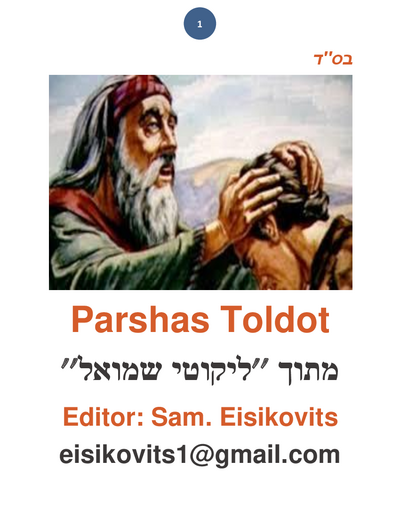
Eisav came into Yitzchak and said, “...I am your first-born son Eisav.” The very next pasuk says “Yitzchak trembled a great trembling...” (Bereshis 27:32-33) The Medrash Tanchuma notes that Yitzchak trembled twice in his life. The first time was when his father placed him on the Mizbayach at the time of Akeidas Yitzchak. The second time was when Eisav entered after Yaakov had taken the brachos (blessings).
Which was the greater of the two frights? From the fact that the pasuk says by the second trembling “Gedolah ad me’od” (exceedingly great), we understand that Yitzchak trembling when Eisav entered after Yaakov took the brachos was the greater of the two frights.
Rav Yaakov Breish said an incredible thing in that Yom Kippur drasha, given the historical context:
Over the centuries, Klal Yisrael has lost millions of people. They have lost millions of people in two ways.
(1) They lost millions of people because people “were moser nefesh al gabay hamizbayach” – i.e., people were willing to give up their lives for Yiddishkeit. They did this throughout the millennia.
(2) Unfortunately, there was also another way how Jews have been lost and that is through assimilation. This is the expression we hear all too often today: We are witnessing our own holocaust. It is not a holocaust of people being killed; it is a holocaust of shrinkage through assimilation. The number of Jews in America has remained steady at approximately five million for the last fifty years. Simple demographics dictate that if there were five million Jews forty or fifty years ago, then there should be a significant geometric progression by now. It should not remain constant at five million.
Why are there still only five million? The answer is that people are intermarrying and we are losing people. It is not because our enemies are killing us, it is because they are embracing us. The major trembling that Yitzchak experienced here was that Eisav was bringing him delicacies. He was trying to win our favor. He was trying to be open to us.
Which is a greater fear—losing Jews who are martyred or losing Jews to the fact that Eisav is bringing delicacies and trying to win us over to his camp? That is the question the Medrash poses. And the Medrash answers that the latter fear is the greater of the two. Charada Gedola ad Me’od. This is a far greater tragedy about which one must tremble exceedingly.