A repeatedly baked offering broken into pieces
Peninim on the Torah | March 28, 2024
Print This Article
View Original PDF

A repeatedly baked offering broken into pieces

Peninim on the Torah | June 27, 2025

The concept of petisah, pitim, breaking the minchah into pieces, applies to all Korbanos Minchah that are baked. The Korban Minchah brought by the Kohen Gadol is slightly different, but the requisite of pitim applies. The Korban Minchah is the korban of choice that the poor man offers, simply due to economics. Horav Aharon Bakst, zl, observes how far the Torah has gone in order to protect the feelings of the poor man (ani). His wealthy counterpart brings a fowl or sheep for a korban. It is large and takes a while to be consumed. The Korban Minchah “disappears” quickly when it is baked. It is hardly noticed. Thus, the Torah instructs us to break it into pieces in order to make the pan appear full. Likewise, we find the wings of fowl used for the korban of a poor man are burned on the Mizbayach. The odor that accompanies this burning is foul. Nonetheless, it is done, so that it appears that something special was burned on the Mizbayach. [The ani’s fowl is very small and would otherwise be consumed quickly.] We have other examples of the Torah’s sensitivity to the feelings of the poor man – anyone whose unfortunate circumstances contribute to his being downcast.
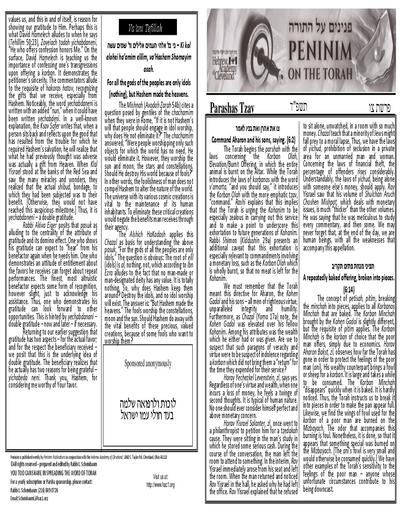
The concept of petisah, pitim, breaking the minchah into pieces, applies to all Korbanos Minchah that are baked. The Korban Minchah brought by the Kohen Gadol is slightly different, but the requisite of pitim applies. The Korban Minchah is the korban of choice that the poor man offers, simply due to economics. Horav Aharon Bakst, zl, observes how far the Torah has gone in order to protect the feelings of the poor man (ani). His wealthy counterpart brings a fowl or sheep for a korban. It is large and takes a while to be consumed. The Korban Minchah “disappears” quickly when it is baked. It is hardly noticed. Thus, the Torah instructs us to break it into pieces in order to make the pan appear full. Likewise, we find the wings of fowl used for the korban of a poor man are burned on the Mizbayach. The odor that accompanies this burning is foul. Nonetheless, it is done, so that it appears that something special was burned on the Mizbayach. [The ani’s fowl is very small and would otherwise be consumed quickly.] We have other examples of the Torah’s sensitivity to the feelings of the poor man – anyone whose unfortunate circumstances contribute to his being downcast.

PDF Preview