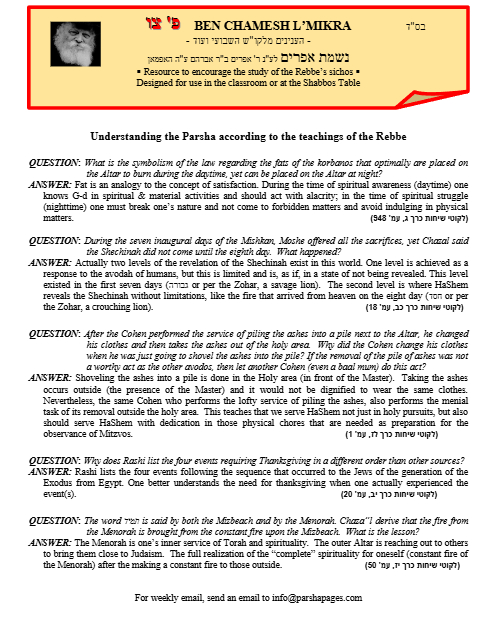
ABSTRACT לקוטי שיחות
Ben Chamesh L'Mikra | April 08, 2025
Print This Article
View Original PDF

ABSTRACT לקוטי שיחות

Ben Chamesh L'Mikra | June 27, 2025

The outer Altar signifies the outer heart of a person; an external, constant ecstasy in longing for HaShem

אש תמיד

(ז) Continuous fire on the outer altar includes Shabbos; and even when a person is in a state of impurity, his “fire” (connection with HaShem) shall not be extinguished

Time of spiritual awareness (daytime) one knows G-d in the spiritual & material; during spiritual struggle (nighttime) one must break one’s nature and not indulge in physical matters

Fats should be burnt on the altar as soon as possible during the daytime (positive fulfillment), but if necessary, can be burnt even at night, as long as one avoids Nosar (prevention of sin)

Fat is an analogy for satisfaction, even when occurs in holy matters

צו

Tzedakah, a difficult Mitzvah that involves the most material items, yet is rooted in the highest level of the soul

The term Tzav “command” (in contrast to “say” or to “speak”) addresses the soul’s inner core (tzavsa v'chibur, "cleaving and attachment"), that always chooses good, which is simply commanded to obey G-d’s Will with alacrity

זה קרבן אהרן ובניו

Purim reflects same concept of light flowing from darkness (“on that night”)

Two types of Korbanos brought by the Cohanim: A special one the Cohanim brought at the initiation of their service, because they didn’t sin; the light breaks through the darkness. A Chatos during the 7 inaugural days of the Mishkan cleansing the Jew’s sin of the Eigel transforming darkness into light (Teshuvah)

A person in Galus, even seemingly having all one’s needs, feels imprisoned by the “darkness” and, need to cry out for Moshiach

Rashi lists four events requiring a Thanksgiving offering; Rashi’s order follows the events that occurred to that generation (one understands the need for thanks more when one actually experienced the event) see table below

Who is obligated in a Korban Todah? One saved from the following:

  • Order according to Rashi
  • Imprisonment -closed within the desert חבוש ח
  • Crossing the Sea -Yam Suf יורדי הים י
  • Suffering and Sickness Only occurred to the Jews later יסורים י
  • Crossing the desert -Midbar מדבר ם

The outer Altar signifies the outer heart of a person; an external, constant ecstasy in longing for HaShem

אש תמיד

(ז) Continuous fire on the outer altar includes Shabbos; and even when a person is in a state of impurity, his “fire” (connection with HaShem) shall not be extinguished

Time of spiritual awareness (daytime) one knows G-d in the spiritual & material; during spiritual struggle (nighttime) one must break one’s nature and not indulge in physical matters

Fats should be burnt on the altar as soon as possible during the daytime (positive fulfillment), but if necessary, can be burnt even at night, as long as one avoids Nosar (prevention of sin)

Fat is an analogy for satisfaction, even when occurs in holy matters

צו

Tzedakah, a difficult Mitzvah that involves the most material items, yet is rooted in the highest level of the soul

The term Tzav “command” (in contrast to “say” or to “speak”) addresses the soul’s inner core (tzavsa v'chibur, "cleaving and attachment"), that always chooses good, which is simply commanded to obey G-d’s Will with alacrity

זה קרבן אהרן ובניו

Purim reflects same concept of light flowing from darkness (“on that night”)

Two types of Korbanos brought by the Cohanim: A special one the Cohanim brought at the initiation of their service, because they didn’t sin; the light breaks through the darkness. A Chatos during the 7 inaugural days of the Mishkan cleansing the Jew’s sin of the Eigel transforming darkness into light (Teshuvah)

A person in Galus, even seemingly having all one’s needs, feels imprisoned by the “darkness” and, need to cry out for Moshiach

Rashi lists four events requiring a Thanksgiving offering; Rashi’s order follows the events that occurred to that generation (one understands the need for thanks more when one actually experienced the event) see table below

Who is obligated in a Korban Todah? One saved from the following:

  • Order according to Rashi
  • Imprisonment -closed within the desert חבוש ח
  • Crossing the Sea -Yam Suf יורדי הים י
  • Suffering and Sickness Only occurred to the Jews later יסורים י
  • Crossing the desert -Midbar מדבר ם
PDF Preview