CLEAN-UP WORK
זכרון יעקב | April 10, 2025
Print This Article
View Original PDF

CLEAN-UP WORK

זכרון יעקב | June 27, 2025

RABBI YISSOCHER FRAND (Aish.com)

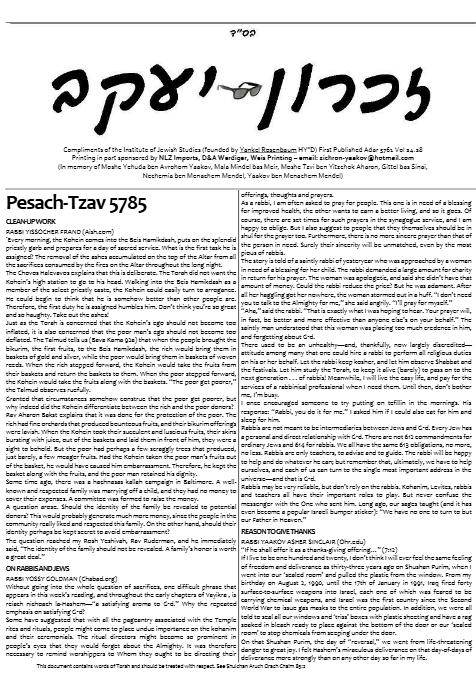
Every morning, the Kohein comes into the Beis Hamikdash, puts on the splendid priestly garb and prepares for a day of sacred service. What is the first task he is assigned? The removal of the ashes accumulated on the top of the Altar from all the sacrifices consumed by the fires on the Altar throughout the long night.

The Chovos Halevavos explains that this is deliberate. The Torah did not want the Kohein’s high station to go to his head. Walking into the Beis Hamikdash as a member of the select priestly caste, the Kohein could easily turn to arrogance. He could begin to think that he is somehow better than other people are. Therefore, the first duty he is assigned humbles him. Don’t think you’re so great and so haughty. Take out the ashes!

Just as the Torah is concerned that the Kohein’s ego should not become too inflated, it is also concerned that the poor man’s ego should not become too deflated. The Talmud tells us (Bava Kama 92a) that when the people brought the bikurim, the first fruits, to the Beis Hamikdash, the rich would bring them in baskets of gold and silver, while the poor would bring them in baskets of woven reeds. When the rich stepped forward, the Kohein would take the fruits from their baskets and return the baskets to them. When the poor stepped forward, the Kohein would take the fruits along with the baskets. “The poor get poorer,” the Talmud observes ruefully.

Granted that circumstances somehow construe that the poor get poorer, but why indeed did the Kohein differentiate between the rich and the poor donors? Rav Aharon Bakst explains that it was done for the protection of the poor. The rich had fine orchards that produced bounteous fruits, and their bikurim offerings were lavish. When the Kohein took their succulent and luscious fruits, their skins bursting with juice, out of the baskets and laid them in front of him, they were a sight to behold. But the poor had perhaps a few scraggly trees that produced, just barely, a few meager fruits. Had the Kohein taken the poor man’s fruits out of the basket, he would have caused him embarrassment. Therefore, he kept the basket along with the fruits, and the poor man retained his dignity.

Some time ago, there was a hachnasas kallah campaign in Baltimore. A well-known and respected family was marrying off a child, and they had no money to cover their expenses. A committee was formed to raise the money.

A question arose. Should the identity of the family be revealed to potential donors? This would probably generate much more money, since the people in the community really liked and respected this family. On the other hand, should their identity perhaps be kept secret to avoid embarrassment?

The question reached my Rosh Yeshivah, Rav Ruderman, and he immediately said, “The identity of the family should not be revealed. A family’s honor is worth a great deal.”
RABBI YISSOCHER FRAND (Aish.com)

Every morning, the Kohein comes into the Beis Hamikdash, puts on the splendid priestly garb and prepares for a day of sacred service. What is the first task he is assigned? The removal of the ashes accumulated on the top of the Altar from all the sacrifices consumed by the fires on the Altar throughout the long night.

The Chovos Halevavos explains that this is deliberate. The Torah did not want the Kohein’s high station to go to his head. Walking into the Beis Hamikdash as a member of the select priestly caste, the Kohein could easily turn to arrogance. He could begin to think that he is somehow better than other people are. Therefore, the first duty he is assigned humbles him. Don’t think you’re so great and so haughty. Take out the ashes!

Just as the Torah is concerned that the Kohein’s ego should not become too inflated, it is also concerned that the poor man’s ego should not become too deflated. The Talmud tells us (Bava Kama 92a) that when the people brought the bikurim, the first fruits, to the Beis Hamikdash, the rich would bring them in baskets of gold and silver, while the poor would bring them in baskets of woven reeds. When the rich stepped forward, the Kohein would take the fruits from their baskets and return the baskets to them. When the poor stepped forward, the Kohein would take the fruits along with the baskets. “The poor get poorer,” the Talmud observes ruefully.

Granted that circumstances somehow construe that the poor get poorer, but why indeed did the Kohein differentiate between the rich and the poor donors? Rav Aharon Bakst explains that it was done for the protection of the poor. The rich had fine orchards that produced bounteous fruits, and their bikurim offerings were lavish. When the Kohein took their succulent and luscious fruits, their skins bursting with juice, out of the baskets and laid them in front of him, they were a sight to behold. But the poor had perhaps a few scraggly trees that produced, just barely, a few meager fruits. Had the Kohein taken the poor man’s fruits out of the basket, he would have caused him embarrassment. Therefore, he kept the basket along with the fruits, and the poor man retained his dignity.

Some time ago, there was a hachnasas kallah campaign in Baltimore. A well-known and respected family was marrying off a child, and they had no money to cover their expenses. A committee was formed to raise the money.

A question arose. Should the identity of the family be revealed to potential donors? This would probably generate much more money, since the people in the community really liked and respected this family. On the other hand, should their identity perhaps be kept secret to avoid embarrassment?

The question reached my Rosh Yeshivah, Rav Ruderman, and he immediately said, “The identity of the family should not be revealed. A family’s honor is worth a great deal.”

PDF Preview