Gratitude and Kabolas HaTorah
Toras Avigdor - Junior | April 10, 2025
Print This Article
View Original PDF

Gratitude and Kabolas HaTorah

Toras Avigdor - Junior | June 27, 2025

Poor Tasting Bread

Now, for the sixth lesson on our list we’ll study again what it means that matzah is called lechem oni. We know it’s a poor man’s bread, but there’s another peirush too – it's a poor kind of bread. Bread is more tasty when it's allowed to ferment and leaven; Hakadosh Baruch Hu puts certain bacteria into materials and certain chemical reactions and it starts creating gasses, carbon dioxide, which causes the dough to rise. The fermentation also creates various flavorful byproducts, such as alcohols and organic acids, which add flavors into the bread.

Matzah on the other hand is much poorer in taste. Because it’s made quickly without the fermentation, it doesn’t have the time or the conditions to develop those flavors and so generally matzah tastes less flavorful, less enjoyable than chometz. And that’s the purpose! We eat a poorer type of bread because we want to go through the motions of reliving, at least in a very small way, the suffering of our forefathers in Mitzrayim and we’ll see soon how important it is to think about that.

Of course we enjoy the matzah too but the contrast between the tasty bread we always eat and the less flavorful matzah today is a reminder that our forefathers lived for a very long time in affliction. They suffered for a long time and they suffered very much.

Remembering the Bad Old Days

So here’s a man; he’s sitting down to lunch on Chol Hamoed, Wednesday afternoon; he’s eating matzah and he’s thinking. “Imagine being enslaved; me, my family, my wife and children.” And your father was enslaved too; for two hundred and ten years you couldn't get out of the country. And the Egyptians worked them with cruelty. It was avodas perach, work that broke the person. Perach means to break a person, to break bones, to break spirits. חַ ֹ צֶ ר ר ו מִ ק – They could hardly breathe from the severity of the labor; they couldn’t catch their breath.

They beat you mercilessly if you didn't produce the number of bricks. They were hitting and they were whipping and they were maiming. Who knows how many they killed in their cruelty? Nobody was there to help.

You remember when Moshe Rabbeinu saw an Egyptian hitting a Hebrew of his brothers and he intervened. Who else intervened? Nobody else. And in addition, the Egyptians despised them. They looked down on them and harassed them. We have no picture of the difficulty of the shibud Mitzrayim, how much they suffered.

Appreciating Contrast

Now, why is it so important to remember the poor life we had? Why is it so important to eat a poor type of bread so that even our mouths, our taste buds, remember it?

And the answer is: in order that we should appreciate the changeover! A poor man who becomes wealthy appreciates it much more than one who is born with a silver spoon in his mouth, no question about it. The poor man sits at his table now and enjoys everything that he has on his table, whereas the rich man never saw anything else. And so the Bnei Yisroel in Mitzrayim absolutely appreciated the changeover. You know how much they appreciated it? They accepted the Torah, all the obligations of being a Jew, because of that! When they left Mitzrayim they became so intoxicated with happiness and gratitude that they fell in love with Hashem and they were mekabel the Torah.

Hashem Reminds Us

How do I know that? Because when Hakadosh Baruch Hu first spoke to the whole Am Yisroel for the first time, how did He introduce Himself? Did He say ָרָ אתִ י שָׁ מַיִם וָאָרֶ ץ אֲ שֶׁ ר ב קֶיך אָנֹכִי ה' אֱל – “I am Hashem Your G-d who created the heavens and the earth”? No, He didn’t say that. He said “I am Your Hashem מֵאֶרֶץ מִצְרַיִם אשר הוֹצֵאתִיך – Who took you out of Mitzrayim.” And He adds the words ֵ ית מִ ב עֲ בָ דִ י ם. What are those added words? ֵית עֲבָדִים ב means tzaros. It means you were in gehakte tzaros until finally suddenly something happened. What happened? I happened! I saved you!

And now we’re leaving Mitzrayim! You remember that day? Oh, was that a day when they walked out of Egypt! Their spirits were soaring! They weren’t walking on earth; they were walking in the air. They never thought they'd get out. Two hundred and ten years?! Even under the Nazis it wasn't as long as that; it was a short period under the Nazis. And so it was the happiest day, not only of their lives – never was there a happy day like that.

And we’re loaded down with our enemies’ wealth. אֶ ת מִ צְ רַ יִם וַ יְנַ צְּלוּ – They emptied out Mitzrayim. We marched out of Mitzrayim loaded down with silver and gold. And then, for the icing on the cake Hashem showed us the destruction of our oppressors at the Yam Suf. More happiness! Our enemies were chasing us to kill us, to bring more tzaros on our heads, and now they’re drowning, gurgling in the water! And we sang that song of happiness to Hashem. We went wild with a delirium of ecstasy.

Purim, Pesach, Shavuos

It was one big א ה וְ נַ הֲ פּ ֹ ך! Everything turned upside down! All of the tzaros, the lechem oni, it’s finished, and now we’re free! And because of that they became so grateful, and they loved Hakadosh Baruch Hu with such an intensity that they were ready to do anything that He asked. Naturally, if Somebody rescues you from a very dangerous situation, you're more grateful to Him. And therefore with such a big preparation, when they came to Har Sinai, they were in the mood, they were ready to commit to anything. Naaseh v’nishma!

If Hakadosh Baruch Hu asked them that they should leap in the fire for Him, absolutely! That's what they meant when they accepted the Torah. We'll give our lives for the Torah. We'll slaughter ourselves and our children for Your Torah!

And they did that in the generations that came. We know that in the Middle Ages when the pilgrims attacked the Jewish ghetto in a number of cases, with the intention of forcing the Jews to accept baptism, the Jews slaughtered their children they shouldn't fall in the hands of the gentiles and be forcibly baptized. And then they slaughtered themselves. It’s described in the kinnos of Tisha Ba'av. The chosson slaughtered the kallah and then he slaughtered himself. And when the enemy finally broke through they saw a nation lying in its own blood.

That was the result of kabbalas haTorah. That's what they meant, Na’aseh v’nishma. It wasn't merely a pious statement that they promised to do something – they meant it from the bottom of their hearts. And they meant it because they were so full of love to Hashem, so grateful that He took off from us the great burden of shibud Mitzrayim. “We are forever grateful to You and no matter what You are going to ask us to do naaseh v’nishma.”

Long Term Gratitude

Now, because it happened 3,000 years ago, should it be any less? Where is the gratitude? Ingratitude is the worst of all crimes. Hakadosh Baruch Hu implanted in human nature a certain reaction and this reaction has to be obeyed; otherwise we are not human. If a person is not human, he doesn't deserve to exist. He must obey the dictates of the decent conscience and the decent conscience says to be grateful.

Now you have to be grateful to everybody. If not, then you're lacking in the attributes of humanity. But gratitude to Hakadosh Baruch Hu supersedes every other form of gratitude. And the gratitude for taking us to be His nation, that supersedes everything else. It doesn’t matter if it’s 3,000 years or 3,000,000 years, that’s the reaction we should feel.

And so as you eat the matzah today you have to try and remind yourself of the suffering that they endured in Mitzrayim. הָ א לַ חְ מָ א עָ נְיָ א – This is the bread of affliction. We go through the motions of eating poor bread, bread that’s not as tasty, not as rich in flavors, as we’re used to. We’re chewing and we’re thinking “Oy, this is the bread of affliction we ate in Mitzrayim.”

It’s yom tov and we have to be happy but this is the introduction to the happiness. We take time to recall the ד וִׁעְבּקוֹשִׁי הַש, the difficulty of our bondage, and to speak about the details of what our fathers suffered in Egypt, in order to be grateful that Hakadosh Baruch Hu redeemed us from it! The more we understand that our forefathers were subjected to ordeals, to suffering, the greater we'll appreciate their deliverance from bondage and from the suffering. And that's going to be the dynamo that's going to motivate you; gratitude for Hakadosh Baruch Hu is going to be expressed always by doing mitzvos. And so matzah, that’s the entire Torah. אָ נֹ כִ י מֵ אֶ רֶ ץ מִ צְרַ יִם אֲ שֶׁ ר הוֹצֵאתִ יך קֶ יך ה' אֱ ל – I am Hashem Who took you out of Mitzrayim. And just because of that we’ll serve You forever.

The Matzah Testifies:

Matzah calls to mind the contrast between our situation today and the affliction we suffered in Mitzrayim. This should engender gratitude in us and a sincere commitment to serve Hashem.
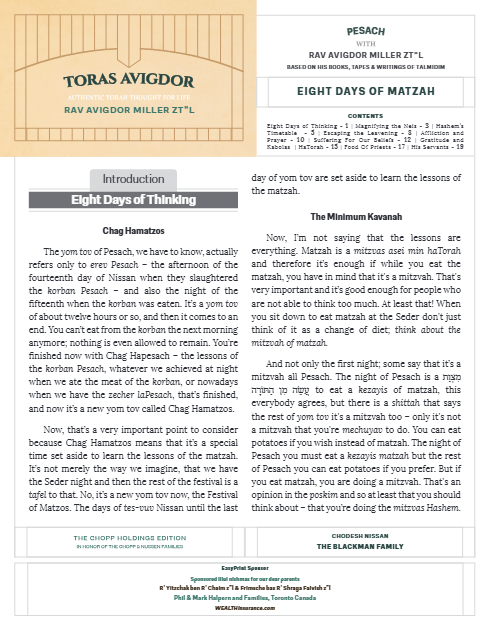

Poor Tasting Bread

Now, for the sixth lesson on our list we’ll study again what it means that matzah is called lechem oni. We know it’s a poor man’s bread, but there’s another peirush too – it's a poor kind of bread. Bread is more tasty when it's allowed to ferment and leaven; Hakadosh Baruch Hu puts certain bacteria into materials and certain chemical reactions and it starts creating gasses, carbon dioxide, which causes the dough to rise. The fermentation also creates various flavorful byproducts, such as alcohols and organic acids, which add flavors into the bread.

Matzah on the other hand is much poorer in taste. Because it’s made quickly without the fermentation, it doesn’t have the time or the conditions to develop those flavors and so generally matzah tastes less flavorful, less enjoyable than chometz. And that’s the purpose! We eat a poorer type of bread because we want to go through the motions of reliving, at least in a very small way, the suffering of our forefathers in Mitzrayim and we’ll see soon how important it is to think about that.

Of course we enjoy the matzah too but the contrast between the tasty bread we always eat and the less flavorful matzah today is a reminder that our forefathers lived for a very long time in affliction. They suffered for a long time and they suffered very much.

Remembering the Bad Old Days

So here’s a man; he’s sitting down to lunch on Chol Hamoed, Wednesday afternoon; he’s eating matzah and he’s thinking. “Imagine being enslaved; me, my family, my wife and children.” And your father was enslaved too; for two hundred and ten years you couldn't get out of the country. And the Egyptians worked them with cruelty. It was avodas perach, work that broke the person. Perach means to break a person, to break bones, to break spirits. חַ ֹ צֶ ר ר ו מִ ק – They could hardly breathe from the severity of the labor; they couldn’t catch their breath.

They beat you mercilessly if you didn't produce the number of bricks. They were hitting and they were whipping and they were maiming. Who knows how many they killed in their cruelty? Nobody was there to help.

You remember when Moshe Rabbeinu saw an Egyptian hitting a Hebrew of his brothers and he intervened. Who else intervened? Nobody else. And in addition, the Egyptians despised them. They looked down on them and harassed them. We have no picture of the difficulty of the shibud Mitzrayim, how much they suffered.

Appreciating Contrast

Now, why is it so important to remember the poor life we had? Why is it so important to eat a poor type of bread so that even our mouths, our taste buds, remember it?

And the answer is: in order that we should appreciate the changeover! A poor man who becomes wealthy appreciates it much more than one who is born with a silver spoon in his mouth, no question about it. The poor man sits at his table now and enjoys everything that he has on his table, whereas the rich man never saw anything else. And so the Bnei Yisroel in Mitzrayim absolutely appreciated the changeover. You know how much they appreciated it? They accepted the Torah, all the obligations of being a Jew, because of that! When they left Mitzrayim they became so intoxicated with happiness and gratitude that they fell in love with Hashem and they were mekabel the Torah.

Hashem Reminds Us

How do I know that? Because when Hakadosh Baruch Hu first spoke to the whole Am Yisroel for the first time, how did He introduce Himself? Did He say ָרָ אתִ י שָׁ מַיִם וָאָרֶ ץ אֲ שֶׁ ר ב קֶיך אָנֹכִי ה' אֱל – “I am Hashem Your G-d who created the heavens and the earth”? No, He didn’t say that. He said “I am Your Hashem מֵאֶרֶץ מִצְרַיִם אשר הוֹצֵאתִיך – Who took you out of Mitzrayim.” And He adds the words ֵ ית מִ ב עֲ בָ דִ י ם. What are those added words? ֵית עֲבָדִים ב means tzaros. It means you were in gehakte tzaros until finally suddenly something happened. What happened? I happened! I saved you!

And now we’re leaving Mitzrayim! You remember that day? Oh, was that a day when they walked out of Egypt! Their spirits were soaring! They weren’t walking on earth; they were walking in the air. They never thought they'd get out. Two hundred and ten years?! Even under the Nazis it wasn't as long as that; it was a short period under the Nazis. And so it was the happiest day, not only of their lives – never was there a happy day like that.

And we’re loaded down with our enemies’ wealth. אֶ ת מִ צְ רַ יִם וַ יְנַ צְּלוּ – They emptied out Mitzrayim. We marched out of Mitzrayim loaded down with silver and gold. And then, for the icing on the cake Hashem showed us the destruction of our oppressors at the Yam Suf. More happiness! Our enemies were chasing us to kill us, to bring more tzaros on our heads, and now they’re drowning, gurgling in the water! And we sang that song of happiness to Hashem. We went wild with a delirium of ecstasy.

Purim, Pesach, Shavuos

It was one big א ה וְ נַ הֲ פּ ֹ ך! Everything turned upside down! All of the tzaros, the lechem oni, it’s finished, and now we’re free! And because of that they became so grateful, and they loved Hakadosh Baruch Hu with such an intensity that they were ready to do anything that He asked. Naturally, if Somebody rescues you from a very dangerous situation, you're more grateful to Him. And therefore with such a big preparation, when they came to Har Sinai, they were in the mood, they were ready to commit to anything. Naaseh v’nishma!

If Hakadosh Baruch Hu asked them that they should leap in the fire for Him, absolutely! That's what they meant when they accepted the Torah. We'll give our lives for the Torah. We'll slaughter ourselves and our children for Your Torah!

And they did that in the generations that came. We know that in the Middle Ages when the pilgrims attacked the Jewish ghetto in a number of cases, with the intention of forcing the Jews to accept baptism, the Jews slaughtered their children they shouldn't fall in the hands of the gentiles and be forcibly baptized. And then they slaughtered themselves. It’s described in the kinnos of Tisha Ba'av. The chosson slaughtered the kallah and then he slaughtered himself. And when the enemy finally broke through they saw a nation lying in its own blood.

That was the result of kabbalas haTorah. That's what they meant, Na’aseh v’nishma. It wasn't merely a pious statement that they promised to do something – they meant it from the bottom of their hearts. And they meant it because they were so full of love to Hashem, so grateful that He took off from us the great burden of shibud Mitzrayim. “We are forever grateful to You and no matter what You are going to ask us to do naaseh v’nishma.”

Long Term Gratitude

Now, because it happened 3,000 years ago, should it be any less? Where is the gratitude? Ingratitude is the worst of all crimes. Hakadosh Baruch Hu implanted in human nature a certain reaction and this reaction has to be obeyed; otherwise we are not human. If a person is not human, he doesn't deserve to exist. He must obey the dictates of the decent conscience and the decent conscience says to be grateful.

Now you have to be grateful to everybody. If not, then you're lacking in the attributes of humanity. But gratitude to Hakadosh Baruch Hu supersedes every other form of gratitude. And the gratitude for taking us to be His nation, that supersedes everything else. It doesn’t matter if it’s 3,000 years or 3,000,000 years, that’s the reaction we should feel.

And so as you eat the matzah today you have to try and remind yourself of the suffering that they endured in Mitzrayim. הָ א לַ חְ מָ א עָ נְיָ א – This is the bread of affliction. We go through the motions of eating poor bread, bread that’s not as tasty, not as rich in flavors, as we’re used to. We’re chewing and we’re thinking “Oy, this is the bread of affliction we ate in Mitzrayim.”

It’s yom tov and we have to be happy but this is the introduction to the happiness. We take time to recall the ד וִׁעְבּקוֹשִׁי הַש, the difficulty of our bondage, and to speak about the details of what our fathers suffered in Egypt, in order to be grateful that Hakadosh Baruch Hu redeemed us from it! The more we understand that our forefathers were subjected to ordeals, to suffering, the greater we'll appreciate their deliverance from bondage and from the suffering. And that's going to be the dynamo that's going to motivate you; gratitude for Hakadosh Baruch Hu is going to be expressed always by doing mitzvos. And so matzah, that’s the entire Torah. אָ נֹ כִ י מֵ אֶ רֶ ץ מִ צְרַ יִם אֲ שֶׁ ר הוֹצֵאתִ יך קֶ יך ה' אֱ ל – I am Hashem Who took you out of Mitzrayim. And just because of that we’ll serve You forever.

The Matzah Testifies:

Matzah calls to mind the contrast between our situation today and the affliction we suffered in Mitzrayim. This should engender gratitude in us and a sincere commitment to serve Hashem.

PDF Preview