Parshas Tzav Sacrificing Pleasure Part 4
The Talmud states:
Text 8
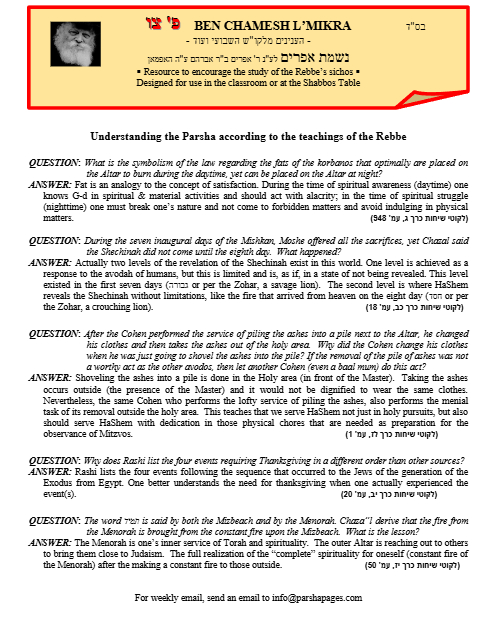
R. Shimon said, “Come and see how precious a precept is in its proper time! For the burning of the fat and limbs is valid the whole night, yet they did not wait until nightfall.” Talmud, Menachos 72a
The reason why it is preferable to burn the fats and the limbs during the daytime, although the burning throughout the night is valid is as follows: Because there are two specific aspects regarding the burning of the fats—the service and the prevention of leftovers—there are specific laws concerning each. The service of burning the fats and limbs should to be done specifically during the day. This is similar to the rest of the services performed in the Temple, which were all done during the daytime. However, there is as well the second aspect of burning the fats and limbs of the sacrifice, in that it prevents any leftovers. This aspect which is only preventive and is not an actual service does not need to be done during the daytime and can be done throughout the night.
Answering Rambam
The question was posed above regarding Rambam’s opinion of this prescribed time. He believed that the Sages mandated the burning of the fats and limbs by midnight (in order to prevent transgression). However, being that the Torah explicitly stated that one may burn these portions of the animal until dawn, how can Rambam hold this view? Is there not a rule that the Sages may not prohibit something that was explicitly permitted in the Torah?
In light of the above explanation concerning the dual purpose of burning the fats however, the question on Rambam’s view can now be understood. The principle that the Sages cannot prohibit something that the Torah explicitly permitted is only applicable when the topic in discussion concerns an actual mitzvah. Meaning to say, that if the Torah said that something should be done, the Rabbis cannot say that one mustn’t do it. However, if the Torah is merely permitting that one may do something during the night, and there is no mitzvah to actually perform it at that time, then the Sages can stipulate an earlier time, and instruct that one must complete it before midnight.
Concerning the burning of the fats and limbs there are two aspects: 1) burning the fats as a mitzvah, i.e. the service of the burning, which must be done preferably during the daytime, and 2) burning the fats to prevent that there be nothing left over from the sacrifice the following day. It is regarding the second purpose of burning the fats—to prevent any leftovers—that the Sages stated that it should be burned by midnight. Because this aspect is preventative and not a mitzvah, the Sages were able to add to the prohibition and limit the time of burning to midnight, although the Torah explicitly stated that one is permitted to burn these portions until dawn.
Related Articles