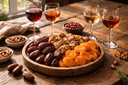
Korban Mincha meal offering
If a person is too poor to afford even a bird offering, he can offer a Korban Mincha, made up of flour, oil and spices. The combination can be prepared 5 different ways: 1 raw, 2 baked and 2 fried. With all these varieties, the Torah forbids the use of leavened dough, the dough may not rise. (shades of Pesach).
The Kohen carries the Mincha offering to the southwest corner of the Mizbayach. He places his hand in the vessel containing the flour mixture and, bending three middle fingers over his palm, he fills it with flour. He uses the thumb and pinky to wipe off any excess flour. This procedure is called Kemitza. This fistful, topped by the spices and salted, is then burned on the Mizbayach. The rest of the Mincha is divided among the Kohanim for them to eat.
The Meal Offering (Excerpts from The Living Torah by Rabbi Aryeh Kaplan)
2:1 If an individual presents a meal offering to G-d, his offering must consist of the best grade of wheat meal. On it, he shall pour olive oil and place frankincense.
2:2 He shall bring it to the priests who are Aaron's descendants, and [a priest] shall scoop out three fingers full of its meal and oil, [and then take] all the frankincense. The priest shall then burn [this] memorial portion on the altar as a fire offering, an appeasing fragrance to G-d.
2:3 The rest of the meal offering shall belong to Aaron and his descendants. It is holy of holies among the fire offerings to G-d.
2:9 The priest shall then lift out the memorial portion from the meal offering, and burn it on the altar. It is a fire offering, an appeasing fragrance to G-d.
6:8 With his three middle fingers he shall lift up some of the wheat meal and oil of the offering, and [then remove] all the frankincense on the offering. He shall burn [this] on the altar as an appeasing fragrance - it is the memorial portion to G-d.
meal offering Minchah in Hebrew. See Genesis 4:3. Some say that it comes from the root nachah denoting lowness, and thus translating it 'homage gift' (Hirsch; HaKethav VeHaKabbalah; cf. Genesis 32:14). It can also be related to the word nicho'ach, see Leviticus 1:9. Or, it can come from the root nachah in the sense that it denotes rest; hence a minchah can denote an 'inanimate offering,' an offering taken from the vegetable kingdom.
wheat meal Soleth in Hebrew. This was wheat meal (Sifra; Rashi; from Exodus 29:2). It was the best grade of meal, perfectly clean of all bran (Saadia; Ibn Ezra; cf. Kiddushin 69b). The soleth used for meal offerings was a coarsely ground meal (Rashi, Menachoth 66a, s.v. Shel Gerosoth; Radak, Sherashim, from Avoth 5:15, cf. Meiri ad loc.) It had to be carefully sifted to remove all the fine flour (Menachoth 85a; Yad, Issurey HaMizbeach 6:12). The amount of such an offering was 1/10 ephah or around 2 quarts (Rashi; Yad, Maaseh HaKorbanoth 13:3).
olive oil At least 1 log (300 cc. or 10 fl. oz.) (Menachoth 51a, 88a; Yad, Maaseh HaKorbanoth 13:7, Ralbag).
frankincense Levonah in Hebrew. See Exodus 30:34. The amount of frankincense placed on the offering was one handful (Sifra; Yad, Maaseh HaKorbanoth 13:7).
three fingers full The priest scooped out the flour with the three middle fingers of the hand, using the thumb and pinky to rub off any flour sticking out at the ends (Menachoth 11a. Rashi; Radak, Sherashim). According to others, however, the Kemitza was a complete handful (Yad, Maaseh HaKorbanoth 13:13, see Kesef Mishneh ad loc.; Ralbag). The priest would have to scoop up at least an amount the size of two olives (around 100 c.c. or 3 1/2 fl. oz.) (Yad, loc.cit.). Before scooping up the flour, the frankincense would be put to the side, so that only flour and oil would be scooped up (Sotah 14b; Yad, Maaseh HaKorbanoth 13:12). Scooping the portion from a meal offering was in place of slaughter of an animal (Rambam on Menachoth 1:1).
and then take... The frankincense would then be removed separately, and placed on the scooped flour (Ibid.; Rashi; Sifra).
memorial portion (Ibn Ezra; Radak, Sherashim). Azkarah in Hebrew. Or, 'burned portion' (Saadia, from Psalms 20:4; cf. Ibn Janach).
lift out Or, 'raise to a higher status.' Harem in Hebrew, related to the word terumah. (See Leviticus 6:8) After the loaf was broken into pieces (Leviticus 2:6), the priest would scoop out three fingers full per Leviticus 2:2 (Menachoth 61a; Rashi).

Related Articles