Constriction of Spirit and the Message of Redemption
Meshech Chochma | January 11, 2024
Print This Article
View Original PDF

Constriction of Spirit and the Message of Redemption

Meshech Chochma | December 10, 2025

Moshe spoke thusly to Bnei Yisrael, but they did not heed Moshe, due to constriction of spirit and hard labor. (6:9)

Our verse relates how, when Moshe informed the people about their redemption, they could not hear it, on account of the harsh conditions of their slavery. Notwithstanding this, in the ensuing verses, Hashem tells Moshe to initiate the process of redemption, such that the people’s unwillingness to accept the news of their redemption appears to simply be not recognized. Is this the case?

The Meshech Chochmah explains that what the people were unable to hear was the totality of Moshe’s message; for not only did Hashem tell Moshe to inform the people that He will deliver them from their slavery and take them out of Egypt, but also that He will bring them to the land of Israel. It was the fuller picture of their future that the people were unable to hear. Due to their constricted spirit and the harsh labor they were enduring, they were unable to hear talk of anything beyond simply being extricated from their current dire situation. Anything beyond that point, any notion of being taken to their glorious ancestral homeland where they would dwell in peace and tranquility, was simply beyond their horizon and their capacity to relate to.

This limitation of the people’s ability to hear this did not go unnoticed or unrecognized. The ensuing verses state that Hashem told Moshe “to take Bnei Yisrael out of Egypt.” In other words, from this point, the focus became exclusively that of redeeming the people from Egypt, with the broader idea of being taken to the Land of Israel being put on hold until after they had actually left.
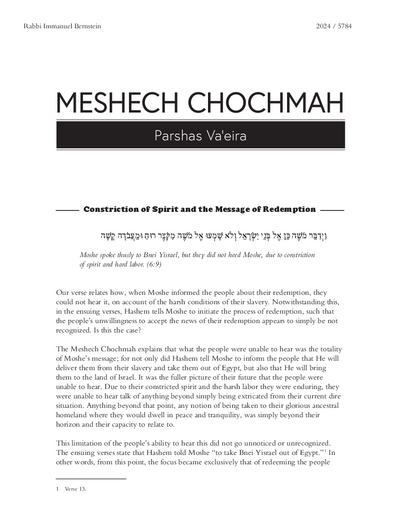

Moshe spoke thusly to Bnei Yisrael, but they did not heed Moshe, due to constriction of spirit and hard labor. (6:9)

Our verse relates how, when Moshe informed the people about their redemption, they could not hear it, on account of the harsh conditions of their slavery. Notwithstanding this, in the ensuing verses, Hashem tells Moshe to initiate the process of redemption, such that the people’s unwillingness to accept the news of their redemption appears to simply be not recognized. Is this the case?

The Meshech Chochmah explains that what the people were unable to hear was the totality of Moshe’s message; for not only did Hashem tell Moshe to inform the people that He will deliver them from their slavery and take them out of Egypt, but also that He will bring them to the land of Israel. It was the fuller picture of their future that the people were unable to hear. Due to their constricted spirit and the harsh labor they were enduring, they were unable to hear talk of anything beyond simply being extricated from their current dire situation. Anything beyond that point, any notion of being taken to their glorious ancestral homeland where they would dwell in peace and tranquility, was simply beyond their horizon and their capacity to relate to.

This limitation of the people’s ability to hear this did not go unnoticed or unrecognized. The ensuing verses state that Hashem told Moshe “to take Bnei Yisrael out of Egypt.” In other words, from this point, the focus became exclusively that of redeeming the people from Egypt, with the broader idea of being taken to the Land of Israel being put on hold until after they had actually left.

PDF Preview