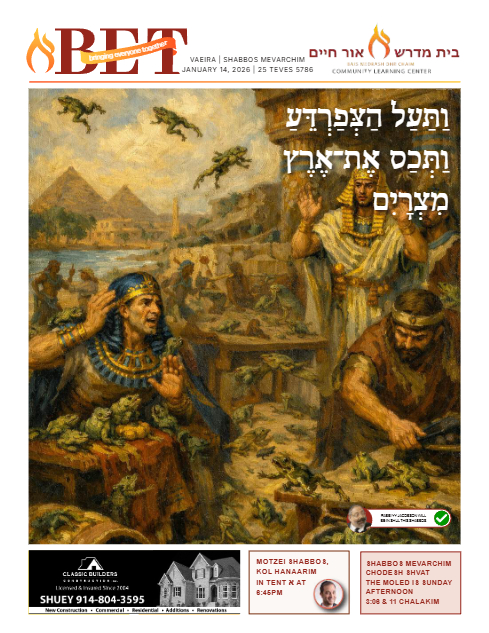
Eye of the Storm
Apple, Google, Facebook, Amazon, Microsoft, Samsung—every major tech giant pours billions into capturing your attention within seconds. With attention spans down to eight seconds, ads must hook instantly. The formula is simple: Catch the eye fast, then keep it.
But this isn’t new. This strategy is as old as Creation itself, dating back to the Nachash HaKadmoni. In Mesivta, my 11th-grade rebbe, Rav Abba Levitan shlita, often taught that the yetzer hara’s greatest strength lies in the “now.“ When an aveirah appears, the yetzer hara pulls you toward what’s immediate, right in front of you, available this very second.
JUST ONCE
The Satan whispers, “Just once. Just a second. Then stop.“ But once he has you for that moment, you’re chapped, caught in the lion’s den. And as we all know, once you’re in, getting out is far harder.
During Shovavim especially, we must strengthen ourselves against the nonstop battles with the Satan. The real nisayon is that first second. After that, the temptation fades quickly. It’s like seeing a piece of cake; the hardest moment is the first glance. Walk past it, and suddenly, you’re fine. The same is true with the yetzer hara. Recognize the challenge in that first second, hold strong, and you own the battle. With foresight, it can feel as simple as walking past that cake.
MAKKAS TZFARDEIAH
This week’s parshah gives a vivid example during the second makkah, Tzfardeiah. The passuk says (Shemos 8:2):
ויט אהרן את־ידו על מימי מצרים ותעל הצפרדע ותכס את־ארץ מצרים
Rashi, quoting Sanhedrin 67, explains that the plague began with one frog. When the Mitzrim hit it, it split into two. Hit again, four. And so on, until Egypt swarmed with frogs.
The Steipler Gaon asks: Why didn’t they stop hitting it? After 100 frogs, after 1,000, why continue? This was a self-inflicted plague.
He explains that the Mitzrim were so consumed by stubbornness and anger toward Hashem and the Jews that they ignored the obvious miracle. Their rage blinded them. Once emotionally hooked, they couldn’t step back, even as they destroyed themselves. Had they paused for even a moment, they could have spared themselves immense suffering. But once they surrendered to that first impulse, they were trapped.
Reb Shimshon Pincus adds that this trait fueled all the makkos. Had Pharaoh set aside arrogance at Moshe’s first warning, Egypt could have avoided catastrophe.
SELF-DISCIPLINE
Rav Eliyahu Dessler, author of Michtav M’Eliyahu, embodied self-discipline. He taught that true greatness, shleimus ha’adam, comes from resisting immediate desires and living with intention.
At the start of World War II, Rav Dessler was in London, but his wife and daughter were trapped in Poland. For six years, he lived with fear, prayer, and uncertainty. Communication was nearly impossible. When a long-awaited letter finally arrived with photos of his daughter, his neighbor found him sitting calmly, the envelope unopened.
Rav Dessler explained, “When something pulls at me with all my soul, that’s when I’m most vulnerable. So I wait. Ten minutes. I regain control. Then I open it.“
Try it. The next time a nisayon hits, pause and say, “One second.“ That single second places you in the eye of the storm, where everything is calm, where clarity returns, where you choose your response instead of reacting impulsively.
Use reminders: “mail“ for Rav Dessler’s restraint, “frog“ for the Mitzrim’s stubbornness, “Apple“ for the billions spent to capture a single moment of attention.
By pausing, you regain control. The storm passes more gently, and you emerge richer—not in money, but in character, growth, and shleimus ha’adam. In that moment, you become the true billionaire.