Hashem's Rebuke and Mercy to Moshe
Pardes Yehuda | January 12, 2024
Print This Article
View Original PDF

Hashem's Rebuke and Mercy to Moshe

Pardes Yehuda | December 10, 2025

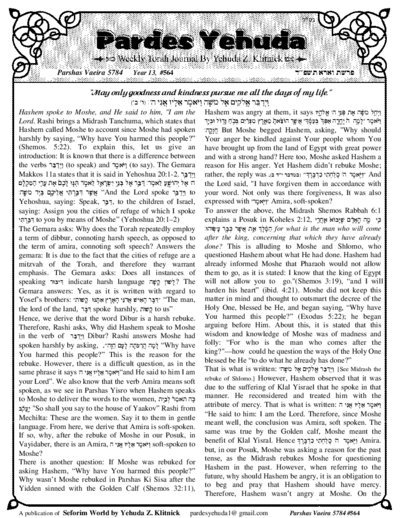
Hashem spoke to Moshe, and He said to him, "I am the Lord." Rashi brings a Midrash Tanchuma, which states that Hashem called Moshe to account since Moshe had spoken harshly by saying, “Why have You harmed this people?” (Shemos. 5:22). To explain this, let us give an introduction: It is known that there is a difference between the verbs x¥A ©c§i©e (to speak) and x¤n` I©e (to say). The Gemara Makkos 11a states that it is said in Yehoshua 20:1-2. x ́¥A ©c§i©e h½ ̈l§w ¦O©d i ́¥x ̈r z¤` Æm¤k ̈l E³p §Y x® n`¥l l−¥` ̈x §U¦i i¬¥p §A l¤` x²¥A ©C :x « n`¥l ©r−ªW ed§i l¤` 'd d«¤W n c©i §A m−¤ki¥l£` i ¦Y §x¬©A ¦C x¤W£`: “And the Lord spoke x ́¥A ©c§i©e to Yehoshua, saying: Speak, x²¥A ©C, to the children of Israel, saying: Assign you the cities of refuge of which I spoke i ¦Y §x¬©A ¦C to you by means of Moshe” (Yehoshua 20:1–2)

The Gemara asks: Why does the Torah repeatedly employ a term of dibbur, connoting harsh speech, as opposed to the term of amira, connoting soft speech? Answers the gemara: It is due to the fact that the cities of refuge are a mitzvah of the Torah, and therefore they warrant emphasis. The Gemara asks: Does all instances of speaking xEAi ¦C indicate harsh language d ̈W ̈w o eW ̈l? The Gemara answers: Yes, as it is written with regard to Yosef’s brothers: "z eW ̈w Ep ̈Y ¦` u ¤x ̈` ̈d i¥p c£` Wi ¦` ̈d x¤A ¦C" “The man, the lord of the land, x¤A ¦C spoke harshly, z eW ̈w to us” Hence, we derive that the word Dibur is a harsh rebuke. Therefore, Rashi asks, Why did Hashem speak to Moshe in the verb of x¥A ©c§i©e Dibur? Rashi answers Moshe had spoken harshly by asking, d¤f©d m ̈r ̈l d ̈z r ¥x£d d ̈n ̈l '"“Why have You harmed this people?” This is the reason for the rebuke. However, there is a difficult question, as in the same phrase it says 'd i¦p£` ei ̈l¥` x¤n` I©e“and He said to him I am your Lord”. We also know that the verb Amira means soft spoken, as we see in Parshas Yisro when Hashem speaks to Moshe to deliver the words to the women, zi ́¥a§l Æx©n` z d ³M a ½w£r«©i "So shall you say to the house of Yaakov” Rashi from Mechilta: These are the women. Say it to them in gentle language. From here, we derive that Amira is soft-spoken. If so, why, after the rebuke of Moshe in our Posuk, in Vayidaber, there is an Amira, d i¦p£` ei ̈l¥` x¤n` I©e soft-spoken to Moshe?

There is another question: If Moshe was rebuked for asking Hashem, “Why have You harmed this people?” Why wasn’t Moshe rebuked in Parshas Ki Sisa after the Yidden sinned with the Golden Calf (Shemos 32:11), Hashem was angry at them, it says ei® ̈d l¡` 'd i−¥p §R z¤` d ½¤W n l ́©g§i©e c¬ ̈i §aE l e −c ̈B ©g¬ k §A m¦i½©x§v ¦n u ¤x ́¤`¥n Æ ̈z`Æ¥v ed x³¤W£` "L ½¤O©r §A ÆL §R©` d³¤x¡g¤i Æd9 d³ ̈n ̈l" x¤n`À I©e :d« ̈w ̈f£g But Moshe begged Hashem, asking, "Why should Your anger be kindled against Your people whom You have brought up from the land of Egypt with great power and with a strong hand? Here too, Moshe asked Hashem a reason for His anger. Yet Hashem didn’t rebuke Moshe; rather, the reply was '(c s"h rcsnc) "' d x¤n` ́I©e L ¤x ̈a §c ¦k i ¦z §g©l ̈q" And the Lord said, "I have forgiven them in accordance with your word. Not only was there forgiveness, It was also expressed with "x¤n` ́I©e" Amira, soft-spoken?

To answer the above, the Midrash Shemos Rabbah 6:1 explains a Posuk in Koheles 2:12, i ́¥x£g«©` Æ` ea ̈I¤W mÀ ̈c ̈`« ̈d d ́¤n i ́¦M :EdE «U ̈r x− ̈a §M x¤W£` z¬¥` K¤l ½¤O©d for what is the man who will come after the king, concerning that which they have already done? This is alluding to Moshe and Shlomo, who questioned Hashem about what He had done. Hashem had already informed Moshe that Pharaoh would not allow them to go, as it is stated: I know that the king of Egypt will not allow you to go."(Shemos 3:19), “and I will harden his heart” (ibid. 4:21). Moshe did not keep this matter in mind and thought to outsmart the decree of the Holy One, blessed be He, and began saying, “Why have You harmed this people?” (Exodus 5:22); he began arguing before Him. About this, it is stated that this wisdom and knowledge of Moshe was of madness and folly: “For who is the man who comes after the king?"—how could he question the ways of the Holy One blessed be He “to do what he already has done?”

That is what is written: "d¤W n l¤` mi¦w l¡` x¥A ©c§i©e. [See Midrash the rebuke of Shlomo.] However, Hashem observed that it was due to the suffering of Klal Yisrael that he spoke in that manner. He reconsidered and treated him with the attribute of mercy. That is what is written: d i¦p£` ei ̈l¥` x¤n` I©e “He said to him: I am the Lord. Therefore, since Moshe meant well, the conclusion was Amira, soft spoken. The same was true by the Golden calf, Moshe meant the benefit of Klal Yisral. Hence ' d x¤n` ́I©e L ¤x ̈a §c ¦k i ¦z §g©l ̈q Amira. but, in our Posuk, Moshe was asking a reason for the past tense, as the Midrash rebukes Moshe for questioning Hashem in the past. However, when referring to the future, why should Hashem be angry, it is an obligation to to beg and pray that Hashem should have mercy. Therefore, Hashem wasn’t angry at Moshe. On the contrary, Hashem was satisfied with Moshe’s request and answered, " ' d x¤n` ́I©e L ¤x ̈a §c ¦k i ¦z §g©l ̈q"" I have forgiven them in accordance with your word.” This is a powerful lesson for us: never question or doubt Hashem for what He has done. Everything has a plan and is for the good of the person. Yet, when it comes to the future, there is an obligation to pray and beg for mercy as Dovid Hamelech prayed in Tehilim 23:6 i® ̈I©g i ́¥n§i l ̈M i¦pEt §C §x¦−i c¤q ́¤g ̈e a e ́h K μ©` “May only goodness and kindness pursue me all the days of my life.” (Yehuda Z. Klitnick)

Hashem spoke to Moshe, and He said to him, "I am the Lord." Rashi brings a Midrash Tanchuma, which states that Hashem called Moshe to account since Moshe had spoken harshly by saying, “Why have You harmed this people?” (Shemos. 5:22). To explain this, let us give an introduction: It is known that there is a difference between the verbs x¥A ©c§i©e (to speak) and x¤n` I©e (to say). The Gemara Makkos 11a states that it is said in Yehoshua 20:1-2. x ́¥A ©c§i©e h½ ̈l§w ¦O©d i ́¥x ̈r z¤` Æm¤k ̈l E³p §Y x® n`¥l l−¥` ̈x §U¦i i¬¥p §A l¤` x²¥A ©C :x « n`¥l ©r−ªW ed§i l¤` 'd d«¤W n c©i §A m−¤ki¥l£` i ¦Y §x¬©A ¦C x¤W£`: “And the Lord spoke x ́¥A ©c§i©e to Yehoshua, saying: Speak, x²¥A ©C, to the children of Israel, saying: Assign you the cities of refuge of which I spoke i ¦Y §x¬©A ¦C to you by means of Moshe” (Yehoshua 20:1–2)

The Gemara asks: Why does the Torah repeatedly employ a term of dibbur, connoting harsh speech, as opposed to the term of amira, connoting soft speech? Answers the gemara: It is due to the fact that the cities of refuge are a mitzvah of the Torah, and therefore they warrant emphasis. The Gemara asks: Does all instances of speaking xEAi ¦C indicate harsh language d ̈W ̈w o eW ̈l? The Gemara answers: Yes, as it is written with regard to Yosef’s brothers: "z eW ̈w Ep ̈Y ¦` u ¤x ̈` ̈d i¥p c£` Wi ¦` ̈d x¤A ¦C" “The man, the lord of the land, x¤A ¦C spoke harshly, z eW ̈w to us” Hence, we derive that the word Dibur is a harsh rebuke. Therefore, Rashi asks, Why did Hashem speak to Moshe in the verb of x¥A ©c§i©e Dibur? Rashi answers Moshe had spoken harshly by asking, d¤f©d m ̈r ̈l d ̈z r ¥x£d d ̈n ̈l '"“Why have You harmed this people?” This is the reason for the rebuke. However, there is a difficult question, as in the same phrase it says 'd i¦p£` ei ̈l¥` x¤n` I©e“and He said to him I am your Lord”. We also know that the verb Amira means soft spoken, as we see in Parshas Yisro when Hashem speaks to Moshe to deliver the words to the women, zi ́¥a§l Æx©n` z d ³M a ½w£r«©i "So shall you say to the house of Yaakov” Rashi from Mechilta: These are the women. Say it to them in gentle language. From here, we derive that Amira is soft-spoken. If so, why, after the rebuke of Moshe in our Posuk, in Vayidaber, there is an Amira, d i¦p£` ei ̈l¥` x¤n` I©e soft-spoken to Moshe?

There is another question: If Moshe was rebuked for asking Hashem, “Why have You harmed this people?” Why wasn’t Moshe rebuked in Parshas Ki Sisa after the Yidden sinned with the Golden Calf (Shemos 32:11), Hashem was angry at them, it says ei® ̈d l¡` 'd i−¥p §R z¤` d ½¤W n l ́©g§i©e c¬ ̈i §aE l e −c ̈B ©g¬ k §A m¦i½©x§v ¦n u ¤x ́¤`¥n Æ ̈z`Æ¥v ed x³¤W£` "L ½¤O©r §A ÆL §R©` d³¤x¡g¤i Æd9 d³ ̈n ̈l" x¤n`À I©e :d« ̈w ̈f£g But Moshe begged Hashem, asking, "Why should Your anger be kindled against Your people whom You have brought up from the land of Egypt with great power and with a strong hand? Here too, Moshe asked Hashem a reason for His anger. Yet Hashem didn’t rebuke Moshe; rather, the reply was '(c s"h rcsnc) "' d x¤n` ́I©e L ¤x ̈a §c ¦k i ¦z §g©l ̈q" And the Lord said, "I have forgiven them in accordance with your word. Not only was there forgiveness, It was also expressed with "x¤n` ́I©e" Amira, soft-spoken?

To answer the above, the Midrash Shemos Rabbah 6:1 explains a Posuk in Koheles 2:12, i ́¥x£g«©` Æ` ea ̈I¤W mÀ ̈c ̈`« ̈d d ́¤n i ́¦M :EdE «U ̈r x− ̈a §M x¤W£` z¬¥` K¤l ½¤O©d for what is the man who will come after the king, concerning that which they have already done? This is alluding to Moshe and Shlomo, who questioned Hashem about what He had done. Hashem had already informed Moshe that Pharaoh would not allow them to go, as it is stated: I know that the king of Egypt will not allow you to go."(Shemos 3:19), “and I will harden his heart” (ibid. 4:21). Moshe did not keep this matter in mind and thought to outsmart the decree of the Holy One, blessed be He, and began saying, “Why have You harmed this people?” (Exodus 5:22); he began arguing before Him. About this, it is stated that this wisdom and knowledge of Moshe was of madness and folly: “For who is the man who comes after the king?"—how could he question the ways of the Holy One blessed be He “to do what he already has done?”

That is what is written: "d¤W n l¤` mi¦w l¡` x¥A ©c§i©e. [See Midrash the rebuke of Shlomo.] However, Hashem observed that it was due to the suffering of Klal Yisrael that he spoke in that manner. He reconsidered and treated him with the attribute of mercy. That is what is written: d i¦p£` ei ̈l¥` x¤n` I©e “He said to him: I am the Lord. Therefore, since Moshe meant well, the conclusion was Amira, soft spoken. The same was true by the Golden calf, Moshe meant the benefit of Klal Yisral. Hence ' d x¤n` ́I©e L ¤x ̈a §c ¦k i ¦z §g©l ̈q Amira. but, in our Posuk, Moshe was asking a reason for the past tense, as the Midrash rebukes Moshe for questioning Hashem in the past. However, when referring to the future, why should Hashem be angry, it is an obligation to to beg and pray that Hashem should have mercy. Therefore, Hashem wasn’t angry at Moshe. On the contrary, Hashem was satisfied with Moshe’s request and answered, " ' d x¤n` ́I©e L ¤x ̈a §c ¦k i ¦z §g©l ̈q"" I have forgiven them in accordance with your word.” This is a powerful lesson for us: never question or doubt Hashem for what He has done. Everything has a plan and is for the good of the person. Yet, when it comes to the future, there is an obligation to pray and beg for mercy as Dovid Hamelech prayed in Tehilim 23:6 i® ̈I©g i ́¥n§i l ̈M i¦pEt §C §x¦−i c¤q ́¤g ̈e a e ́h K μ©` “May only goodness and kindness pursue me all the days of my life.” (Yehuda Z. Klitnick)

PDF Preview