Insights Into Halachah
למודי משה | January 15, 2026
Print This Article
View Original PDF

Insights Into Halachah

למודי משה | January 20, 2026

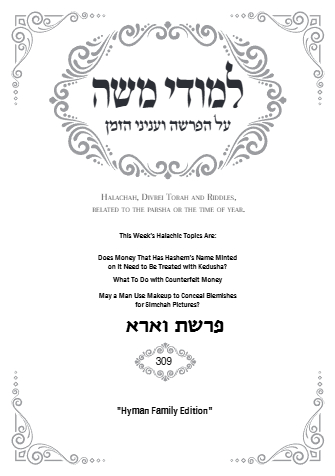
Does Money That Has Hashem’s Name Minted on It Need to Be Treated with Kedusha?

In this week’s parsha we begin to learn about the Ten Makkos [Plagues] that Hashem punished the Egyptians with. The first of the makkos was the makkah of Dam [Blood]. Chazal tell us that the only way that the Egyptians would be able to obtain water was by buying it off the Yidden, and the Yidden became rich because of this.

If the Yidden would have been paid with money that contained the name of Hashem on it (something that was highly unlikely to be found on the Egyptian currency), would the money need to be treated with kedusha? Additionally, what would have been the din if the Yidden would have received counterfeit money, what would they be able to do with it? Would they be able to pass it on to another Jew without telling him? To find out the answers, read on.

Name of Hashem

On the American dollar bills it is written “IN GOD WE TRUST”. The question that has been discussed by many poskim is if this is considered a name of Hashem, and if it has any kedusha.

The poskim also discuss pasukim that are printed on money. On the 100-shekel note the pasuk from Yeshayah (54:17), כל כלי יוצר עליך לא יצלח, is written. Does this mean that the 100-shekel note must be treated with kedusha?

On the new 200-shekel note, the name א-לוהי is written in very small letters (it can only be seen with a magnifying glass, or with sharp eyes, for where to find it see the arrow on the picture attached. Where the arrow points there is an entire poem, and part of the poem is the name of Hashem).

Although it is very small, it’s clear from the Maharsham (Vol. 3, siman 357) and the Shu”t Even Yekorah (Tinyona, siman 33) that there is a prohibition to disgrace kisvei kodesh [holy writing] even if the letters are very small and not easily recognizable. Does this mean that the 200-shekel note must be treated with kedusha?

What is the din in all these cases?

They Have No Kedusha

The opinion of the Mishnah Berurah (334:52) regarding the four-letter name of Hashem that is minted on the coins in Sweden, is that they have no kedusha and one is permitted to melt them down. They were printed with intention for the coins to be spent and it is as if they were written with explicit intention to be mundane.

Based on the above, R’ Elyashiv zt”l (Ginzei Kodesh, Perek 4, he’orah 6) writes that it is permissible to take into the beis hakisay a dollar bill, without making an extra cover over it. R’ Elyashiv explains: Since the name of Hashem wasn’t written with intent to be holy it doesn’t need to be treated with kedusha. He also held, that the pasukim written on the 100-shekel note in Eretz Yisrael which can’t be read don’t need to be treated with kedusha, and even if they could be read, they still wouldn’t have kedusha, as the pasuk wasn’t printed with any intention of being kadosh.

One May Disgrace Them

It is brought down in the name of R’ Shlomah Zalman Auerbach (Halichos Shlomah, Perek 7, s.k. 33) that there is no need to treat them with respect, however, for a different reason. He is not so keen with the opinion of the Shach (Yoreh De’ah, siman 179, s.k. 11) who holds that one may be lenient with a name of Hashem written in a foreign language (i.e. not lashon hakodesh), however, he holds that bringing them into a beis hakisay is more lenient than erasing them and is not considered as much of a disgrace. This is also the opinion of R’ Wosner zt”l (Shu”t Shevet HaLevi, Vol. 6, siman 8) and R’ Menashe Klein zt”l (Shu”t Mishneh Halachos 5:117).

Forbidden to Disgrace Them

On the other hand, R’ Moshe Sternbuch shlita (Teshuvos V’Hanhagos, Vol. 2, siman 466) brings that R’ Chaim Brisker would avoid bringing coins with a name of Hashem printed on into the beis hakisay, as it is forbidden to treat such coins disrespectfully.

R’ Shach zt”l (cited in Ginzei Kodesh, Perek 4, he’orah 6) also held regarding the one shekel note which had part of the Rambam in Hilchos Shtoros (see attached picture) printed on it, that there is no need to treat it with respect, however, one shouldn’t treat it disgracefully. Regarding whether it may be brought into the beis hakisay, R’ Shach was in doubt, if it is enough to cover them it with a single covering. See further the Shu”t Tzitz Eliezer (16:31) who speaks about this at great length.

A Single Covering

A middle approach is that of R’ Nissim Karelitz zt”l (Ginzei Kodesh, Perek 4, he’orah 6). He writes that one shouldn’t take out the dollar bill inside the beis hakisay, however, if it is inside one’s pocket then he may take it inside with him.

R’ Binyomin Zilber zt”l (Shu”t Oz Nidberu, Vol. 2, siman 64) also takes a middle ground approach and says that one covering is enough. He explains that the requirement of כלי בתוך כלי – a utensil inside a utensil, i.e. a double covering, is when something must be treated with kavod, however, when there is no requirement to show kavod, and one simply needs to make sure not to disgrace the item, then a single covering is enough. In our case, since the name of Hashem hasn’t been printed with any kedusha, it is enough to simply cover it with a single covering and to avoid causing any disgrace.

Halachah Lema’aseh

The Ginzei Kodesh (Perek 4, sif 5) concludes: “In regard to a note/bill that has printed on it a pasuk or name of Hashem, according to most poskim there is no need to cover it when taking it into the beis hakisay or bathhouse, and there are those that are stringent.”
Does Money That Has Hashem’s Name Minted on It Need to Be Treated with Kedusha?

In this week’s parsha we begin to learn about the Ten Makkos [Plagues] that Hashem punished the Egyptians with. The first of the makkos was the makkah of Dam [Blood]. Chazal tell us that the only way that the Egyptians would be able to obtain water was by buying it off the Yidden, and the Yidden became rich because of this.

If the Yidden would have been paid with money that contained the name of Hashem on it (something that was highly unlikely to be found on the Egyptian currency), would the money need to be treated with kedusha? Additionally, what would have been the din if the Yidden would have received counterfeit money, what would they be able to do with it? Would they be able to pass it on to another Jew without telling him? To find out the answers, read on.

Name of Hashem

On the American dollar bills it is written “IN GOD WE TRUST”. The question that has been discussed by many poskim is if this is considered a name of Hashem, and if it has any kedusha.

The poskim also discuss pasukim that are printed on money. On the 100-shekel note the pasuk from Yeshayah (54:17), כל כלי יוצר עליך לא יצלח, is written. Does this mean that the 100-shekel note must be treated with kedusha?

On the new 200-shekel note, the name א-לוהי is written in very small letters (it can only be seen with a magnifying glass, or with sharp eyes, for where to find it see the arrow on the picture attached. Where the arrow points there is an entire poem, and part of the poem is the name of Hashem).

Although it is very small, it’s clear from the Maharsham (Vol. 3, siman 357) and the Shu”t Even Yekorah (Tinyona, siman 33) that there is a prohibition to disgrace kisvei kodesh [holy writing] even if the letters are very small and not easily recognizable. Does this mean that the 200-shekel note must be treated with kedusha?

What is the din in all these cases?

They Have No Kedusha

The opinion of the Mishnah Berurah (334:52) regarding the four-letter name of Hashem that is minted on the coins in Sweden, is that they have no kedusha and one is permitted to melt them down. They were printed with intention for the coins to be spent and it is as if they were written with explicit intention to be mundane.

Based on the above, R’ Elyashiv zt”l (Ginzei Kodesh, Perek 4, he’orah 6) writes that it is permissible to take into the beis hakisay a dollar bill, without making an extra cover over it. R’ Elyashiv explains: Since the name of Hashem wasn’t written with intent to be holy it doesn’t need to be treated with kedusha. He also held, that the pasukim written on the 100-shekel note in Eretz Yisrael which can’t be read don’t need to be treated with kedusha, and even if they could be read, they still wouldn’t have kedusha, as the pasuk wasn’t printed with any intention of being kadosh.

One May Disgrace Them

It is brought down in the name of R’ Shlomah Zalman Auerbach (Halichos Shlomah, Perek 7, s.k. 33) that there is no need to treat them with respect, however, for a different reason. He is not so keen with the opinion of the Shach (Yoreh De’ah, siman 179, s.k. 11) who holds that one may be lenient with a name of Hashem written in a foreign language (i.e. not lashon hakodesh), however, he holds that bringing them into a beis hakisay is more lenient than erasing them and is not considered as much of a disgrace. This is also the opinion of R’ Wosner zt”l (Shu”t Shevet HaLevi, Vol. 6, siman 8) and R’ Menashe Klein zt”l (Shu”t Mishneh Halachos 5:117).

Forbidden to Disgrace Them

On the other hand, R’ Moshe Sternbuch shlita (Teshuvos V’Hanhagos, Vol. 2, siman 466) brings that R’ Chaim Brisker would avoid bringing coins with a name of Hashem printed on into the beis hakisay, as it is forbidden to treat such coins disrespectfully.

R’ Shach zt”l (cited in Ginzei Kodesh, Perek 4, he’orah 6) also held regarding the one shekel note which had part of the Rambam in Hilchos Shtoros (see attached picture) printed on it, that there is no need to treat it with respect, however, one shouldn’t treat it disgracefully. Regarding whether it may be brought into the beis hakisay, R’ Shach was in doubt, if it is enough to cover them it with a single covering. See further the Shu”t Tzitz Eliezer (16:31) who speaks about this at great length.

A Single Covering

A middle approach is that of R’ Nissim Karelitz zt”l (Ginzei Kodesh, Perek 4, he’orah 6). He writes that one shouldn’t take out the dollar bill inside the beis hakisay, however, if it is inside one’s pocket then he may take it inside with him.

R’ Binyomin Zilber zt”l (Shu”t Oz Nidberu, Vol. 2, siman 64) also takes a middle ground approach and says that one covering is enough. He explains that the requirement of כלי בתוך כלי – a utensil inside a utensil, i.e. a double covering, is when something must be treated with kavod, however, when there is no requirement to show kavod, and one simply needs to make sure not to disgrace the item, then a single covering is enough. In our case, since the name of Hashem hasn’t been printed with any kedusha, it is enough to simply cover it with a single covering and to avoid causing any disgrace.

Halachah Lema’aseh

The Ginzei Kodesh (Perek 4, sif 5) concludes: “In regard to a note/bill that has printed on it a pasuk or name of Hashem, according to most poskim there is no need to cover it when taking it into the beis hakisay or bathhouse, and there are those that are stringent.”

PDF Preview