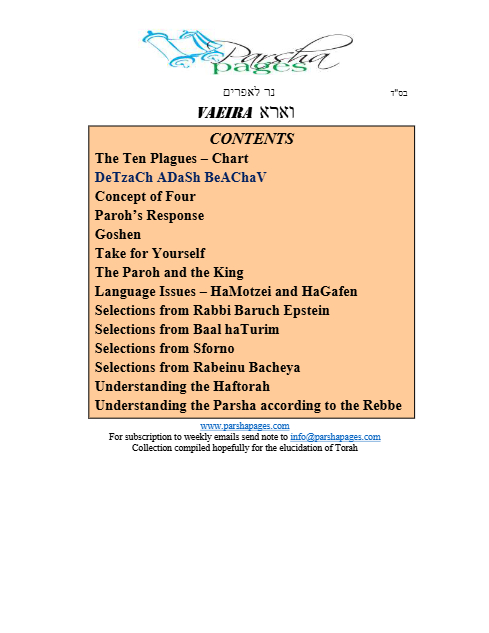
Issues in the Language of HaMotzi and HaGefen
Parsha Pages | January 24, 2025
Print This Article
View Original PDF

Issues in the Language of HaMotzi and HaGefen

Parsha Pages | June 27, 2025

והלכתא המוציא לחם מן הארץ דקיימא לן כרבנן דאמרי דאפיק משמע—ברכות לח .
And the final law is that one pronounces on bread the blessing of: “he who brings forth bread from the earth” because we hold like the view of the Chachamim that “hamotzi” means “He who has brought forth.” - Berachos38b

וְהוֹצֵאתִי אֶׁתְכֶׁם מִתַחַת סִבְלֹת מִצְרַיִם (שמות ו,ו)

Tosafos and others quote a Yerushalmi that provides another reason why the formula of hamotzi is superior to the formula of motzi. We should say "ha'Motzi" in the blessing in order to create a break between the word "ha'Olam," which ends with the letter "Mem," and the word "Motzi," which begins with the letter "Mem," so that we do not slur the words and say "ha'Olamotzi" inadvertently. This concern is removed by the addition of the letter ה to the word מוציא, thus effectively separating these two words.

It is then pointed out that if so, why does the formula include מן לחם, where the same concern exists? They respond that this language is based upon a verse that states להוציא לחם מן הארץ, and therefore it was retained. However, it should be noted that due to this consideration the Tur states that while recited this blessing one should pause slightly between the words לחם and מן so as not to slur them together. This exhortation is cited in the Shulchan Aruch as well.

The Poskim discuss what would happen if a person mistakenly recited מוציא לחם מן הארץ instead of המוציא. Some authorities opine that it is simply preferable to recite המוציא, and if one said מוציא he fulfills his responsibility. Others seem to hold that one would not fulfill his obligation if he said לחם המוציא. The Mishnah Berura rules that if one said מוציא instead of המוציא, after the fact he is considered to have fulfilled his obligation. [It should be mentioned that if the person said הארץ מן פת המוציא instead of לחם המוציא, he has not fulfilled his responsibility, (since it is considered bread פת only after being baked).]

The Rashba questions why we don’t say הגפן פרי הבורא just as we say לחם המוציא. The question is explained by the S’michas Chachamim: bread represents a qualitative improvement, a ה was therefore added to its blessing to reflect this elevation. If so, wine, which also represents a qualitative improvement over the original grape-state, should also reflect this with the addition of a א"ה in its blessing. A response for this question may be deduced from the words of the Ra’ah who wonders why we don’t say הבורא instead of בורא for the blessing on fruits, just as we say המוציא instead of מוציא. The Ra’ah answers that המוציא connotes past, present and future, which is appropriate for grain that grows at all times of the year. However, such a connotation would not apply to fruits, since they do not grow at all times like grain. Based upon this, it can be answered that for grapes as well בורא is more appropriate than הבורא, since grapes don’t grow in all seasons.

The S’michas Chachamim responds that the language of הבורא implies that wine was created as such in its original form. Being that this is not the case, the wine’s original form was grapes, then the term הבורא is inaccurate. However, the blessing for bread is based upon the verse in which bread is described as having come from the earth.

Based on dafdigest.org
והלכתא המוציא לחם מן הארץ דקיימא לן כרבנן דאמרי דאפיק משמע—ברכות לח .
And the final law is that one pronounces on bread the blessing of: “he who brings forth bread from the earth” because we hold like the view of the Chachamim that “hamotzi” means “He who has brought forth.” - Berachos38b

וְהוֹצֵאתִי אֶׁתְכֶׁם מִתַחַת סִבְלֹת מִצְרַיִם (שמות ו,ו)

Tosafos and others quote a Yerushalmi that provides another reason why the formula of hamotzi is superior to the formula of motzi. We should say "ha'Motzi" in the blessing in order to create a break between the word "ha'Olam," which ends with the letter "Mem," and the word "Motzi," which begins with the letter "Mem," so that we do not slur the words and say "ha'Olamotzi" inadvertently. This concern is removed by the addition of the letter ה to the word מוציא, thus effectively separating these two words.

It is then pointed out that if so, why does the formula include מן לחם, where the same concern exists? They respond that this language is based upon a verse that states להוציא לחם מן הארץ, and therefore it was retained. However, it should be noted that due to this consideration the Tur states that while recited this blessing one should pause slightly between the words לחם and מן so as not to slur them together. This exhortation is cited in the Shulchan Aruch as well.

The Poskim discuss what would happen if a person mistakenly recited מוציא לחם מן הארץ instead of המוציא. Some authorities opine that it is simply preferable to recite המוציא, and if one said מוציא he fulfills his responsibility. Others seem to hold that one would not fulfill his obligation if he said לחם המוציא. The Mishnah Berura rules that if one said מוציא instead of המוציא, after the fact he is considered to have fulfilled his obligation. [It should be mentioned that if the person said הארץ מן פת המוציא instead of לחם המוציא, he has not fulfilled his responsibility, (since it is considered bread פת only after being baked).]

The Rashba questions why we don’t say הגפן פרי הבורא just as we say לחם המוציא. The question is explained by the S’michas Chachamim: bread represents a qualitative improvement, a ה was therefore added to its blessing to reflect this elevation. If so, wine, which also represents a qualitative improvement over the original grape-state, should also reflect this with the addition of a א"ה in its blessing. A response for this question may be deduced from the words of the Ra’ah who wonders why we don’t say הבורא instead of בורא for the blessing on fruits, just as we say המוציא instead of מוציא. The Ra’ah answers that המוציא connotes past, present and future, which is appropriate for grain that grows at all times of the year. However, such a connotation would not apply to fruits, since they do not grow at all times like grain. Based upon this, it can be answered that for grapes as well בורא is more appropriate than הבורא, since grapes don’t grow in all seasons.

The S’michas Chachamim responds that the language of הבורא implies that wine was created as such in its original form. Being that this is not the case, the wine’s original form was grapes, then the term הבורא is inaccurate. However, the blessing for bread is based upon the verse in which bread is described as having come from the earth.

Based on dafdigest.org

PDF Preview