Kiruv The Message and the Medium
The Shmuz | January 17, 2026
Print This Article
View Original PDF

Kiruv The Message and the Medium

The Shmuz | January 20, 2026

HASHEM said to Moshe, “Go to Pharaoh and tell him to let my people go.” Moshe responded, “The Jewish People haven’t accepted my word. How will Pharaoh listen?” Rashi explains that this is one of the ten kal vachomers written in the Torah. The Siftei Chachamim clarifies: “The message that I am carrying is for good of the Jewish people, yet they have not accepted it. Surely then Pharaoh, to whom this message is detrimental, will reject it.”

However, Moshe added one more phrase, “When I am of blocked lips.” The actual statement that he said to HASHEM was, “The Jewish People haven’t accepted my word. How will Pharaoh listen when I am of blocked lips?” The Siftei Chachamim explains that this was the pivotal point of the kal vachomer. As an infant, Moshe burnt his tongue, and from that point on, he had difficulty with speech. Now many years later, Moshe assumed that the reason his words weren’t accepted was because of his speech impediment. Effectively he was saying, “I am bringing good news to the Jews, yet they don’t believe me because of my lack of clear speech. Surely Pharaoh, who is biased against my message, will not accept it either because of my unclear speech.”

This Rashi is difficult to understand. Moshe wasn’t a salesman selling a product. He wasn’t claiming that his charisma and leadership would cause an uprising. According to Moshe’s claim, the All Powerful Master of the Universe sent him on a mission. There was only one question: was he telling the truth? If he was a representative of G-d, then both the Jewish Nation and Pharaoh had better listen. If he wasn’t, then who cares what he said? The words and the style of his delivery weren’t relevant. Either he was sent by HASHEM or he wasn’t. What difference does it make how clearly he spoke?

THE WONDER OF FREE WILL

The answer to this question is based on understanding one of the great dilemmas of Creation. How do you take man, more brilliant than the highest form of angel, and give him free will? Even if you load him with great temptations, he would never sin. He understands that every sin damages him, and every mitzvah helps him. If so, how does he have free will? He would never do something to willfully damage himself?

To give man free will in a practical sense, HASHEM created a powerful force called imagination. Imagination allows him believe what he wants. Now if he desires something, he is free to construct a worldview that makes that act not just permitted but a mitzvah as well. Sin isn’t damaging, it’s something good, beneficial and helpful. And man is capable of actually believing what he wants. Now he is free to choose his path.

BEFORE THEY ACCEPT MY MESSAGE, THEY MUST ACCEPT ME

This seems to be the answer to the question on Rashi. Whether Moshe was telling the truth or not was only part of the question. The crux of the issue was, “Do we want to believe him?” To the Jewish people, he was bringing news of redemption. As such, they wanted to believe him. On the other hand, Pharaoh had a strong interest in not accepting Moshe’s words, so he was unlikely to believe him.

But Moshe understood that there was another element that would influence whether his words would be received as truth — what kind of impression did he make? Was he handsome? Did he cut a good figure? Would people want to accept him as a person? He understood that being an effective educator isn’t based on being right, it’s based on my message being accepted. However, before they accept my message, they have to accept me. And before they accept me, they have to like me. Because he wasn’t of perfect speech, Moshe assumed this would influence his chances of acceptance.

WE ARE ALL TEACHERS

This concept is very applicable to us. When we don the robe of educators, whether to our students, to our children, or to our peers, we need to focus on both the truth of our message as well as the method we use to present it. It must be pleasing and readily acceptable to others, otherwise it just won’t be heard.
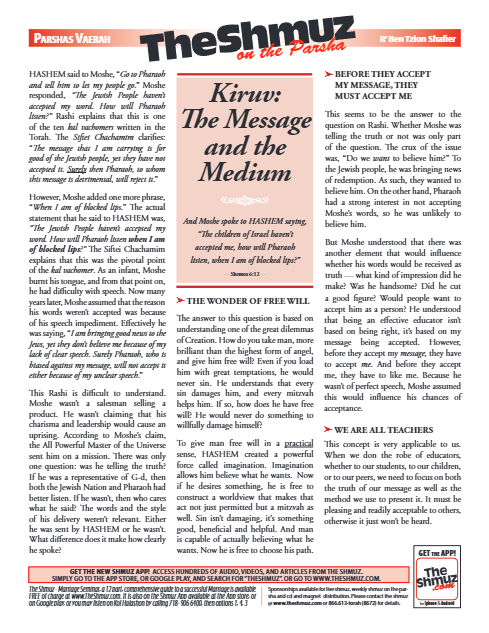

HASHEM said to Moshe, “Go to Pharaoh and tell him to let my people go.” Moshe responded, “The Jewish People haven’t accepted my word. How will Pharaoh listen?” Rashi explains that this is one of the ten kal vachomers written in the Torah. The Siftei Chachamim clarifies: “The message that I am carrying is for good of the Jewish people, yet they have not accepted it. Surely then Pharaoh, to whom this message is detrimental, will reject it.”

However, Moshe added one more phrase, “When I am of blocked lips.” The actual statement that he said to HASHEM was, “The Jewish People haven’t accepted my word. How will Pharaoh listen when I am of blocked lips?” The Siftei Chachamim explains that this was the pivotal point of the kal vachomer. As an infant, Moshe burnt his tongue, and from that point on, he had difficulty with speech. Now many years later, Moshe assumed that the reason his words weren’t accepted was because of his speech impediment. Effectively he was saying, “I am bringing good news to the Jews, yet they don’t believe me because of my lack of clear speech. Surely Pharaoh, who is biased against my message, will not accept it either because of my unclear speech.”

This Rashi is difficult to understand. Moshe wasn’t a salesman selling a product. He wasn’t claiming that his charisma and leadership would cause an uprising. According to Moshe’s claim, the All Powerful Master of the Universe sent him on a mission. There was only one question: was he telling the truth? If he was a representative of G-d, then both the Jewish Nation and Pharaoh had better listen. If he wasn’t, then who cares what he said? The words and the style of his delivery weren’t relevant. Either he was sent by HASHEM or he wasn’t. What difference does it make how clearly he spoke?

THE WONDER OF FREE WILL

The answer to this question is based on understanding one of the great dilemmas of Creation. How do you take man, more brilliant than the highest form of angel, and give him free will? Even if you load him with great temptations, he would never sin. He understands that every sin damages him, and every mitzvah helps him. If so, how does he have free will? He would never do something to willfully damage himself?

To give man free will in a practical sense, HASHEM created a powerful force called imagination. Imagination allows him believe what he wants. Now if he desires something, he is free to construct a worldview that makes that act not just permitted but a mitzvah as well. Sin isn’t damaging, it’s something good, beneficial and helpful. And man is capable of actually believing what he wants. Now he is free to choose his path.

BEFORE THEY ACCEPT MY MESSAGE, THEY MUST ACCEPT ME

This seems to be the answer to the question on Rashi. Whether Moshe was telling the truth or not was only part of the question. The crux of the issue was, “Do we want to believe him?” To the Jewish people, he was bringing news of redemption. As such, they wanted to believe him. On the other hand, Pharaoh had a strong interest in not accepting Moshe’s words, so he was unlikely to believe him.

But Moshe understood that there was another element that would influence whether his words would be received as truth — what kind of impression did he make? Was he handsome? Did he cut a good figure? Would people want to accept him as a person? He understood that being an effective educator isn’t based on being right, it’s based on my message being accepted. However, before they accept my message, they have to accept me. And before they accept me, they have to like me. Because he wasn’t of perfect speech, Moshe assumed this would influence his chances of acceptance.

WE ARE ALL TEACHERS

This concept is very applicable to us. When we don the robe of educators, whether to our students, to our children, or to our peers, we need to focus on both the truth of our message as well as the method we use to present it. It must be pleasing and readily acceptable to others, otherwise it just won’t be heard.

PDF Preview