Light after the Darkness
Living Jewish | January 14, 2026
Print This Article
View Original PDF

Light after the Darkness

Living Jewish | January 20, 2026

The world is moving toward redemption. All the long exiles are merely a path—perhaps a winding one—leading to redemption. Especially in our generation, which, according to the signs mentioned by the Sages and the words of the tzaddikim of our time, is the generation of redemption. However, the path to redemption can be direct and swift—if we are meritorious—or it can be difficult and winding, full of ups and downs—if, heaven forbid, we are not.

Even in Egypt, the path to redemption went through a stage of great descent. Precisely after G-d sent Moshe to the Jewish people, carrying the message of redemption, the opposite occurred: Pharaoh increased the burden of slavery, stopped providing straw to the people, and increased the demands on the Israelites. The crisis was so severe that the Israelite overseers expressed their pain to Moshe, and Moshe cried out to G-d: “Why have You mistreated this people? Why have You sent me?” Yet, this was the stage after which the plagues began, ultimately bringing redemption.

Before the Dawn

The Sages words are full of descriptions of such situations on the eve of redemption and even at its beginning. In Zohar Chadash (Bereshit 6:1), the order of the future redemption is described: “Thus is the redemption of Israel—at the moment the sun of redemption will shine upon them, trouble will come after trouble, darkness after darkness, and while they are in it—the light of G-d will shine upon them.”

The Kli Yakar (end of Parshat Shemot) says: “Such is the pattern: every day near sunrise, the darkness is thickest... and similarly in winter, near sunrise, the cold increases until it is finally overcome by the sun... Likewise, what Pharaoh now does to Israel, worse than before, is a clear sign that its end is near and the time of redemption is close.”

Just as, in general, redemption is preceded by the period of Ikveta D’Meshicha, the footsteps of Moshiach, a difficult and low period unlike any in previous generations—so too the processes bringing the redemption itself are made up of difficult and painful events that occur precisely as the light of redemption approaches. This is the growing darkness before the arrival of light.

Knowledge Brings Strength

Knowing all this leads to the realization that we must not fall in spirit or doubt the belief in redemption. On the contrary, precisely in the face of the great and utterly incomprehensible descent occurring in the final days, we must strengthen our faith in the redemption, which will also come in a surprising and incomprehensible manner—as the Sages said, it will arrive “in a moment of forgetfulness (b’hesech hada’at).”

Precisely when reaching the lowest point, one understands that from here there is only ascent—and not just any ascent, but to the highest peak.

Along with this, a Jew must also know that these things are not predetermined and sealed in advance; much depends on our deeds and actions. Adding mitzvot and good deeds, along with prayer to G-d to shorten the suffering and bring our righteous Moshiach, can certainly create a “leap forward (kefitzat haderech)” and spare us much suffering and hardship.

In Egypt there was harsh exile... yet, Hashem took the Jews out. So too now... one must not fall in spirit. One must strengthen oneself in faith in the redemption through Moshiach. At least, one should begin by saying, “I believe - Ani Ma’amin,” until this will also effect one’s heart, so that faith in the coming of Moshiach will be settled within him. This faith will bring about the redemption speedily. (the Rebbe)
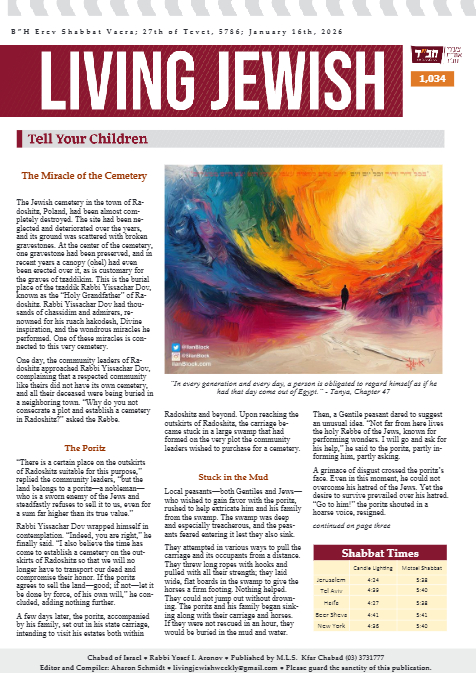
The world is moving toward redemption. All the long exiles are merely a path—perhaps a winding one—leading to redemption. Especially in our generation, which, according to the signs mentioned by the Sages and the words of the tzaddikim of our time, is the generation of redemption. However, the path to redemption can be direct and swift—if we are meritorious—or it can be difficult and winding, full of ups and downs—if, heaven forbid, we are not.

Even in Egypt, the path to redemption went through a stage of great descent. Precisely after G-d sent Moshe to the Jewish people, carrying the message of redemption, the opposite occurred: Pharaoh increased the burden of slavery, stopped providing straw to the people, and increased the demands on the Israelites. The crisis was so severe that the Israelite overseers expressed their pain to Moshe, and Moshe cried out to G-d: “Why have You mistreated this people? Why have You sent me?” Yet, this was the stage after which the plagues began, ultimately bringing redemption.

Before the Dawn

The Sages words are full of descriptions of such situations on the eve of redemption and even at its beginning. In Zohar Chadash (Bereshit 6:1), the order of the future redemption is described: “Thus is the redemption of Israel—at the moment the sun of redemption will shine upon them, trouble will come after trouble, darkness after darkness, and while they are in it—the light of G-d will shine upon them.”

The Kli Yakar (end of Parshat Shemot) says: “Such is the pattern: every day near sunrise, the darkness is thickest... and similarly in winter, near sunrise, the cold increases until it is finally overcome by the sun... Likewise, what Pharaoh now does to Israel, worse than before, is a clear sign that its end is near and the time of redemption is close.”

Just as, in general, redemption is preceded by the period of Ikveta D’Meshicha, the footsteps of Moshiach, a difficult and low period unlike any in previous generations—so too the processes bringing the redemption itself are made up of difficult and painful events that occur precisely as the light of redemption approaches. This is the growing darkness before the arrival of light.

Knowledge Brings Strength

Knowing all this leads to the realization that we must not fall in spirit or doubt the belief in redemption. On the contrary, precisely in the face of the great and utterly incomprehensible descent occurring in the final days, we must strengthen our faith in the redemption, which will also come in a surprising and incomprehensible manner—as the Sages said, it will arrive “in a moment of forgetfulness (b’hesech hada’at).”

Precisely when reaching the lowest point, one understands that from here there is only ascent—and not just any ascent, but to the highest peak.

Along with this, a Jew must also know that these things are not predetermined and sealed in advance; much depends on our deeds and actions. Adding mitzvot and good deeds, along with prayer to G-d to shorten the suffering and bring our righteous Moshiach, can certainly create a “leap forward (kefitzat haderech)” and spare us much suffering and hardship.

In Egypt there was harsh exile... yet, Hashem took the Jews out. So too now... one must not fall in spirit. One must strengthen oneself in faith in the redemption through Moshiach. At least, one should begin by saying, “I believe - Ani Ma’amin,” until this will also effect one’s heart, so that faith in the coming of Moshiach will be settled within him. This faith will bring about the redemption speedily. (the Rebbe)

PDF Preview