One Point from Likkutei Sichos Parshas Vaera
IN THE PARSHA:
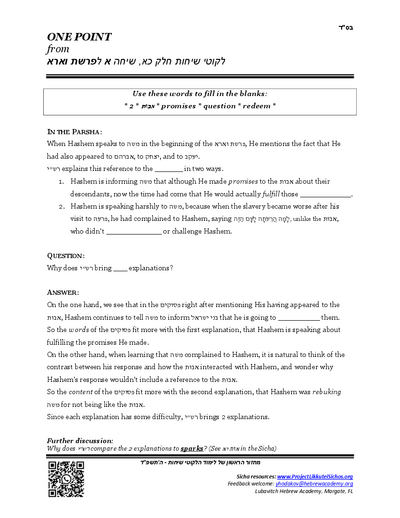
When Hashem speaks to משה in the beginning of the פרשת וארא, He mentions the fact that He had also appeared to אברהם, to יצחק, and to יעקב.
רש"י explains this reference to the אבות in two ways.
1. Hashem is informing משה that although He made promises to the אבות about their descendants, now the time had come that He would actually fulfill those promises.
2. Hashem is speaking harshly to משה, because when the slavery became worse after his visit to פרעה, he had complained to Hashem, saying הלָמָה הֲרֵעֹתָה לָעָם הַז, unlike the אבות, who didn’t question or challenge Hashem.
QUESTION:
Why does רש"י bring 2 explanations?
ANSWER:
On the one hand, we see that in the פסוקים right after mentioning His having appeared to the אבות, Hashem continues to tell משה to inform בני ישראל that he is going to redeem them. So the words of the פסוקים fit more with the first explanation, that Hashem is speaking about fulfilling the promises He made.
On the other hand, when learning that משה complained to Hashem, it is natural to think of the contrast between his response and how the אבות interacted with Hashem, and wonder why Hashem’s response wouldn’t include a reference to the אבות.
So the content of the פסוקים fit more with the second explanation, that Hashem was rebuking משה for not being like the אבות.
Since each explanation has some difficulty, רש"י brings 2 explanations.
Further discussion:
Why does רש"י compare the 2 explanations to sparks? (See יא אות in the Sicha)