The Blessing of Normalcy
BET Journal | January 17, 2026
Print This Article
View Original PDF

The Blessing of Normalcy

BET Journal | January 20, 2026

This week’s thought emerges from the stranger I met ever-so-briefly at the end of my driveway Thursday morning. While I was leaving for shul, the garbage man (or “sanitation worker,“ as he might prefer to be called) remarked, “What a nice day it is.“ An unexpectedly upbeat comment from a man collecting trash at 6:30 AM in dark, damp, 37-degree temperatures. How strong could this guy’s Java possibly be to maintain (and express) such a positive perspective under such seemingly dismal conditions?

The answer, obviously enough, was the fact that this morning’s balmy weather was a marked departure from the single-digit freeze wave that had gripped Monsey for the last two weeks.

Call it the theory of relativity. Call it the power of contrast. Thirty-seven degrees is a whole lot more pleasant when one can still feel yesterday’s wind chill in their bones.

Indeed, we have all experienced that surge of contentedness that invariably accompanies the removal of aggravation.

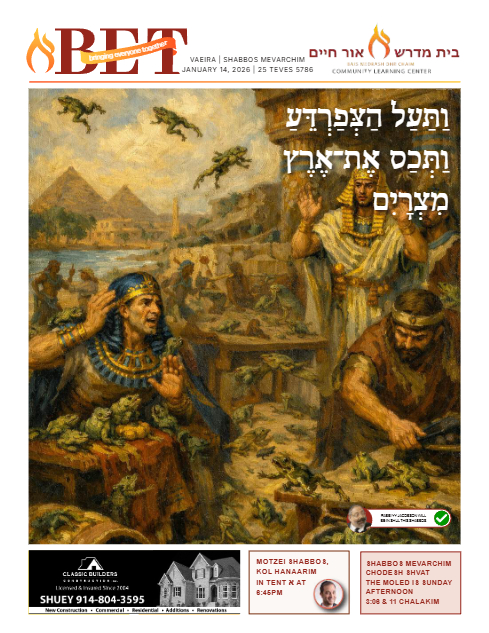
In this week’s Torah portion, can you imagine the euphoric relief of the Egyptian population when the frogs finally stopped their incessant, nationwide croaking? I envision that first frog-free morning and its impact on the Egyptians. “Yeah, sure is a lot of traffic in Cairo today, but at least there are no frogs!“ “Yeah, the price of hummus is going through the roof, but anything’s better than those slimy toads everywhere.“

And that morning after the swarm of wild beasts departed, wouldn’t life as “normal“ be a reason to smile? After all, no wild boars breathing down my neck. No deadly scorpions or Siberian tigers on the prowl. Just normal is just great.

“Therefore, say to the Children of Israel: ’I am G-d, and I shall take you out from under the burdens of Egypt; I shall rescue you from their service; I shall redeem you with an outstretched arm and with great judgments. I shall take you to Me for a people, and I shall be a G-d to you; and you shall know that I am the Lord your G-d Who takes you out from under the burdens of Egypt.“ [6:6-7]

These four expressions of liberation correspond to the four cups of wine we consume at the Pesach Seder.

Rabbeinu Bachya explains that the very first expression, “I shall take you out,“ signifies G-d’s removal of the Jews from the burdens of slavery even though they would remain as the Egyptians’ chattel for another six months.

What kind of half-baked, watered-down notion of freedom is this?! We are not free to flee Egyptian borders and are already hoisting wine in celebration?!

The answer could be that relatively-speaking, the cessation from back-breaking servitude was indeed a watershed transformation in the lives of the Jewish people. This initial stage of redemption was euphoric to the extent that it marked a radical departure from the bitterness of decades upon decades of physical and emotional burdens. Are we home free? For sure not. Do we have what to rejoice over? 100%.

Carrying this notion into our everyday lives, on those days when we “can’t complain,“ take a moment to appreciate how beautiful the view is from emotional and physical sea level. The mere fact that you are not in the hospital. That you have a closet full of clothes. The mere fact that so many things are not going wrong. The myriad number of hassles you don’t have to contend with. These milestones are all too often lost in the shuffle of everyday life. When we take them to heart, our capacity for gratefulness and positivity will undoubtedly be closer at hand.

This week’s thought emerges from the stranger I met ever-so-briefly at the end of my driveway Thursday morning. While I was leaving for shul, the garbage man (or “sanitation worker,“ as he might prefer to be called) remarked, “What a nice day it is.“ An unexpectedly upbeat comment from a man collecting trash at 6:30 AM in dark, damp, 37-degree temperatures. How strong could this guy’s Java possibly be to maintain (and express) such a positive perspective under such seemingly dismal conditions?

The answer, obviously enough, was the fact that this morning’s balmy weather was a marked departure from the single-digit freeze wave that had gripped Monsey for the last two weeks.

Call it the theory of relativity. Call it the power of contrast. Thirty-seven degrees is a whole lot more pleasant when one can still feel yesterday’s wind chill in their bones.

Indeed, we have all experienced that surge of contentedness that invariably accompanies the removal of aggravation.

In this week’s Torah portion, can you imagine the euphoric relief of the Egyptian population when the frogs finally stopped their incessant, nationwide croaking? I envision that first frog-free morning and its impact on the Egyptians. “Yeah, sure is a lot of traffic in Cairo today, but at least there are no frogs!“ “Yeah, the price of hummus is going through the roof, but anything’s better than those slimy toads everywhere.“

And that morning after the swarm of wild beasts departed, wouldn’t life as “normal“ be a reason to smile? After all, no wild boars breathing down my neck. No deadly scorpions or Siberian tigers on the prowl. Just normal is just great.

“Therefore, say to the Children of Israel: ’I am G-d, and I shall take you out from under the burdens of Egypt; I shall rescue you from their service; I shall redeem you with an outstretched arm and with great judgments. I shall take you to Me for a people, and I shall be a G-d to you; and you shall know that I am the Lord your G-d Who takes you out from under the burdens of Egypt.“ [6:6-7]

These four expressions of liberation correspond to the four cups of wine we consume at the Pesach Seder.

Rabbeinu Bachya explains that the very first expression, “I shall take you out,“ signifies G-d’s removal of the Jews from the burdens of slavery even though they would remain as the Egyptians’ chattel for another six months.

What kind of half-baked, watered-down notion of freedom is this?! We are not free to flee Egyptian borders and are already hoisting wine in celebration?!

The answer could be that relatively-speaking, the cessation from back-breaking servitude was indeed a watershed transformation in the lives of the Jewish people. This initial stage of redemption was euphoric to the extent that it marked a radical departure from the bitterness of decades upon decades of physical and emotional burdens. Are we home free? For sure not. Do we have what to rejoice over? 100%.

Carrying this notion into our everyday lives, on those days when we “can’t complain,“ take a moment to appreciate how beautiful the view is from emotional and physical sea level. The mere fact that you are not in the hospital. That you have a closet full of clothes. The mere fact that so many things are not going wrong. The myriad number of hassles you don’t have to contend with. These milestones are all too often lost in the shuffle of everyday life. When we take them to heart, our capacity for gratefulness and positivity will undoubtedly be closer at hand.

PDF Preview