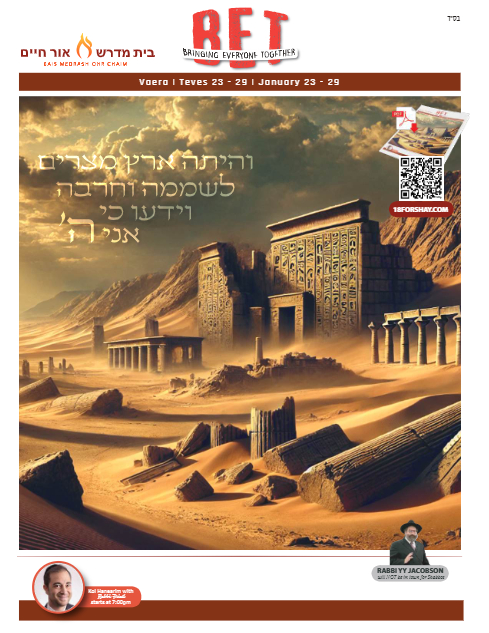
Ultimate Justice
The bulk of parashat Va’eira revolves around the first seven plagues visited upon the Egyptians, the warnings given to Par’oh and his stubborn refusal to free the slaves. We would, however, be mistaken if we see these afflictions simply as prelude to the redemption from Egypt. For, although it is true that these plagues served as educational tools to teach the Egyptians of Hashem’s omnipotence and as motivation to release the Israelites, they were, in fact, an essential part of the redemptive process itself.
Redemption is an act of Justice. Justice demands fairness. Fairness demands reward for the righteous and punishment of the wicked as well. There can be no just world in which evil is ignored and the wicked remain unpunished. G-d, THE Judge of all creation, demands just that. These plagues were part of Hashem’s justice and, as a result, part of the redemption (which is perhaps why the wonders G-d visits against the Egyptians are referred to as “shfatim” [“uv’chol elohei Mitzrayim Eh’eseh shfatim”] from the root form sh,f,t-judge).
The selection for this week’s haftarah shares this very theme. Taken from the 28th and 29th prakim of Yechezkel, this reading centers about the retributions that G-d would visit upon Egypt due to her betrayal of Judea, the Southern Kingdom, during the prophet’s time. Although the navi lived in the Babylonian exile, he offers his words to both the Jews of the Diaspora as well as those who remained in Eretz Yisrael. He reminds the people of how the Judean leaders ignored the warning of the prophets, and supported Egypt in her struggle against Babylonia. The leaders foolishly believed that her “salvation” would come from Egypt – not from Hashem - and therefore relied upon their southern neighbor to save her from the Babylonian hordes. Rather than save Israel as G-d could, Egypt proved to be a “staff of reeds” that collapsed whenever it was needed for support, and, as a result, led to Israel’s exile.
Yechezkel, therefore, received a message from Hashem of how He would bring Egypt down from her lofty post and her haughty attitude. Egypt’s treachery would be punished by debilitating military losses that would leave their land decimated and their government powerless. Additionally, the nevu’ah also predicts the exile of the Egyptians from their land and their eventual return 40 years later, bringing to mind the 40 years that it took the freed Israelites to return to their land. Likewise, it is interesting to note that the spoils of war that would be taken by the Babylonians parallels the story of yetziat Mitzrayim, when B’nai Yisra’el also left with much of Egypt’s wealth, despoiling that empire as well.
Righteousness, punishment and reward prophesied by Yechezkel so many years after the Exodus, connect us to the theme of the parasha by providing us with lessons of emunah in G-d’s ultimate justice for all future generations.