What The Poskim of Our Times Have to Say About Davening in A Place Where There is a Loud Noise
Limuday Moshe | January 23, 2025
Print This Article
View Original PDF

What The Poskim of Our Times Have to Say About Davening in A Place Where There is a Loud Noise

Limuday Moshe | June 27, 2025

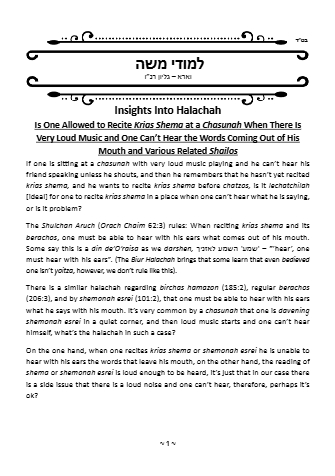
The poskim discuss the shailah we started with, about reciting krias shema, shemonah esrei etc. in places where there is a loud noise, and we will briefly bring the various different opinions.

Lenient

As we mentioned above, both R’ Zilberstein and R’ Chaim Kanievsky are lenient. R’ Shlomah Zalman Auerbach (Halichos Shlomah, Tefillah 22:4, pg. 258) is cited to say: “If one is in a place where there is a loud noise, there is room to doubt if one must raise his voice in order that he can hear the berachah he is saying. Seemingly, it’s obvious that the din of “hearing with the ears” is a reality, that one can actually hear the words, and it’s not just a din in how loud the words one says should be. So it appears from the Gemara in Berachos (13a) which says, “Hear with your ears, that which you speak with your mouth”. If one doesn’t actually hear the words with his ears, he doesn’t fulfil this din. However, practically tzorich iyun. He once ruled (R’ Shlomah Zalman) when asked about this, that one doesn’t need to worry about it, and he can recite berachos in a normal fashion, and there is no need for one to raise his voice.”

Similarly, in the sefer Sha’arei Berachah (Perek 10, he’orah 20, pg. 201) they bring in the name of R’ Wosner: “So I heard from R’ Wosner, that if one is in a place where there is lots of noise, even if practically one can’t hear the berachah he is saying, nonetheless, if he says it in a manner when normally it can be heard, it doesn’t matter that he can’t hear. Similarly, the Sha’arei Teshuvah (689:2) concludes in regard to someone who has hearing difficulty that since he could hear if it was said very loud, the fact that he can’t hear now is not a problem.”

Stringent

However, a number of poskim rule stringently. R’ Elyashiv was asked by R’ Moshe Fried about this and R’ Moshe writes in Vayishma Moshe (Vol. 2, pg. 75) as follows: “In regard to that which happens at chasunah’s that they have very loud music and due to the noise one who recites birchas hamazon is unable to hear the berachos that he recites, we rule that lechatchilah one must hear the berachah he recites, and only bedieved if one can’t is he yoitza. If one finds himself in such a situation, should he ideally not recite birchas hamazon? And he answered: Reciting birchas hamazon in such a scenario is not ideal.

He added, even if one can bentch very loud, in the end of the day, since he can’t hear what he is saying it’s considered “that he can’t hear with his ears what he is saying” and ideally one shouldn’t do this. Therefore, ideally one should wait until the music quietens down.”

Similarly, the sefer MiPi Kohen (Tefillah pg. 162) brings from R’ Aharon Leib Steinman that if there is a loud noise one must raise his voice so he can hear what he is saying, as one must physically be able to hear what he says. It’s not enough, that if there would be no interference one could hear himself. This is based on the Sifsei Chachomim. (This is also cited in K’Ayol Tarog, Halachah pg. 141.)
The poskim discuss the shailah we started with, about reciting krias shema, shemonah esrei etc. in places where there is a loud noise, and we will briefly bring the various different opinions.

Lenient

As we mentioned above, both R’ Zilberstein and R’ Chaim Kanievsky are lenient. R’ Shlomah Zalman Auerbach (Halichos Shlomah, Tefillah 22:4, pg. 258) is cited to say: “If one is in a place where there is a loud noise, there is room to doubt if one must raise his voice in order that he can hear the berachah he is saying. Seemingly, it’s obvious that the din of “hearing with the ears” is a reality, that one can actually hear the words, and it’s not just a din in how loud the words one says should be. So it appears from the Gemara in Berachos (13a) which says, “Hear with your ears, that which you speak with your mouth”. If one doesn’t actually hear the words with his ears, he doesn’t fulfil this din. However, practically tzorich iyun. He once ruled (R’ Shlomah Zalman) when asked about this, that one doesn’t need to worry about it, and he can recite berachos in a normal fashion, and there is no need for one to raise his voice.”

Similarly, in the sefer Sha’arei Berachah (Perek 10, he’orah 20, pg. 201) they bring in the name of R’ Wosner: “So I heard from R’ Wosner, that if one is in a place where there is lots of noise, even if practically one can’t hear the berachah he is saying, nonetheless, if he says it in a manner when normally it can be heard, it doesn’t matter that he can’t hear. Similarly, the Sha’arei Teshuvah (689:2) concludes in regard to someone who has hearing difficulty that since he could hear if it was said very loud, the fact that he can’t hear now is not a problem.”

Stringent

However, a number of poskim rule stringently. R’ Elyashiv was asked by R’ Moshe Fried about this and R’ Moshe writes in Vayishma Moshe (Vol. 2, pg. 75) as follows: “In regard to that which happens at chasunah’s that they have very loud music and due to the noise one who recites birchas hamazon is unable to hear the berachos that he recites, we rule that lechatchilah one must hear the berachah he recites, and only bedieved if one can’t is he yoitza. If one finds himself in such a situation, should he ideally not recite birchas hamazon? And he answered: Reciting birchas hamazon in such a scenario is not ideal.

He added, even if one can bentch very loud, in the end of the day, since he can’t hear what he is saying it’s considered “that he can’t hear with his ears what he is saying” and ideally one shouldn’t do this. Therefore, ideally one should wait until the music quietens down.”

Similarly, the sefer MiPi Kohen (Tefillah pg. 162) brings from R’ Aharon Leib Steinman that if there is a loud noise one must raise his voice so he can hear what he is saying, as one must physically be able to hear what he says. It’s not enough, that if there would be no interference one could hear himself. This is based on the Sifsei Chachomim. (This is also cited in K’Ayol Tarog, Halachah pg. 141.)

PDF Preview