Why the Pain
Chabad Research Unit | January 17, 2026
Print This Article
View Original PDF

Why the Pain

Chabad Research Unit | January 20, 2026

WHY DID THE JEWISH PEOPLE SUFFER SO MUCH IN EGYPT?

The Sedra tells us that although Moses had come to redeem them, they could not listen to him because of their distress on account of the hard labour (Ex. 6:12). Earlier in the Torah there was a prophecy to Abraham that his descendants would be in exile in a foreign land. But why should there also be such pain?

Rabbi Shneur Zalman explains in Torah Or that what the Jewish people were achieving through their bitter experience in Egypt was that they were purifying the world, so that it would be possible for the Torah to be given at Sinai. Prior to their exile and suffering, the world was too coarse to be able to accept the illumination of Torah and Mitzvot.

It is true that our Sages explain that Abraham Isaac and Jacob studied Torah and observed Mitzvot before the Torah was given. But their Torah observance did not affect the world. It was part of their personal relationship with the Divine. By contrast after the Giving of the Torah on Sinai, the Mitzvot have a transformative effect on the world. In order for this to take place, the world had to be purified. This was achieved by the Jewish people entering the slavery of Egypt and enduring its pain.

This idea emphasises the significance of the body. The soul comes from an exalted spiritual source and in itself, does not have to go through any transformative process such as ‘Tikkun’, repair. But the body does. That is why the Mitzvot are addressed to the soul within the body. This idea helps explain the pain of the Egyptian exile. The goal is that the physical body, in this physical world, should be illuminated with the exalted holiness of the soul, and even more. The Sages tell us that, ultimately, the spirituality of the body will feed the soul.

Why should pain be a factor? On one level, there is no answer. But the Zohar presents a teaching which Rabbi Shimon bar Yochai thought was very significant. “The head of the Yeshivah said: if a log does not radiate with fire – one breaks it up, and it bursts into flames. Similarly if the body does not reveal the light of the soul, one bruises it... Rabbi Shimon said ‘these are the words I was waiting for all my life’”

This passage in the Zohar has often been understood as encouraging asceticism. However, Hasidism, for the most part, rejected the earlier pietistic-kabbalistic forms of asceticism. Here the Rebbe is using this passage to explain the meaning of the pain of exile. The pain enables the body, the physicality of the Jewish people, to become a vehicle for holiness. Since the world connects with the Jewish people this enables the whole world to become a vehicle for holiness.

At the time of the Exodus from Egypt, the pain of exile was a crucial process enabling the Giving of the Torah. Today, our people have lived through incredible pain, especially in the events of the mid 20th century. This means nothing again of such a kind should or will ever happen again. But it also means that the world is prepared for Divine revelation. At Sinai the revealed aspect of Torah, the laws, was disclosed to the Jewish people. With the coming of Moshiach, the inner dimension of Torah, the meaning of the laws, will be revealed. Chassidic teachings are themselves a foretaste of this.

As an example of the process of spiritually transforming the body and the Animal Soul, the discourse includes a section about the daily prayers, based on a discourse by Rabbi Shneur Zalman.

Transformation Through Prayer

At the beginning of our prayers we say ‘My G-d, the soul which You put in me is pure...’. Who is the subject speaking? The Animal Soul, the intermediary between the body and the Divine Soul. It is speaking about the Divine Soul entering successive stages of existence, from the world of Atzilut to Creation, Formation and Action. This Divine Soul comes to help the Animal Soul be inspired and transformed in prayer.

During the Pesukei deZimra, the person, ie the Animal Soul, is excited and moved, he or she sings aloud and is moved. This is at the level of the ‘external’ emotions. They are inspired by the idea that ‘the closeness of G-d is good for me’ (Ps 73:28). The self is still present. Then in the Amidah, one is still. The inspiration here is simply the infinite greatness of G-d in Himself, utterly beyond the person. The person achieves a state of selflessness, bitul. This is the inwardness of the emotions, transcending what we generally call emotion. In this state the physicality of the person, and his or her Animal Soul, has become a vehicle for the Divine. This is an example of the transformation of the world which will take place in the time of Moshiach.

Torah teachings are holy – please treat these pages with care
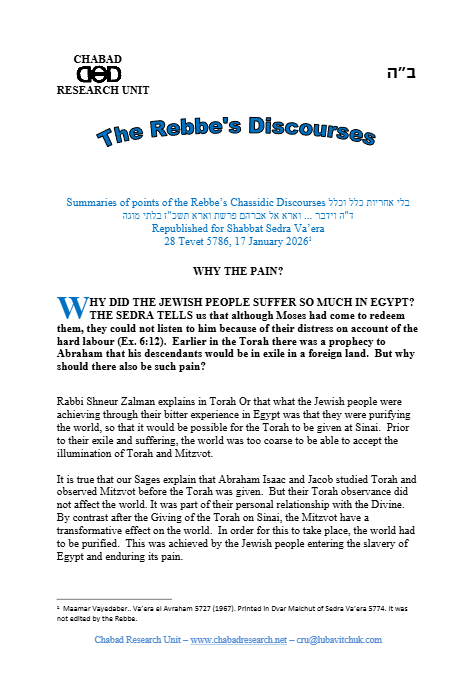
WHY DID THE JEWISH PEOPLE SUFFER SO MUCH IN EGYPT?

The Sedra tells us that although Moses had come to redeem them, they could not listen to him because of their distress on account of the hard labour (Ex. 6:12). Earlier in the Torah there was a prophecy to Abraham that his descendants would be in exile in a foreign land. But why should there also be such pain?

Rabbi Shneur Zalman explains in Torah Or that what the Jewish people were achieving through their bitter experience in Egypt was that they were purifying the world, so that it would be possible for the Torah to be given at Sinai. Prior to their exile and suffering, the world was too coarse to be able to accept the illumination of Torah and Mitzvot.

It is true that our Sages explain that Abraham Isaac and Jacob studied Torah and observed Mitzvot before the Torah was given. But their Torah observance did not affect the world. It was part of their personal relationship with the Divine. By contrast after the Giving of the Torah on Sinai, the Mitzvot have a transformative effect on the world. In order for this to take place, the world had to be purified. This was achieved by the Jewish people entering the slavery of Egypt and enduring its pain.

This idea emphasises the significance of the body. The soul comes from an exalted spiritual source and in itself, does not have to go through any transformative process such as ‘Tikkun’, repair. But the body does. That is why the Mitzvot are addressed to the soul within the body. This idea helps explain the pain of the Egyptian exile. The goal is that the physical body, in this physical world, should be illuminated with the exalted holiness of the soul, and even more. The Sages tell us that, ultimately, the spirituality of the body will feed the soul.

Why should pain be a factor? On one level, there is no answer. But the Zohar presents a teaching which Rabbi Shimon bar Yochai thought was very significant. “The head of the Yeshivah said: if a log does not radiate with fire – one breaks it up, and it bursts into flames. Similarly if the body does not reveal the light of the soul, one bruises it... Rabbi Shimon said ‘these are the words I was waiting for all my life’”

This passage in the Zohar has often been understood as encouraging asceticism. However, Hasidism, for the most part, rejected the earlier pietistic-kabbalistic forms of asceticism. Here the Rebbe is using this passage to explain the meaning of the pain of exile. The pain enables the body, the physicality of the Jewish people, to become a vehicle for holiness. Since the world connects with the Jewish people this enables the whole world to become a vehicle for holiness.

At the time of the Exodus from Egypt, the pain of exile was a crucial process enabling the Giving of the Torah. Today, our people have lived through incredible pain, especially in the events of the mid 20th century. This means nothing again of such a kind should or will ever happen again. But it also means that the world is prepared for Divine revelation. At Sinai the revealed aspect of Torah, the laws, was disclosed to the Jewish people. With the coming of Moshiach, the inner dimension of Torah, the meaning of the laws, will be revealed. Chassidic teachings are themselves a foretaste of this.

As an example of the process of spiritually transforming the body and the Animal Soul, the discourse includes a section about the daily prayers, based on a discourse by Rabbi Shneur Zalman.

Transformation Through Prayer

At the beginning of our prayers we say ‘My G-d, the soul which You put in me is pure...’. Who is the subject speaking? The Animal Soul, the intermediary between the body and the Divine Soul. It is speaking about the Divine Soul entering successive stages of existence, from the world of Atzilut to Creation, Formation and Action. This Divine Soul comes to help the Animal Soul be inspired and transformed in prayer.

During the Pesukei deZimra, the person, ie the Animal Soul, is excited and moved, he or she sings aloud and is moved. This is at the level of the ‘external’ emotions. They are inspired by the idea that ‘the closeness of G-d is good for me’ (Ps 73:28). The self is still present. Then in the Amidah, one is still. The inspiration here is simply the infinite greatness of G-d in Himself, utterly beyond the person. The person achieves a state of selflessness, bitul. This is the inwardness of the emotions, transcending what we generally call emotion. In this state the physicality of the person, and his or her Animal Soul, has become a vehicle for the Divine. This is an example of the transformation of the world which will take place in the time of Moshiach.

Torah teachings are holy – please treat these pages with care

PDF Preview