ABSTRACT Likkutei Sichos Part 1
Ben Chamesh L'Mikra | August 16, 2024
Print This Article
View Original PDF

ABSTRACT Likkutei Sichos Part 1

Ben Chamesh L'Mikra | June 25, 2025

We need to be living signposts to those in need of direction to the “refuge” of Torah. Torah speaks of the spiritual reality and we grasp it as an allusion to mundane matters. One who kills spiritually also needs a corresponding spiritual city of refuge.

Bring people close to Torah & not the other way around

Definition of the letter Aleph: Yud on top – G-d; Yud on bottom – A Jew; Line of yiras shemayim joins them.

The Torah due to its unlimited G-dliness permeates to our “heel”, even when involved in mundane matters. At Har Sinai the Divine Words had no echo since they were absorbed in all materials, and they remain for each generation; similarly, in the future times, spirituality will permeate all.

When one “happens” to be someone’s teacher, one must continue to teach to the end and finish the job

Students are called one’s children since obligated to listen to their teacher; also, the teacher is called a father since must strive like a father to take responsibility for their learning.

Middos & Mochin each have its own function, but the ultimate is to harness both and operate together

In Shmos, Tefillin of the head and of the arm appear as one mitzvah; In Devarim, they appear as two Mitzvos (see table on the final page).

  • Tefillin shel yad: yichuda tataah, face of Yehoshua like the moon, hearing, middos, it’hapcha
  • Tefillin shel rosh: yichuda ilaah, face of Moshe like the sun, seeing, mochin, it’hapcha

First Beis haMikdash had the advantage of a higher level of revelation (tzaddikim). Second Beis haMikdash had the advantage of worldly service (baalei Teshuvah). Third Beis haMikdash fuses both advantages and serves as a “comfort” for each.

Mishneh Shabbos concludes with laws which spiritually express the accomplishments of keeping Shabbos and being partners with HaShem. Permission (conditionally) to stop up, to measure & to tie.

  • צילות וביטול הקליפותאעליית המלכות מבי"ע ל פוקקין ליל שבת וינוחו בה
  • צילות אד (ז"א) גילוי מדות מודדין יום שבת וינוחו בו
  • צילות אגילוי המקשר ז"א ומלכות דקושרין מנחת שבת וינוחו בם

Through Torah, which is beyond change, one can overcome all external “changes” of time & place. The idea of unity out of diversity (day & night) lies at heart of the mitzvah of Shema (vs. Torah/bitul). Shema, at the beginning of the Mishnah, can overcome “Nidah”, the conclusion of the Mishnah.

Mitzvah of learning Torah (unifying one’s intellect with HaShem) is given with the concept of teaching one’s child; expresses the need for Bitul (קטן) in one’s learning.

Tefillin of HaShem contains the unity of the Jews, the “simple” Jews (shel yad) with the “wise ones” (shel rosh). Put on the head Tefillin when already wearing the hand Tefillin; general rule in Torah and Mitzvos that intellectual understanding must be preceded by fear and awe.
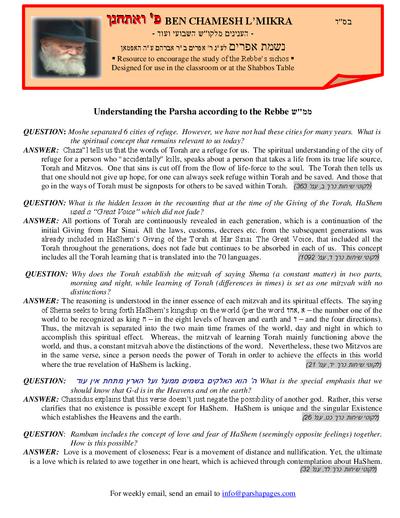

We need to be living signposts to those in need of direction to the “refuge” of Torah. Torah speaks of the spiritual reality and we grasp it as an allusion to mundane matters. One who kills spiritually also needs a corresponding spiritual city of refuge.

Bring people close to Torah & not the other way around

Definition of the letter Aleph: Yud on top – G-d; Yud on bottom – A Jew; Line of yiras shemayim joins them.

The Torah due to its unlimited G-dliness permeates to our “heel”, even when involved in mundane matters. At Har Sinai the Divine Words had no echo since they were absorbed in all materials, and they remain for each generation; similarly, in the future times, spirituality will permeate all.

When one “happens” to be someone’s teacher, one must continue to teach to the end and finish the job

Students are called one’s children since obligated to listen to their teacher; also, the teacher is called a father since must strive like a father to take responsibility for their learning.

Middos & Mochin each have its own function, but the ultimate is to harness both and operate together

In Shmos, Tefillin of the head and of the arm appear as one mitzvah; In Devarim, they appear as two Mitzvos (see table on the final page).

  • Tefillin shel yad: yichuda tataah, face of Yehoshua like the moon, hearing, middos, it’hapcha
  • Tefillin shel rosh: yichuda ilaah, face of Moshe like the sun, seeing, mochin, it’hapcha

First Beis haMikdash had the advantage of a higher level of revelation (tzaddikim). Second Beis haMikdash had the advantage of worldly service (baalei Teshuvah). Third Beis haMikdash fuses both advantages and serves as a “comfort” for each.

Mishneh Shabbos concludes with laws which spiritually express the accomplishments of keeping Shabbos and being partners with HaShem. Permission (conditionally) to stop up, to measure & to tie.

  • צילות וביטול הקליפותאעליית המלכות מבי"ע ל פוקקין ליל שבת וינוחו בה
  • צילות אד (ז"א) גילוי מדות מודדין יום שבת וינוחו בו
  • צילות אגילוי המקשר ז"א ומלכות דקושרין מנחת שבת וינוחו בם

Through Torah, which is beyond change, one can overcome all external “changes” of time & place. The idea of unity out of diversity (day & night) lies at heart of the mitzvah of Shema (vs. Torah/bitul). Shema, at the beginning of the Mishnah, can overcome “Nidah”, the conclusion of the Mishnah.

Mitzvah of learning Torah (unifying one’s intellect with HaShem) is given with the concept of teaching one’s child; expresses the need for Bitul (קטן) in one’s learning.

Tefillin of HaShem contains the unity of the Jews, the “simple” Jews (shel yad) with the “wise ones” (shel rosh). Put on the head Tefillin when already wearing the hand Tefillin; general rule in Torah and Mitzvos that intellectual understanding must be preceded by fear and awe.

PDF Preview