Honoring a Dangerous Request
Fascinating Insights | July 23, 2023
Print This Article
View Original PDF

Honoring a Dangerous Request

Fascinating Insights | December 31, 2025

The poskim deliberate as to whether there is a mitzva of kibud av in a case where the father commands his son to buy something for him that damages his health. An example of this is if the father tells his son to buy him cigarettes. Since there is a prohibition involved, maybe it is akin to the father telling his son to desecrate Shabbos where there is no mitzva to listen to him.

The Birkei Yosef writes that only something dangerous should he not listen to his father. If there is no danger, even if it damages him, then it is permitted. He makes this inference from the following Sefer Chassidim.

The Sefer Chassidim relates a story where a doctor came to heal a person who was sick. The doctor told him that if he drinks water or eats a certain food his life will be in danger. The father later told his son to bring him water and that food that the doctor instructed him not to eat. The father continued, “If you don't bring it, I will not forgive you in this world or in the next.” The son was told that he doesn’t need to listen to what his father said. So the inference is that only that which dangerous should he not listen to his father in contrast to where there is no danger but it damages him.

However, most Achronim cite this Sefer Chassidim and do not make the Birkei Yosef’s extrapolation. So seemingly even if it’s not life threatening but it counters the father’s health, the son doesn’t need to honor his father’s request. Rather he honors his father by the fact that he is guarding his father’s health.
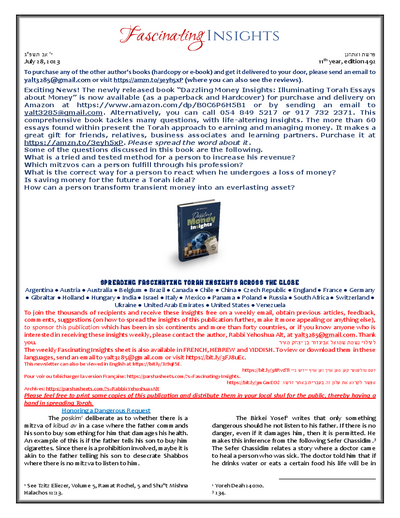

The poskim deliberate as to whether there is a mitzva of kibud av in a case where the father commands his son to buy something for him that damages his health. An example of this is if the father tells his son to buy him cigarettes. Since there is a prohibition involved, maybe it is akin to the father telling his son to desecrate Shabbos where there is no mitzva to listen to him.

The Birkei Yosef writes that only something dangerous should he not listen to his father. If there is no danger, even if it damages him, then it is permitted. He makes this inference from the following Sefer Chassidim.

The Sefer Chassidim relates a story where a doctor came to heal a person who was sick. The doctor told him that if he drinks water or eats a certain food his life will be in danger. The father later told his son to bring him water and that food that the doctor instructed him not to eat. The father continued, “If you don't bring it, I will not forgive you in this world or in the next.” The son was told that he doesn’t need to listen to what his father said. So the inference is that only that which dangerous should he not listen to his father in contrast to where there is no danger but it damages him.

However, most Achronim cite this Sefer Chassidim and do not make the Birkei Yosef’s extrapolation. So seemingly even if it’s not life threatening but it counters the father’s health, the son doesn’t need to honor his father’s request. Rather he honors his father by the fact that he is guarding his father’s health.

PDF Preview


