K’tiva Vachatima Tova May You Be Written and Sealed for Good
L’Chaim | July 28, 2023
Print This Article
View Original PDF

K’tiva Vachatima Tova May You Be Written and Sealed for Good

L’Chaim | December 31, 2025

Starting from the fifteenth of the Hebrew month of Av (this coming Wednesday), it’s a Jewish custom to wish each other in correspondence and in conversations: “K’tiva vachatima tova - may you be written and sealed for good.”

You may well be wondering, “Isn’t Monday a little early to start thinking about Rosh Hashana, let alone sending out holiday greetings? After all, it’s over six weeks until the High Holidays!”

What’s more, gift shops and supermarkets haven’t even yet set aside a place in their card racks for “Jewish New Year” cards!

Perhaps if we understand the value of each one of us blessing our friends and family we’ll come to realize that it’s not early at all!

Wishing friends and relatives a sweet, New Year, along with any other blessings you wish to include, is deeply rooted in Jewish tradition. “I will bless those who bless you,” G-d informed our illustrious ancestor Abraham. By blessing someone else, we precipitate receiving our own Divine blessing. The weeks before Rosh Hashana are an especially good time to “reach out and touch someone,” whether in person, via phone, social media or mail. When you offer the hope that they be inscribed and sealed for a good and sweet year, your are actualizing a blessing for yourself.

“But wait a minute. Who am I anyway to be blessing someone else?” you wonder. In the Talmud, Rabbi Elazar teaches, “Never let the blessing of even a common person be considered insignificant in your eyes.” For, as the Talmud continues, two great men, King David and the prophet Daniel, were blessed by simple people and those blessings were fulfilled.

Just how far does this concept of the value of a simple person’s blessing go?

The quote above is preceded in the Talmud by these words: Rabbi Ishmael ben Elisha, a High Priest said, “Once, when I entered the Holy of Holies, I beheld the Holy One and He said to me, ‘Ishmael, My son, bless Me!’ I said, ‘Sovereign of the Universe, may it be Your will that Your mercy overcome Your anger, and that Your compassion overrule Your attributes; let Your conduct toward Your children be with loving kindness... and may You overlook strict Judgment.’ The Holy One bowed His head to me [in confirmation].” According to the Talmud these words of Ishmael ben Elisha are the same prayers G-d, Himself, offers.

In this coming year, may we bless our friends and relatives – and thereby ourselves – with a year of mercy and compassion, loving kindness and the forgiving of transgressions, by one another and by G-d.
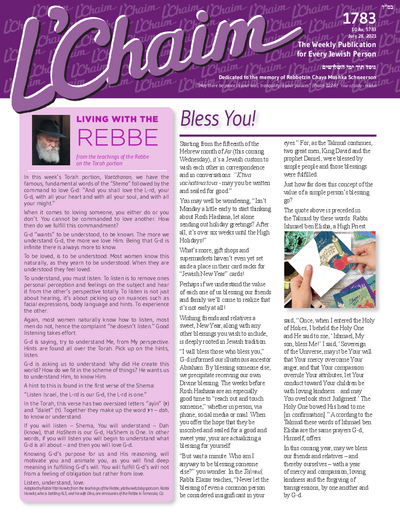
Starting from the fifteenth of the Hebrew month of Av (this coming Wednesday), it’s a Jewish custom to wish each other in correspondence and in conversations: “K’tiva vachatima tova - may you be written and sealed for good.”

You may well be wondering, “Isn’t Monday a little early to start thinking about Rosh Hashana, let alone sending out holiday greetings? After all, it’s over six weeks until the High Holidays!”

What’s more, gift shops and supermarkets haven’t even yet set aside a place in their card racks for “Jewish New Year” cards!

Perhaps if we understand the value of each one of us blessing our friends and family we’ll come to realize that it’s not early at all!

Wishing friends and relatives a sweet, New Year, along with any other blessings you wish to include, is deeply rooted in Jewish tradition. “I will bless those who bless you,” G-d informed our illustrious ancestor Abraham. By blessing someone else, we precipitate receiving our own Divine blessing. The weeks before Rosh Hashana are an especially good time to “reach out and touch someone,” whether in person, via phone, social media or mail. When you offer the hope that they be inscribed and sealed for a good and sweet year, your are actualizing a blessing for yourself.

“But wait a minute. Who am I anyway to be blessing someone else?” you wonder. In the Talmud, Rabbi Elazar teaches, “Never let the blessing of even a common person be considered insignificant in your eyes.” For, as the Talmud continues, two great men, King David and the prophet Daniel, were blessed by simple people and those blessings were fulfilled.

Just how far does this concept of the value of a simple person’s blessing go?

The quote above is preceded in the Talmud by these words: Rabbi Ishmael ben Elisha, a High Priest said, “Once, when I entered the Holy of Holies, I beheld the Holy One and He said to me, ‘Ishmael, My son, bless Me!’ I said, ‘Sovereign of the Universe, may it be Your will that Your mercy overcome Your anger, and that Your compassion overrule Your attributes; let Your conduct toward Your children be with loving kindness... and may You overlook strict Judgment.’ The Holy One bowed His head to me [in confirmation].” According to the Talmud these words of Ishmael ben Elisha are the same prayers G-d, Himself, offers.

In this coming year, may we bless our friends and relatives – and thereby ourselves – with a year of mercy and compassion, loving kindness and the forgiving of transgressions, by one another and by G-d.

PDF Preview