Lessons from our Gedolim
BET Journal | July 28, 2023
Print This Article
View Original PDF

Lessons from our Gedolim

BET Journal | December 31, 2025

The customs we observe on the day of Tisha B’Av are strikingly similar to those of an avel (mourner), one whose close relative has recently passed away. We abstain from washing ourselves and putting on perfume, from wearing leather shoes and talking frivolously. We even refrain from studying parts of Torah which are unrelated to the events and the mood of the day. Instead we sit on the floor or a low chair and solemnly contemplate the loss of the Beit HaMikdash, the First and Second Temples in Jerusalem.

On Tisha B’Av the sense of mourning and sadness is palpable. But, in truth, the observances of mourning begin long before Tisha B’Av itself. Already from the Seventeenth of Tamuz, at the start of the “Three Weeks” period, Ashkenazic communities minimize their involvement in pleasurable activities like getting married, taking haircuts and buying new clothing. From the beginning of the month of Av through Tisha B’Av, a period commonly referred to as the “Nine Days,” we refrain as well from doing laundry and from wearing freshly laundered clothing. Many men refrain from shaving. Tisha B’Av itself is certainly the most restrictive of the entire Three Weeks period, but the observances of aveilut (mourning) are not limited to that day alone.

Rav Yosef Dov Soloveitchik zt”l , (1903-1993) known to his many talmidim as the Rav, used to say that these three periods of time mirror the three periods of mourning that a child observes when losing a parent. Tisha B’Av is like the seven-day period of shiva when the sense of mourning is most intense. The “Nine Days” beginning with Rosh Chodesh Av are similar to the period of shloshim (30 days of mourning), and from the Seventeenth of Tammuz until the month of Av we observe laws of mourning similar to the twelve-month period of aveilut that a child observes after losing a parent.

What Mourning Means: Reflections of Rav Soloveitchik zt”l on the 3 Weeks and Tisha B’Av

Rabbi Eliakim Koenigsberg

What’s interesting, though, is that the order of observances is reversed. The child who loses a parent observes shiva first, then shloshim and then the twelve-month period of aveilut , while during the “Three Weeks” we first observe the aveilut of the twelve-month period, then shloshim, and only on Tisha B’Av do we keep to the restrictions of shiva. Why is the order changed when we mourn the loss of the Beit HaMikdash?

Differences in Mourning

The Rav explained that there is a fundamental difference between aveilut chadasha (newly occurring, personal mourning), as the Rabbis refer to it (Yevamot 43b), and aveilut yeshana (ancient, annual mourning for the Beit HaMikdash). When a close relative passes away, the grief, the pain, the sense of loss come naturally and easily. It is therefore most appropriate to begin the observances of aveilut with shiva, the most intense expression of mourning. But after seven days, the avel is ready to take a step back. Although his loss is still very much on his mind, nevertheless his emotions have tempered; his feelings of sorrow have lessened. For him, the observances of shloshim are more fitting. By the end of thirty days, the avel has gained perspective on his loss. For most relatives, he is now able to conclude the observances of aveilut . Even for a parent, while he continues to mourn, he still reduces his aveilut once again.

In the case of aveilut yeshana (an older mourning), on the other hand, this progression is out of place. We have become so used to living in a world without the Beit HaMikdash, that it would be unfair to expect anyone to begin the “Three Weeks” with the observances of shiva. It simply would be unnatural for anyone to suddenly break down and cry over the loss of the Beit HaMikdash. The sense of mourning for the destruction of the Beit HaMikdash can be internalized only through gradual increments. Only by slowly increasing our observances of aveilut from the Seventeenth of Tamuz through the Nine Days, while at the same time reflecting
The customs we observe on the day of Tisha B’Av are strikingly similar to those of an avel (mourner), one whose close relative has recently passed away. We abstain from washing ourselves and putting on perfume, from wearing leather shoes and talking frivolously. We even refrain from studying parts of Torah which are unrelated to the events and the mood of the day. Instead we sit on the floor or a low chair and solemnly contemplate the loss of the Beit HaMikdash, the First and Second Temples in Jerusalem.

On Tisha B’Av the sense of mourning and sadness is palpable. But, in truth, the observances of mourning begin long before Tisha B’Av itself. Already from the Seventeenth of Tamuz, at the start of the “Three Weeks” period, Ashkenazic communities minimize their involvement in pleasurable activities like getting married, taking haircuts and buying new clothing. From the beginning of the month of Av through Tisha B’Av, a period commonly referred to as the “Nine Days,” we refrain as well from doing laundry and from wearing freshly laundered clothing. Many men refrain from shaving. Tisha B’Av itself is certainly the most restrictive of the entire Three Weeks period, but the observances of aveilut (mourning) are not limited to that day alone.

Rav Yosef Dov Soloveitchik zt”l , (1903-1993) known to his many talmidim as the Rav, used to say that these three periods of time mirror the three periods of mourning that a child observes when losing a parent. Tisha B’Av is like the seven-day period of shiva when the sense of mourning is most intense. The “Nine Days” beginning with Rosh Chodesh Av are similar to the period of shloshim (30 days of mourning), and from the Seventeenth of Tammuz until the month of Av we observe laws of mourning similar to the twelve-month period of aveilut that a child observes after losing a parent.

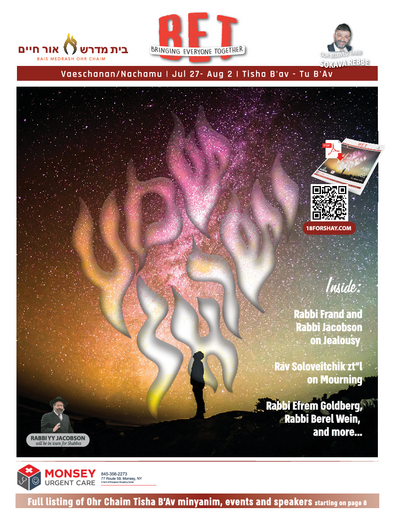
What Mourning Means: Reflections of Rav Soloveitchik zt”l on the 3 Weeks and Tisha B’Av

Rabbi Eliakim Koenigsberg

What’s interesting, though, is that the order of observances is reversed. The child who loses a parent observes shiva first, then shloshim and then the twelve-month period of aveilut , while during the “Three Weeks” we first observe the aveilut of the twelve-month period, then shloshim, and only on Tisha B’Av do we keep to the restrictions of shiva. Why is the order changed when we mourn the loss of the Beit HaMikdash?

Differences in Mourning

The Rav explained that there is a fundamental difference between aveilut chadasha (newly occurring, personal mourning), as the Rabbis refer to it (Yevamot 43b), and aveilut yeshana (ancient, annual mourning for the Beit HaMikdash). When a close relative passes away, the grief, the pain, the sense of loss come naturally and easily. It is therefore most appropriate to begin the observances of aveilut with shiva, the most intense expression of mourning. But after seven days, the avel is ready to take a step back. Although his loss is still very much on his mind, nevertheless his emotions have tempered; his feelings of sorrow have lessened. For him, the observances of shloshim are more fitting. By the end of thirty days, the avel has gained perspective on his loss. For most relatives, he is now able to conclude the observances of aveilut . Even for a parent, while he continues to mourn, he still reduces his aveilut once again.

In the case of aveilut yeshana (an older mourning), on the other hand, this progression is out of place. We have become so used to living in a world without the Beit HaMikdash, that it would be unfair to expect anyone to begin the “Three Weeks” with the observances of shiva. It simply would be unnatural for anyone to suddenly break down and cry over the loss of the Beit HaMikdash. The sense of mourning for the destruction of the Beit HaMikdash can be internalized only through gradual increments. Only by slowly increasing our observances of aveilut from the Seventeenth of Tamuz through the Nine Days, while at the same time reflecting

PDF Preview