Not Like a Goy Would Think
Hashgacha Pratis | August 04, 2025
Print This Article
View Original PDF

Not Like a Goy Would Think

Hashgacha Pratis | December 10, 2025

Which type of organ would have the most influence on a person’s life – one that is gentle and sensitive, or one that is hard and strong? If you would ask a young child this question, he probably would answer that a gentle, sensitive organ is much less influential than a strong one. He would say that the stronger an organ is, the more important it is and the more it influences a person’s health.

If you ask an adult this question, he will almost certainly think of the heart. Of course, a person’s heart is relatively small and it is definitely sensitive, but human life is totally dependent on it. No one would consider allowing his heart to take a break from its functions, even for a few seconds.

The Zohar to parashas Pinchas tells that a goy once asked Rabi Elazar the following: The people of Yisrael claim to be the nation that Hashem favors the most, so why is it that they are the nation that suffers more than any other? You can’t even compare their suffering to that of other nations! It must be that Hashem favors the other nations more than He favors Yisrael, and because of that they must suffer more than all others.

The goy’s way of thinking is that a king imposes hardships on those he loves the least, and he grants those closer to him an easy life. But Rabi Elazar replied that the heart is the most critically important of all the body’s organs. It delivers life-giving blood to all the other body parts, and so it is the most influential organ, despite the fact that it is soft and sensitive.

Consider the punishment Hashem decreed on the serpent in Gan Eden: “you shall eat dust all the days of your life.” The most terrible curse is to become detached from Hakadosh Baruch Hu, to feel that one is not dependent on His assistance and that there is no need to daven for it. The serpent was cursed by the decree that all its needs would be readily available wherever it might turn. It will never need to search for its sustenance, and so it is severed from Hashem’s Presence.

The entire world is dependent on Am Yisrael, but Am Yisrael is the nation that feels the most dependent on Hashem. It is precisely because Hashem cares the most about Bnei Yisrael that He constantly punishes them when it is warranted and pushes them to improve themselves. He wants to hear them pray and plead for His assistance, and He listens to their prayers. He helps, protects, and provides their needs with perfect, precise hashgachah.

This is true of Am Yisrael as a whole, and it is true of every individual Jew. Everyone has his own challenges and crises, both physical and spiritual. It can happen that a person breaks from the pressure and begins to think that his problems prove that Hashem is distant from him.

Rabi Elazar taught us, however, that quite the opposite is true. The most sensitive, seemingly weakest organ is also the most influential one, and a Jew’s challenges and hardships are a clear sign of Hashem’s love and care for him.

Gut Shabbat
Pinchas Shefer
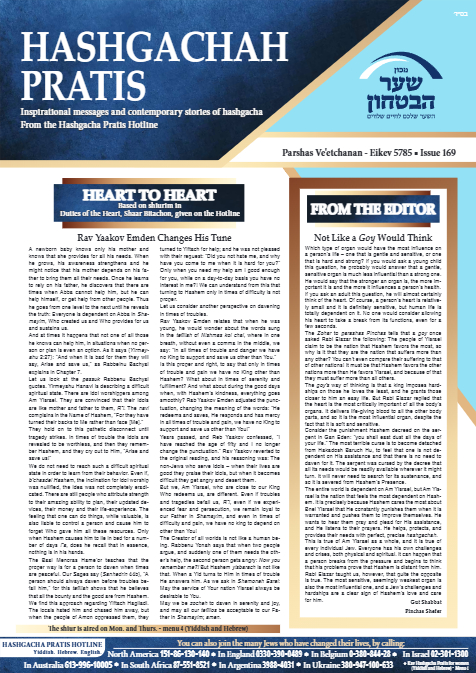
Which type of organ would have the most influence on a person’s life – one that is gentle and sensitive, or one that is hard and strong? If you would ask a young child this question, he probably would answer that a gentle, sensitive organ is much less influential than a strong one. He would say that the stronger an organ is, the more important it is and the more it influences a person’s health.

If you ask an adult this question, he will almost certainly think of the heart. Of course, a person’s heart is relatively small and it is definitely sensitive, but human life is totally dependent on it. No one would consider allowing his heart to take a break from its functions, even for a few seconds.

The Zohar to parashas Pinchas tells that a goy once asked Rabi Elazar the following: The people of Yisrael claim to be the nation that Hashem favors the most, so why is it that they are the nation that suffers more than any other? You can’t even compare their suffering to that of other nations! It must be that Hashem favors the other nations more than He favors Yisrael, and because of that they must suffer more than all others.

The goy’s way of thinking is that a king imposes hardships on those he loves the least, and he grants those closer to him an easy life. But Rabi Elazar replied that the heart is the most critically important of all the body’s organs. It delivers life-giving blood to all the other body parts, and so it is the most influential organ, despite the fact that it is soft and sensitive.

Consider the punishment Hashem decreed on the serpent in Gan Eden: “you shall eat dust all the days of your life.” The most terrible curse is to become detached from Hakadosh Baruch Hu, to feel that one is not dependent on His assistance and that there is no need to daven for it. The serpent was cursed by the decree that all its needs would be readily available wherever it might turn. It will never need to search for its sustenance, and so it is severed from Hashem’s Presence.

The entire world is dependent on Am Yisrael, but Am Yisrael is the nation that feels the most dependent on Hashem. It is precisely because Hashem cares the most about Bnei Yisrael that He constantly punishes them when it is warranted and pushes them to improve themselves. He wants to hear them pray and plead for His assistance, and He listens to their prayers. He helps, protects, and provides their needs with perfect, precise hashgachah.

This is true of Am Yisrael as a whole, and it is true of every individual Jew. Everyone has his own challenges and crises, both physical and spiritual. It can happen that a person breaks from the pressure and begins to think that his problems prove that Hashem is distant from him.

Rabi Elazar taught us, however, that quite the opposite is true. The most sensitive, seemingly weakest organ is also the most influential one, and a Jew’s challenges and hardships are a clear sign of Hashem’s love and care for him.

Gut Shabbat
Pinchas Shefer

PDF Preview