Rav Yaakov Emden Changes His Tune
Hashgacha Pratis | August 04, 2025
Print This Article
View Original PDF

Rav Yaakov Emden Changes His Tune

Hashgacha Pratis | December 10, 2025

A newborn baby knows only his mother and knows that she provides for all his needs. When he grows, his awareness strengthens and he might notice that his mother depends on his father to bring them all their needs. Once he learns to rely on his father, he discovers that there are times when Abba cannot help him, but he can help himself, or get help from other people. Thus he goes from one level to the next until he reveals the truth: Everyone is dependent on Abba in Shamayim, Who created us and Who provides for us and sustains us.

And at times it happens that not one of all those he knows can help him, in situations when no person or plan is even an option. As it says (Yirmeyahu 2:27): “And when it is bad for them they will say, Arise and save us,” as Rabbeinu Bachyai explains in Chapter 7.

Let us look at the passuk Rabbenu Bachyai quotes. Yirmeyahu Hanavi is describing a difficult spiritual state. There are idol worshippers among Am Yisrael. They are convinced that their idols are like mother and father to them, R”l. The navi complains in the Name of Hashem, “For they have turned their backs to Me rather than face [Me].”

They hold on to this pathetic disconnect until tragedy strikes. In times of trouble the idols are revealed to be worthless, and then they remember Hashem, and they cry out to Him, “Arise and save us!”

We do not need to reach such a difficult spiritual state in order to learn from their behavior. Even if, b’chasdei Hashem, the inclination for idol worship was nullified, the idea was not completely eradicated. There are still people who attribute strength to their amazing ability to plan, their updated devices, their money and their life-experience. The feeling that one can do things, while valuable, is also liable to control a person and cause him to forget Who gave him all these resources. Only when Hashem causes him to lie in bed for a number of days l”a, does he recall that in essence, nothing is in his hands.

The Baal Menoras Hame’or teaches that the proper way is for a person to daven when times are peaceful. Our Sages say (Sanhedrin 44b), “A person should always daven before troubles befall him,” for this tefillah shows that he believes that all the bounty and the good are from Hashem.

We find this approach regarding Yiftach Hagiladi. The locals hated him and chased him away, but when the people of Amon oppressed them, they turned to Yiftach for help; and he was not pleased with their request: “Did you not hate me, and why have you come to me when it is hard for you?” Only when you need my help am I good enough for you, while on a day-to-day basis you have no interest in me?! We can understand from this that turning to Hashem only in times of difficulty is not proper.

Let us consider another perspective on davening in times of troubles.

Rav Yaakov Emden relates that when he was young, he would wonder about the words sung in the tefillah of Nishmas kol chai, where in one breath, without even a comma in the middle, we say: “In all times of trouble and danger we have no King to support and save us other than You.”

Is this proper and right, to say that only in times of trouble and pain we have no King other than Hashem? What about in times of serenity and fulfillment? And what about during the good days when, with Hashem’s kindness, everything goes smoothly? Rab Yaakov Emden adjusted the punctuation, changing the meaning of the words: “He redeems and saves, He responds and has mercy in all times of trouble and pain, we have no King to support and save us other than You!”

Years passed, and Reb Yaakov confessed, “I have reached the age of fifty and I no longer change the punctuation.” Rav Yaakov reverted to the original reading, and his reasoning was: The non-Jews who serve idols – when their lives are good they praise their idols, but when it becomes difficult they get angry and desert them.

But we, Am Yisrael, who are close to our King Who redeems us, are different. Even if troubles and tragedies befall us, R”l, even if we experienced fear and persecution, we remain loyal to our Father in Shamayim, and even in times of difficulty and pain, we have no king to depend on other than You!

The Creator of all worlds is not like a human being. Rabbenu Yonah says that when two people argue, and suddenly one of them needs the other’s help, the second person gets angry: Now you remember me?! But Hashem yisbarach is not like that. When a Yid turns to Him in times of trouble He answers him. As we ask in Shemoneh Esrei: May the service of Your nation Yisrael always be desirable to You.

May we be zocheh to daven in serenity and joy, and may all our tefillos be acceptable to our Father in Shamayim; amen.
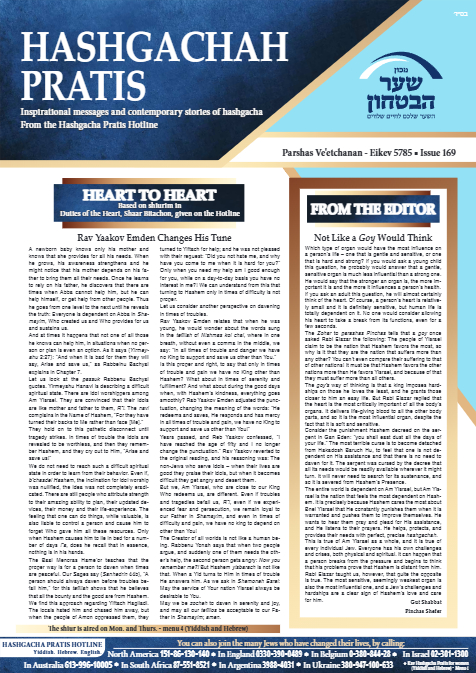

A newborn baby knows only his mother and knows that she provides for all his needs. When he grows, his awareness strengthens and he might notice that his mother depends on his father to bring them all their needs. Once he learns to rely on his father, he discovers that there are times when Abba cannot help him, but he can help himself, or get help from other people. Thus he goes from one level to the next until he reveals the truth: Everyone is dependent on Abba in Shamayim, Who created us and Who provides for us and sustains us.

And at times it happens that not one of all those he knows can help him, in situations when no person or plan is even an option. As it says (Yirmeyahu 2:27): “And when it is bad for them they will say, Arise and save us,” as Rabbeinu Bachyai explains in Chapter 7.

Let us look at the passuk Rabbenu Bachyai quotes. Yirmeyahu Hanavi is describing a difficult spiritual state. There are idol worshippers among Am Yisrael. They are convinced that their idols are like mother and father to them, R”l. The navi complains in the Name of Hashem, “For they have turned their backs to Me rather than face [Me].”

They hold on to this pathetic disconnect until tragedy strikes. In times of trouble the idols are revealed to be worthless, and then they remember Hashem, and they cry out to Him, “Arise and save us!”

We do not need to reach such a difficult spiritual state in order to learn from their behavior. Even if, b’chasdei Hashem, the inclination for idol worship was nullified, the idea was not completely eradicated. There are still people who attribute strength to their amazing ability to plan, their updated devices, their money and their life-experience. The feeling that one can do things, while valuable, is also liable to control a person and cause him to forget Who gave him all these resources. Only when Hashem causes him to lie in bed for a number of days l”a, does he recall that in essence, nothing is in his hands.

The Baal Menoras Hame’or teaches that the proper way is for a person to daven when times are peaceful. Our Sages say (Sanhedrin 44b), “A person should always daven before troubles befall him,” for this tefillah shows that he believes that all the bounty and the good are from Hashem.

We find this approach regarding Yiftach Hagiladi. The locals hated him and chased him away, but when the people of Amon oppressed them, they turned to Yiftach for help; and he was not pleased with their request: “Did you not hate me, and why have you come to me when it is hard for you?” Only when you need my help am I good enough for you, while on a day-to-day basis you have no interest in me?! We can understand from this that turning to Hashem only in times of difficulty is not proper.

Let us consider another perspective on davening in times of troubles.

Rav Yaakov Emden relates that when he was young, he would wonder about the words sung in the tefillah of Nishmas kol chai, where in one breath, without even a comma in the middle, we say: “In all times of trouble and danger we have no King to support and save us other than You.”

Is this proper and right, to say that only in times of trouble and pain we have no King other than Hashem? What about in times of serenity and fulfillment? And what about during the good days when, with Hashem’s kindness, everything goes smoothly? Rab Yaakov Emden adjusted the punctuation, changing the meaning of the words: “He redeems and saves, He responds and has mercy in all times of trouble and pain, we have no King to support and save us other than You!”

Years passed, and Reb Yaakov confessed, “I have reached the age of fifty and I no longer change the punctuation.” Rav Yaakov reverted to the original reading, and his reasoning was: The non-Jews who serve idols – when their lives are good they praise their idols, but when it becomes difficult they get angry and desert them.

But we, Am Yisrael, who are close to our King Who redeems us, are different. Even if troubles and tragedies befall us, R”l, even if we experienced fear and persecution, we remain loyal to our Father in Shamayim, and even in times of difficulty and pain, we have no king to depend on other than You!

The Creator of all worlds is not like a human being. Rabbenu Yonah says that when two people argue, and suddenly one of them needs the other’s help, the second person gets angry: Now you remember me?! But Hashem yisbarach is not like that. When a Yid turns to Him in times of trouble He answers him. As we ask in Shemoneh Esrei: May the service of Your nation Yisrael always be desirable to You.

May we be zocheh to daven in serenity and joy, and may all our tefillos be acceptable to our Father in Shamayim; amen.

PDF Preview