Shabbos Nachamu
Project Likkutei Sichos | July 27, 2023
Print This Article
View Original PDF

Shabbos Nachamu

Project Likkutei Sichos | December 31, 2025

The Story:

Tractate Makkos concludes with two stories concerning Rabbi Akiva’s unusual reaction to tragedy: “Once Rabbi Gamliel, Rabbi Elazar ben Azariah, Rabbi Joshua, and Rabbi Akiva were traveling together, when they heard the sounds of Rome from the plaza one hundred and twenty mil away. They started to cry, but Rabbi Akiva was laughing. They said to him, “For what reason are you laughing?”

He said to them, “And you, why do you weep?”

They told him, “These heathens that bow down to wood and burn incense to idols live in safety and ease, while our home, the “Footstool of our G-d,” is burned down by fire. Should we not weep?”

He replied, “For that reason I laugh. If this is what happens to those who transgress His will, how much more so [awaits] those who fulfill His will!”

Another time, they were ascending to Jerusalem together. When they came to Mt. Scopus [from where they could see the ruin of the Temple] they tore their clothes [as the law prescribes, Rabbeinu Gershom]. When they reached the Temple Mount, they saw a fox emerging from the place of the Holy of Holies. They started to cry, but Rabbi Akiva was laughing.

They said to him, “Why are you laughing?”

He said to them, “Why do you weep?”

They replied, “The place about which was written “And the non-Kohen that draws near shall be put to death,” is now a haunt of foxes. Should we not weep?”

He replied, “For that reason I laugh. It is written, “And I will take unto Me faithful witnesses to record, Uriah the priest, and Zechariah the son of Yeberechaihu.” Now what connection was there between this Uriah and Zechariah? Uriah lived during the times of the first Temple, while Zechariah lived [and prophesied] during the second Temple; but scripture was making the prophecy of Zechariah dependent on the prophecy of Uriah.

Regarding Uriah, it is written, “Therefore, because of you, Zion shall be plowed as a field.” In Zechariah it is written, “There shall yet be old men and women in the squares of Jerusalem.”

So long as the Uriah’s [threatening] prophecy had not been fulfilled, I was afraid that Zechariah’s [positive] prophecy would likewise remain unfulfilled. Now that Uriah’s prophecy was fulfilled, I know that the prophecy of Zechariah will be fulfilled.”

They said to him these words: “Akiva, you have comforted us. Akiva, you have comforted us.” (Makkos 24a)

The Questions:

Why does Rabbi Akiva need to ask his colleagues why they are crying? The devastation is obvious. In the second episode, even Rabbi Akiva tears his garment as the law prescribes, he, too, feels the destruction. He knows exactly why they are crying!

Secondly, of all of Uriah’s prophecies about Jerusalem’s destruction, why does Rabbi Akiva specifically quote the one that likens Jerusalem to a plowed field?

The Explanation - First Episode:

Rabbi Akiva was asking his colleagues why their tears were prompted at these times specifically. They knew of the destruction, they experienced it, why were they crying now? In the first episode, they answered that while they had disgusted the destruction, they could not cope with Rome’s success and freedom, in contrast with Israel’s devastation. The added insult of Rome’s boisterous market brought them to tears.

Rabbi Akiva answered that he was not perturbed by this, for Rome’s success only means that there will be even greater prosperity and happiness in store for the Jewish people in the future.

This amounts to a philosophical and legal disagreement about the present and the future. Rabbi Akiva is willing to tolerate a negative present because it will bring a greater future. But the sages cannot condone the present hardship just because of some value in the future. The present predicament outweighs the future and is cause for tears.

This disagreement is seen in various halachic contexts: when a minor violation in the present will allow a greater observance in the future, do we allow the present violation by appealing to the future consideration, or do we only concern ourselves with the present violation? Rabbi Akiva and the sages disagreed on this question.

Second Episode:

In the second episode, Rabbi Akiva again asked why they cried only at the site of the fox and not earlier, at the sight of the destruction itself. The sage explained that what prompted their tears was the extent of the disrespect shown to the place of the Temple.

To console them, Rabbi Akiva cited Uriah’s prophecy that Zion will be plowed as a field. The objective of plowing is to overturn the soil in order to plant crops in the future. The destruction of the plow in the field is part of the process of creating a nourishing crop. Rabbi Akiva was telling his companions that the destruction in all its ugliness was one part of the process, the plowing of the field, that was leading to the greater growth of the field once again in the future. The two prophecies are not distinct, they are part of the same testimony, the same process of rebirth.

The sages then responded, “Akiva, you have comforted us. Akiva, you have comforted us.” Akiva comforted the sages twice, once in regards to the future redemption, but also in regards to the destruction itself. With Rabbi Akiva’s explanation, the destruction became part of the comforting narrative of plowing and rebirth.

Of all the sages it was Rabbi Akiva who was best positioned to offer this comfort, to see the future growth in the present destruction, because he had seen this in his own life. Akiva was a descendant of converts, and he himself was initiated in Torah study at the advanced age of forty. A convert is someone who transforms the darkness into light, they can see the darkness and destruction as leading to light and revelation. And as one who began studying late, he was able to appreciate the future possibilities and not be held back by the present darkness.

***
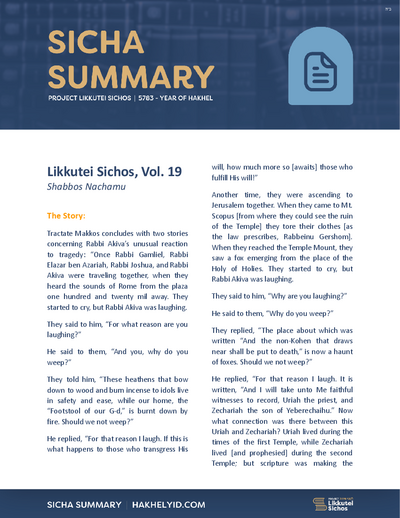
The Story:

Tractate Makkos concludes with two stories concerning Rabbi Akiva’s unusual reaction to tragedy: “Once Rabbi Gamliel, Rabbi Elazar ben Azariah, Rabbi Joshua, and Rabbi Akiva were traveling together, when they heard the sounds of Rome from the plaza one hundred and twenty mil away. They started to cry, but Rabbi Akiva was laughing. They said to him, “For what reason are you laughing?”

He said to them, “And you, why do you weep?”

They told him, “These heathens that bow down to wood and burn incense to idols live in safety and ease, while our home, the “Footstool of our G-d,” is burned down by fire. Should we not weep?”

He replied, “For that reason I laugh. If this is what happens to those who transgress His will, how much more so [awaits] those who fulfill His will!”

Another time, they were ascending to Jerusalem together. When they came to Mt. Scopus [from where they could see the ruin of the Temple] they tore their clothes [as the law prescribes, Rabbeinu Gershom]. When they reached the Temple Mount, they saw a fox emerging from the place of the Holy of Holies. They started to cry, but Rabbi Akiva was laughing.

They said to him, “Why are you laughing?”

He said to them, “Why do you weep?”

They replied, “The place about which was written “And the non-Kohen that draws near shall be put to death,” is now a haunt of foxes. Should we not weep?”

He replied, “For that reason I laugh. It is written, “And I will take unto Me faithful witnesses to record, Uriah the priest, and Zechariah the son of Yeberechaihu.” Now what connection was there between this Uriah and Zechariah? Uriah lived during the times of the first Temple, while Zechariah lived [and prophesied] during the second Temple; but scripture was making the prophecy of Zechariah dependent on the prophecy of Uriah.

Regarding Uriah, it is written, “Therefore, because of you, Zion shall be plowed as a field.” In Zechariah it is written, “There shall yet be old men and women in the squares of Jerusalem.”

So long as the Uriah’s [threatening] prophecy had not been fulfilled, I was afraid that Zechariah’s [positive] prophecy would likewise remain unfulfilled. Now that Uriah’s prophecy was fulfilled, I know that the prophecy of Zechariah will be fulfilled.”

They said to him these words: “Akiva, you have comforted us. Akiva, you have comforted us.” (Makkos 24a)

The Questions:

Why does Rabbi Akiva need to ask his colleagues why they are crying? The devastation is obvious. In the second episode, even Rabbi Akiva tears his garment as the law prescribes, he, too, feels the destruction. He knows exactly why they are crying!

Secondly, of all of Uriah’s prophecies about Jerusalem’s destruction, why does Rabbi Akiva specifically quote the one that likens Jerusalem to a plowed field?

The Explanation - First Episode:

Rabbi Akiva was asking his colleagues why their tears were prompted at these times specifically. They knew of the destruction, they experienced it, why were they crying now? In the first episode, they answered that while they had disgusted the destruction, they could not cope with Rome’s success and freedom, in contrast with Israel’s devastation. The added insult of Rome’s boisterous market brought them to tears.

Rabbi Akiva answered that he was not perturbed by this, for Rome’s success only means that there will be even greater prosperity and happiness in store for the Jewish people in the future.

This amounts to a philosophical and legal disagreement about the present and the future. Rabbi Akiva is willing to tolerate a negative present because it will bring a greater future. But the sages cannot condone the present hardship just because of some value in the future. The present predicament outweighs the future and is cause for tears.

This disagreement is seen in various halachic contexts: when a minor violation in the present will allow a greater observance in the future, do we allow the present violation by appealing to the future consideration, or do we only concern ourselves with the present violation? Rabbi Akiva and the sages disagreed on this question.

Second Episode:

In the second episode, Rabbi Akiva again asked why they cried only at the site of the fox and not earlier, at the sight of the destruction itself. The sage explained that what prompted their tears was the extent of the disrespect shown to the place of the Temple.

To console them, Rabbi Akiva cited Uriah’s prophecy that Zion will be plowed as a field. The objective of plowing is to overturn the soil in order to plant crops in the future. The destruction of the plow in the field is part of the process of creating a nourishing crop. Rabbi Akiva was telling his companions that the destruction in all its ugliness was one part of the process, the plowing of the field, that was leading to the greater growth of the field once again in the future. The two prophecies are not distinct, they are part of the same testimony, the same process of rebirth.

The sages then responded, “Akiva, you have comforted us. Akiva, you have comforted us.” Akiva comforted the sages twice, once in regards to the future redemption, but also in regards to the destruction itself. With Rabbi Akiva’s explanation, the destruction became part of the comforting narrative of plowing and rebirth.

Of all the sages it was Rabbi Akiva who was best positioned to offer this comfort, to see the future growth in the present destruction, because he had seen this in his own life. Akiva was a descendant of converts, and he himself was initiated in Torah study at the advanced age of forty. A convert is someone who transforms the darkness into light, they can see the darkness and destruction as leading to light and revelation. And as one who began studying late, he was able to appreciate the future possibilities and not be held back by the present darkness.

***

PDF Preview