Shamor V'Zachor
Parsha Pages | August 04, 2012
SHAMOR V’ZACHOR
דברים פרק ה יב שָמוֹר אֶת-יוֹם הַשַבָת לְקַדְשוֹ כַאֲשֶר צִוְּךָ יְהוָֹה אֱלֹהֶיךָ :
Shavous 20b: "Zachor” (mention Shabbos, i.e. in Kiddush) and "Shamor” (guard Shabbos, i.e. don't do Melachah) were said simultaneously, something that only HaShem could do.
HaShem stated the 10 Commandments at Har Sinai (Shmos 20) and Moshe stated them again in “Mishneh Torah” (Devarim 5). Many differences exist (listed in Ibn Ezra).
Why does Chaza”l specify this particular difference (Shamor and Zachor)?
- Rambam: Since Moshe selected a form to indicate a mitzvah not to do, he would not have changed unnecessarily from the positive mitzvah format the HaShem used. Therefore, Chaza”l understood that was a unique change indicating that the words were said simultaneously.
- Ikarim: Special nature of Shabbos; remember the aspect that Shabbos commemorates the Creation while also guarding the fact the HaShem continues to be involved as exemplified by the Going Out of Egypt.
- Mizrachi: This derivation teaches the tradition of Chaza”l that women were also obligated in Kiddush of Shabbos (which is not derived from any other source).
- Gur Aryeh: Chaza”l only taught this concept of simultaneous communication about a main mitzvah (Shabbos) and not regarding the other “minor” differences.
- Torah Temimah: The specific case of Shabbos is different. Shamor and Zachor do not in fact contradict one another. “Remember” refers to the period prior to or at the onset of Shabbos, while “Observes” refers to its conclusion. From this, the Rabbis inferred that “one adds from the holy to the mundane.” That is, one observes all the stringencies of Shabbos during the twilight hours of both Friday and Saturday, even though this involves a logical contradiction. The fact that we observe Shabbos for somewhat more than 24 hours stretches the common-sense definition of a “day.”
Which word(s) (Shamor/Zachor) appeared on the Luchos?
- Ibn Ezra (1): First Luchos (that Moshe shattered) were written per Shmos; the second Luchos (that Moshe brought down after 120 days) were written as stated in Devarim.
- Ibn Ezra (2): On both sets of Luchos were written the same words; however, within each set one Luach had two columns as written in Shmos, with the second Luach having two columns as written in Devarim.
- Ibn Ezra (3): On both sets of the Luchos, were written the words from Shmos; except for the one exception that one Luach contained the word Shamor in place of Zachor.
- Ramban: On both sets of the Luchos were written the words from Shmos; Moshe just explained that Shamor was also intended, just not said.
- Rashi: Zachor and Shamor were communicated as one word; possibly to mean that each set of Luchos contained both words together in a means of אלקבץ וזאמורה.
- R’ Kaminetzki: Both sets of Luchos contained Shamor and did not mention Zachor at all (see Shabbos morning Tefilah); Zachor was sort of a “Kri” (spoken but not written).
What is the reference in the verse “according to that which HaShem already commanded”?
- Rashi: Refers to before the giving of the Torah, at the place of Morah, where (some of) the laws of Shabbos were given by Moshe to the Jews.
- Ibn Ezra, Rashbam, Chizkuni: Simply refers to the giving of Shabbos at Har Sinai as recorded in the first set of 10 Commandments. The term “tzivuy” is used for Shabbos and honoring one’s parents (and not the other 8 commandments that were also mentioned at Har Sinai) since this term only used regarding these two positive mitzvos.
- Meschech Chochmah: The reference is to the derivation stated by the Ramban (on VaYikra 23,24). The words, “And the Shabboson should be to you”, (besides the 39 restricted acts of Shabbos) empowered the Rabbis with deciding which acts are also restricted on Shabbos because they take away from the sanctity of the day. Thus, the Rabbis instituted: restrictions on business transactions, muktzah, etc. At the time of the first Proclamation, these restrictions had no practical difference to the Jews. However, at the second Proclamation when the Jews were ready to enter “regular” life in Eretz Yisrael, they now had meaning to the Jews.
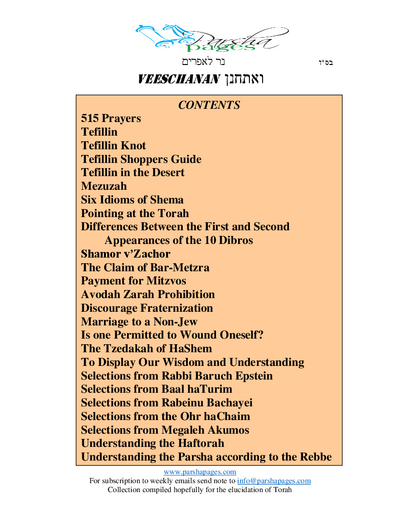
View The Full Article (PDF)
Related Articles

The Dearness of the Jewish Soul
Project Likkutei Sichos • Acharei Mos-Kedoshim

The Dearness of the Jewish Soul
Lessons in Likutay Torah • Acharei Mos-Kedoshim

Purpose of this Sefer
Nefesh Shimshon • Terumah

Differences between the First and Second Appearances of the Ten Commandments
Parsha Pages • Va'etchanan

Tefillin
Parsha Pages • Va'etchanan