Uplifting the Sparks
Ben Chamesh L'Mikra | July 23, 2023
Print This Article
View Original PDF

Uplifting the Sparks

Ben Chamesh L'Mikra | December 31, 2025

There is another important lesson to be learned from the fact that the voice of the Giving of the Torah divided into seventy languages.

Concerning the purpose of exile the Talmud states:

Text 8
The Holy One, blessed be He, did not exile Israel among the nations save in order that proselytes might join them, for it is said: “And I will sow her unto Me in the land; surely a man sows a se'ah in order to harvest many kor!”
Talmud, Pesachim 87b

The intent of this statement is not only in regard to actual converts but in reference to uplifting the sparks of holiness that are found throughout the exile. When the Jewish people refine the world around them in exile, they uplift the sparks of G-dliness and create converts.

When a Jewish person conducts his business in the proper way that Torah directs using a secular language or when he learns Torah in a secular language, he uplifts those languages as well and transforms them to G-dliness.

A person, though, is inclined to assume that while true that the Torah which he learns in other languages is indeed holy, it nevertheless is not as holy as learning Torah in the original Hebrew.

To negate this mistake, the Torah states that the voice at the Giving of the Torah was “a great voice, which did not cease.” That the same great voice that was stated in Hebrew subsequently divided into the seventy languages so that they too are exactly like the voice that was heard on Sinai.

In truth, there is an advantage of learning Torah in other languages, as it is more elevated to a degree. All of the above is the intent of the first two explanations of the Medrash—that of the voice splitting into seventy languages and that from it prophesized all subsequent prophets. What, however, is the lesson in the idea that the voice had no echo?
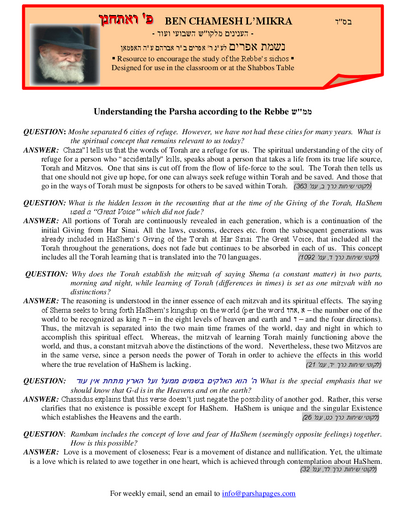

There is another important lesson to be learned from the fact that the voice of the Giving of the Torah divided into seventy languages.

Concerning the purpose of exile the Talmud states:

Text 8
The Holy One, blessed be He, did not exile Israel among the nations save in order that proselytes might join them, for it is said: “And I will sow her unto Me in the land; surely a man sows a se'ah in order to harvest many kor!”
Talmud, Pesachim 87b

The intent of this statement is not only in regard to actual converts but in reference to uplifting the sparks of holiness that are found throughout the exile. When the Jewish people refine the world around them in exile, they uplift the sparks of G-dliness and create converts.

When a Jewish person conducts his business in the proper way that Torah directs using a secular language or when he learns Torah in a secular language, he uplifts those languages as well and transforms them to G-dliness.

A person, though, is inclined to assume that while true that the Torah which he learns in other languages is indeed holy, it nevertheless is not as holy as learning Torah in the original Hebrew.

To negate this mistake, the Torah states that the voice at the Giving of the Torah was “a great voice, which did not cease.” That the same great voice that was stated in Hebrew subsequently divided into the seventy languages so that they too are exactly like the voice that was heard on Sinai.

In truth, there is an advantage of learning Torah in other languages, as it is more elevated to a degree. All of the above is the intent of the first two explanations of the Medrash—that of the voice splitting into seventy languages and that from it prophesized all subsequent prophets. What, however, is the lesson in the idea that the voice had no echo?

PDF Preview


