Washing Clothes on Motzei Tisha BAv
Limuday Moshe | July 23, 2023
Print This Article
View Original PDF

Washing Clothes on Motzei Tisha BAv

Limuday Moshe | December 31, 2025

The Gemara (Ta’anis 29a) records the following: “On the Seventh of Av, the gentiles entered the Beis HaMikdosh and spent three days feasting and contaminating it. As the sun was setting on the Ninth of Av, they set the Beis HaMikdosh ablaze, and it continued to burn for the entire next day.” (The Shulchan Aruch notes that the Beis HaMikdosh burned the entire Tenth of Av, with the fire finally going out as the sun set on the Tenth.) Because of this event, Rabbi Yochanan declared that had he been alive at the time of the churban [destruction], he would have declared the fast on the Tenth of Av, rather than the Ninth. He felt that the main mourning should be on the day that the Beis HaMikdosh was actually destroyed rather than on the day that the tragedy began.

The halachah does not follow Rabbi Yochanan: the main observance is on the Ninth, when the destruction began. Nevertheless, the custom is to observe the Tenth of Av as a day of mourning.

Although Chazal did not institute two consecutive days of fasting because it is dangerous for most people to go 48 hours without eating, the Yerushalmi records that Rabbi Avin fasted for two consecutive days – the entire Ninth and the entire Tenth days of Av to commemorate the tragedy on both days. Rabbi Levi, who was not as strong, fasted only the Ninth and through the night of the Tenth, but broke his fast on the morning of the Tenth. Note that these rabbonim did not require people to fast both days. Rabbi Avin felt the loss of the Beis HaMikdosh so intensely that he fasted both days to grieve its loss. Rabbi Levi also felt the intensity of the churban, but could not fast two consecutive days because of his health. Thus, he observed the Tenth of Av as a fast day to the extent that he could, refraining from ending his Tisha B’Av fast until the following morning.

The Tur (558) mentions that although we lack the strength to extend our fast into the Tenth of Av, nonetheless it is appropriate to refrain from eating meat on the Tenth. Thus, on the Tenth we eat only what is necessary to regain our strength from the Tisha B’Av fast, but not luxury items such as meat and wine. Nevertheless, we find that even in later generations there were great tzadikim who fasted both the Ninth and the Tenth of Av. Several interesting shailos result from this fast:

Nacheim on the Tenth

Does someone who is fasting on the Tenth of Av recite Nacheim, the special prayer added to the Shemoneh Esrei of Tisha B’Av, when he is fasting the day after Tisha B’Av? On the one hand, it is no longer Tisha B’Av, so why should someone recite Nacheim? On the other hand, one is commemorating the day that the Beis HaMikdosh was destroyed by fasting on that day. The Shlah Hakodesh ruled that one who is still fasting on the Tenth of Av because of the churban should recite Nacheim then (quoted by Birkei Yosef). We see from his discussion that it was not unusual in his time for people to fast two consecutive days because of the churban!

The Shulchan Aruch (Orach Chaim 558) rules one should refrain from eating meat or drinking wine the entire day of the Tenth of Av, and this is the normative practice of the Sephardim. The Rema rules that one need refrain only until midday of the Tenth, and this is standard Ashkenazic practice.

The Mishnah Berurah (s.k. 3) cites from Achronim, that one should also refrain from washing himself, washing his clothes and from having a haircut until midday. However, when Tisha B’Av falls on Thursday, which means that the Tenth of Av is erev Shabbos, everything is allowed in honor of Shabbos. The Achronim argue as to when the special heter starts, some maintain it starts immediately after Tisha B’Av, whereas others maintain it only starts from the morning of erev Shabbos. Practically it seems that one may be lenient, and this is how R’ Pesach Eliyohu Falk zt”l would pasken.

What is the Reason for Leniency

There are two reason offered to explain the opinion of those who are lenient:

  1. The Mishnah Berurah (551:21) explains, that the reason one should refrain from washing clothes in the week before Tisha B’Av, is because: “it looks like he is taking his mind of the aveilus [mourning]”. Accordingly, since the poskim allow one to wash his clothes on erev Shabbos before midday even though it is still a time of mourning, one might as well do it the night before, as either way he will be taking his mind off mourning.
  2. Another reason given, is that Ezra made a takonah [enactment] that clothes should be washed on Thursday, in order that people will be free on erev Shabbos to get ready for Shabbos. Meikar hadin [according to strict halachah] washing clothes on motzei Tisha B’Av is allowed, however, it became customary not to. However, takonas Ezra overrides the custom of not washing clothes, and therefore, it is better to wash clothes on motzei Tisha B’Av than to wait until Friday and violate takonas Ezra.

Forgot Tisha B’Av!

Some poskim mention another interesting shailah. A traveler without access to a Jewish calendar arrived in a Jewish community the afternoon of Tisha B’Av and discovered that he had failed to observe any of the halachos of Tisha B’Av. Since he ate the entire day because of his mistake, what should he do now? Can he observe any of the halachos of Tisha B’Av?

Firstly, he should not eat the rest of Tisha B’Av, because every piece of food that he eats violates the fast of Tisha B’Av. He is also required to observe the other halachos of Tisha B’Av until the end of the day.

What else should he do?

The gadol who paskened the shailah ruled that he should fast and observe the halachos of Tisha B’Av on the Tenth of Av, because Chazal would have instituted the Tenth of Av as a fast were it not too difficult for people. Therefore, someone who failed to observe the fast on the Ninth of Av should fast on the Tenth (Birkay Yosef).
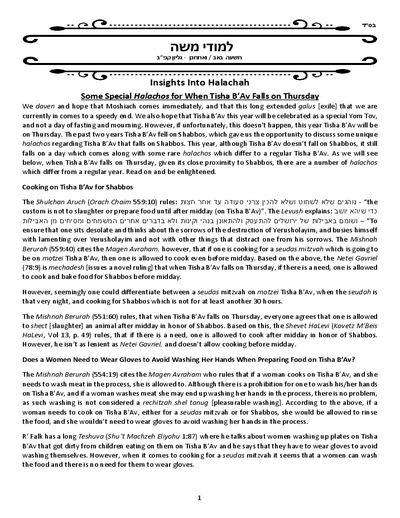
The Gemara (Ta’anis 29a) records the following: “On the Seventh of Av, the gentiles entered the Beis HaMikdosh and spent three days feasting and contaminating it. As the sun was setting on the Ninth of Av, they set the Beis HaMikdosh ablaze, and it continued to burn for the entire next day.” (The Shulchan Aruch notes that the Beis HaMikdosh burned the entire Tenth of Av, with the fire finally going out as the sun set on the Tenth.) Because of this event, Rabbi Yochanan declared that had he been alive at the time of the churban [destruction], he would have declared the fast on the Tenth of Av, rather than the Ninth. He felt that the main mourning should be on the day that the Beis HaMikdosh was actually destroyed rather than on the day that the tragedy began.

The halachah does not follow Rabbi Yochanan: the main observance is on the Ninth, when the destruction began. Nevertheless, the custom is to observe the Tenth of Av as a day of mourning.

Although Chazal did not institute two consecutive days of fasting because it is dangerous for most people to go 48 hours without eating, the Yerushalmi records that Rabbi Avin fasted for two consecutive days – the entire Ninth and the entire Tenth days of Av to commemorate the tragedy on both days. Rabbi Levi, who was not as strong, fasted only the Ninth and through the night of the Tenth, but broke his fast on the morning of the Tenth. Note that these rabbonim did not require people to fast both days. Rabbi Avin felt the loss of the Beis HaMikdosh so intensely that he fasted both days to grieve its loss. Rabbi Levi also felt the intensity of the churban, but could not fast two consecutive days because of his health. Thus, he observed the Tenth of Av as a fast day to the extent that he could, refraining from ending his Tisha B’Av fast until the following morning.

The Tur (558) mentions that although we lack the strength to extend our fast into the Tenth of Av, nonetheless it is appropriate to refrain from eating meat on the Tenth. Thus, on the Tenth we eat only what is necessary to regain our strength from the Tisha B’Av fast, but not luxury items such as meat and wine. Nevertheless, we find that even in later generations there were great tzadikim who fasted both the Ninth and the Tenth of Av. Several interesting shailos result from this fast:

Nacheim on the Tenth

Does someone who is fasting on the Tenth of Av recite Nacheim, the special prayer added to the Shemoneh Esrei of Tisha B’Av, when he is fasting the day after Tisha B’Av? On the one hand, it is no longer Tisha B’Av, so why should someone recite Nacheim? On the other hand, one is commemorating the day that the Beis HaMikdosh was destroyed by fasting on that day. The Shlah Hakodesh ruled that one who is still fasting on the Tenth of Av because of the churban should recite Nacheim then (quoted by Birkei Yosef). We see from his discussion that it was not unusual in his time for people to fast two consecutive days because of the churban!

The Shulchan Aruch (Orach Chaim 558) rules one should refrain from eating meat or drinking wine the entire day of the Tenth of Av, and this is the normative practice of the Sephardim. The Rema rules that one need refrain only until midday of the Tenth, and this is standard Ashkenazic practice.

The Mishnah Berurah (s.k. 3) cites from Achronim, that one should also refrain from washing himself, washing his clothes and from having a haircut until midday. However, when Tisha B’Av falls on Thursday, which means that the Tenth of Av is erev Shabbos, everything is allowed in honor of Shabbos. The Achronim argue as to when the special heter starts, some maintain it starts immediately after Tisha B’Av, whereas others maintain it only starts from the morning of erev Shabbos. Practically it seems that one may be lenient, and this is how R’ Pesach Eliyohu Falk zt”l would pasken.

What is the Reason for Leniency

There are two reason offered to explain the opinion of those who are lenient:

  1. The Mishnah Berurah (551:21) explains, that the reason one should refrain from washing clothes in the week before Tisha B’Av, is because: “it looks like he is taking his mind of the aveilus [mourning]”. Accordingly, since the poskim allow one to wash his clothes on erev Shabbos before midday even though it is still a time of mourning, one might as well do it the night before, as either way he will be taking his mind off mourning.
  2. Another reason given, is that Ezra made a takonah [enactment] that clothes should be washed on Thursday, in order that people will be free on erev Shabbos to get ready for Shabbos. Meikar hadin [according to strict halachah] washing clothes on motzei Tisha B’Av is allowed, however, it became customary not to. However, takonas Ezra overrides the custom of not washing clothes, and therefore, it is better to wash clothes on motzei Tisha B’Av than to wait until Friday and violate takonas Ezra.

Forgot Tisha B’Av!

Some poskim mention another interesting shailah. A traveler without access to a Jewish calendar arrived in a Jewish community the afternoon of Tisha B’Av and discovered that he had failed to observe any of the halachos of Tisha B’Av. Since he ate the entire day because of his mistake, what should he do now? Can he observe any of the halachos of Tisha B’Av?

Firstly, he should not eat the rest of Tisha B’Av, because every piece of food that he eats violates the fast of Tisha B’Av. He is also required to observe the other halachos of Tisha B’Av until the end of the day.

What else should he do?

The gadol who paskened the shailah ruled that he should fast and observe the halachos of Tisha B’Av on the Tenth of Av, because Chazal would have instituted the Tenth of Av as a fast were it not too difficult for people. Therefore, someone who failed to observe the fast on the Ninth of Av should fast on the Tenth (Birkay Yosef).

PDF Preview