The Concept of Tefilah as Matnas Chinom and Its Connection to Shabbos
Print This Article
View Original PDF

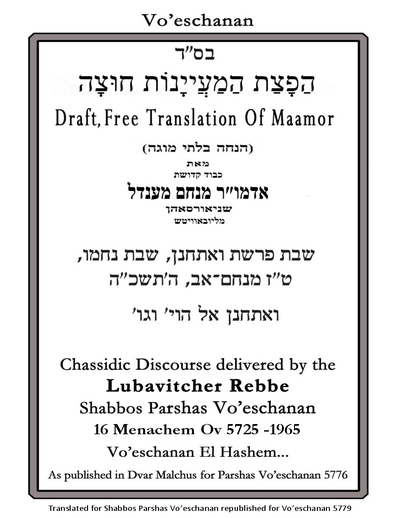
The Concept of Tefilah as Matnas Chinom and Its Connection to Shabbos

הפצת המיינות חוצה | December 31, 2025

It can be said that the concept of ‘Tefilah’ in a manner of ‘Matnas Chinom’ corresponds to Shabbos.

External Dimension of Kesser

Therefore, it is included as one of the ten expressions of prayer because the external dimension of ‘Kesser’ is a close encompass and furthermore it pervades the ten Sefiros. Incidentally every prayer is for a new will which is Kesser which understandably is complete when it is in the scope of ‘Bechol Me’odecho’ - without limitations (Kesser).

Who is praying: Because in reality one’s merits do play a role with regards to the prayer itself.

Everything is as nought: In comparison all existence of absolutely no value.

Matnas Chinom: And there is no scope to ask for anything as retribution for merits and good deeds.

Matnas Chinom: This is a very high exalted level of prayer. When a person prays to Hashem whilst in his heart he feels that he does not exist, and he has no merits.

Davening Because Shabbos is a Gift

As our sages of blessed memory have said; “I have a good gift in My treasure house and Shabbos is its name.” From a closer perspective; even weekday Davening itself represents a state of Shabbos, as it is known that ‘Tefilah’ is a ray of Shabbos which is extended into the days of the week.

Accordingly, it can be said that these two different above-mentioned explanations of the concept of ‘וָאֶתְחַנַן’ which are first ‘Tefilah’ that is only said in a style of pleading for a ‘Matnas Chinom’ (like the Medrash Rabbah) and secondly ‘Tefilah’ which is an actual pleading for a ‘Matnas Chinom’ (like the explanation from the Sifri) correspond to the two aspects of ‘Tefilah’ in the weekday and ‘Tefilah’ on Shabbos.

Although, the weekday ‘Tefilah’ is itself a state of Shabbos it is only Shabbos of the weekday and therefore the ‘Tefilah’ is arduous and requires effort and [consequently] there is ‘Tachnun’.

Shabbos Davening: Effortless and a Gift

But on Shabbos the Davening is effortless and there is no ‘Selach Lonu’ (because already on Erev Shabbos after midday “All strict judgements are severed from her”) only the ‘Tefilah’ is like a gift. This refers to both the ‘Tefilah’ on Friday night and in a greater way during the ‘Tefilah’ of Shabbos day, particularly on Shabbos afternoon, the time known as Raavin DeRaavin because that is when the aspect of the day of Shabbos being ‘A gift’ is most prominent.

The Third Meal and the Inner Dimension of Atik

It is explained in Chassidus that a gift is a ‘Hamshocha’ and influence which comes from above, on its own - not as a result of a person’s efforts. This concept takes place with a greater emphasis at ‘Raavin DeRaavin’ as it has been explained by the Rebbe Rashab in the series of 144 Chassidic discourses known by the year 5672 (1911-12) in which the first of that series was said known as Tehrav or Eyin Beis. Regarding the virtue of the third meal on Shabbos which is eaten around Mincha time over the virtues of the other two meals on Shabbos: “The third meal of Shabbos is a revelation of the inner dimension of Atik. Because the other two Shabbos meals are a result of an Issarusa Diletatoh which triggers an Issarusa Dil’eila of Friday night which is through an Avodah of refinement. Similarly, Shabbos day is a level of Divine pleasure that comes from Everything Hashem has made ... therefore the pleasure comes inside something else. However, with the third meal is a result of an unsolicited Issarusa Dile’eilah which is the concept of a Tzaddik eats to satiate in a state of a Hamshocha from above to below... therefore it is a level of pleasure from Hashem’s very essence just as it is in Hashem’s very essence ... with this we can now understand why there is no Kiddush with this meal.. this is because this meal is a much higher level of an unsolicited Issarusa Dile’eilah which is the state of a ‘good present’.
It can be said that the concept of ‘Tefilah’ in a manner of ‘Matnas Chinom’ corresponds to Shabbos.

External Dimension of Kesser

Therefore, it is included as one of the ten expressions of prayer because the external dimension of ‘Kesser’ is a close encompass and furthermore it pervades the ten Sefiros. Incidentally every prayer is for a new will which is Kesser which understandably is complete when it is in the scope of ‘Bechol Me’odecho’ - without limitations (Kesser).

Who is praying: Because in reality one’s merits do play a role with regards to the prayer itself.

Everything is as nought: In comparison all existence of absolutely no value.

Matnas Chinom: And there is no scope to ask for anything as retribution for merits and good deeds.

Matnas Chinom: This is a very high exalted level of prayer. When a person prays to Hashem whilst in his heart he feels that he does not exist, and he has no merits.

Davening Because Shabbos is a Gift

As our sages of blessed memory have said; “I have a good gift in My treasure house and Shabbos is its name.” From a closer perspective; even weekday Davening itself represents a state of Shabbos, as it is known that ‘Tefilah’ is a ray of Shabbos which is extended into the days of the week.

Accordingly, it can be said that these two different above-mentioned explanations of the concept of ‘וָאֶתְחַנַן’ which are first ‘Tefilah’ that is only said in a style of pleading for a ‘Matnas Chinom’ (like the Medrash Rabbah) and secondly ‘Tefilah’ which is an actual pleading for a ‘Matnas Chinom’ (like the explanation from the Sifri) correspond to the two aspects of ‘Tefilah’ in the weekday and ‘Tefilah’ on Shabbos.

Although, the weekday ‘Tefilah’ is itself a state of Shabbos it is only Shabbos of the weekday and therefore the ‘Tefilah’ is arduous and requires effort and [consequently] there is ‘Tachnun’.

Shabbos Davening: Effortless and a Gift

But on Shabbos the Davening is effortless and there is no ‘Selach Lonu’ (because already on Erev Shabbos after midday “All strict judgements are severed from her”) only the ‘Tefilah’ is like a gift. This refers to both the ‘Tefilah’ on Friday night and in a greater way during the ‘Tefilah’ of Shabbos day, particularly on Shabbos afternoon, the time known as Raavin DeRaavin because that is when the aspect of the day of Shabbos being ‘A gift’ is most prominent.

The Third Meal and the Inner Dimension of Atik

It is explained in Chassidus that a gift is a ‘Hamshocha’ and influence which comes from above, on its own - not as a result of a person’s efforts. This concept takes place with a greater emphasis at ‘Raavin DeRaavin’ as it has been explained by the Rebbe Rashab in the series of 144 Chassidic discourses known by the year 5672 (1911-12) in which the first of that series was said known as Tehrav or Eyin Beis. Regarding the virtue of the third meal on Shabbos which is eaten around Mincha time over the virtues of the other two meals on Shabbos: “The third meal of Shabbos is a revelation of the inner dimension of Atik. Because the other two Shabbos meals are a result of an Issarusa Diletatoh which triggers an Issarusa Dil’eila of Friday night which is through an Avodah of refinement. Similarly, Shabbos day is a level of Divine pleasure that comes from Everything Hashem has made ... therefore the pleasure comes inside something else. However, with the third meal is a result of an unsolicited Issarusa Dile’eilah which is the concept of a Tzaddik eats to satiate in a state of a Hamshocha from above to below... therefore it is a level of pleasure from Hashem’s very essence just as it is in Hashem’s very essence ... with this we can now understand why there is no Kiddush with this meal.. this is because this meal is a much higher level of an unsolicited Issarusa Dile’eilah which is the state of a ‘good present’.

PDF Preview