Abstract Likkutei Sichos Part 2
Torah gives the ability for a closed opening (a door) which conceals, to become open and reveal G-dliness
Since the woven tapestry at the courtyard entrance it is part of the hanging walls, it is the same height; an opening even without a door is meant as an entrance (not a closure), thus requires a mezuzah
When HaShem gives a Jew a special ability, one needs to use it to make the world a Mishkan
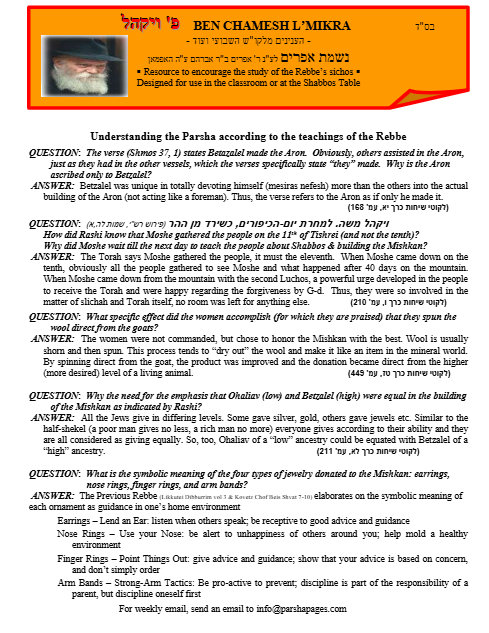
Special praise of the women in spinning the wool straight from live goats to offer as a donation to the Mishkan, even though it was not commanded. They accomplished an increase in the quality of the wool and in offering from the “animal” world
The light in Moshiach’s time was lit in Galus beforehand
Actions only for the Kavod of the Beis HaMikdash doesn’t override the gezeiros of Shabbos
Individual depends on being part of the Jewish whole, yet the collective good benefits the individual
VaYakhel –creation of the Mishkan & its vessels; each Jew is gathered & is part of the whole. Pekudai – Just as each item in the Mishkan is counted and is important, so with each Jew
Each person learns to the best of their abilities
Service of the Rashbi – Torah is his profession. Service of Rabbi Yosi – Birurim (community needs)
For B’nei Yisrael the Mishkan was a means of forgiveness for the Golden Calf and thus, they needed first a warning not to violate Shabbos
Work with the women and children as well as the head of the house
This Parsha mentions voluntary contributions, since this is the main element in ensuring atonement. Unique quality of women and their donations
In the manner of chinuch the teacher must be involved in all aspects of the student
The wise men were involved with the pegs (the lowest and last detail); thus, also an integral part of the coverings, and not of a lesser purpose
Women did no participate in Eigel, thus no questions about their commitment
Rashi understands concept in giving לשמה means giving any one or more item (but not all15 categories of items) is indicative of its being לשמה
Even though many traits and abilities separate one from another, nevertheless, we are equal before HaShem
Equating of Ohaliav (“low” ancestry) to Betzalel (“high” ancestry) teaches that all are equal in making the Mishkan, bringing all together in unity
Spiritual fire is loving G-d so that one wishes to leave one’s body; but the actual purpose is to remain in the body (like ash as the most-base type of physical)
מלאכת מבעיר defined as causing fire or increasing fire, and then needing the ashes; the מלאכה needs a purpose even though ashes are not much value, they still can fulfill a purpose. כלות נשמה and צריך לאפר These two concepts are complementary (not opposites)