Fire and Ashes
Lamplighter | March 06, 2024
Print This Article
View Original PDF

Fire and Ashes

Lamplighter | June 27, 2025

There are 39 categories of "work" prohibited on Shabbat, derived from the 39 different types of labour that were required to build the Sanctuary. As every Jew is enjoined to erect a "Sanctuary" to G-d in the spiritual sense, these laws reveal many important lessons for our Divine service.

As we read in this week's Torah portion, setting a fire is one of these prohibited labours, as it states, "You shall kindle no fire throughout your habitations on the Sabbath day." The strict definition of "setting a fire" for which a Jew is culpable requires that some sort of benefit be derived from the act of combustion: either illumination, heat, or for the purpose of producing ashes. Without the element of benefit, it is not considered "setting a fire." (However, by Rabbinic decree all forms are forbidden regardless of the intention.)

In spiritual terms, this means that "fire," in and of itself, is not considered an actual component of our Divine service unless it produces practical benefit. To explain:

"Fire" refers to the innate flame within the Jewish soul, as it states, "The candle of G-d is the soul of man." A Jew is required to kindle and encourage this inner fire, until his whole being is suffused with longing to reunite with its G-dly Source.

In Judaism, however, spiritual elevation is not an end in itself. The objective is not to feel elevated and close to G-d, to the extent that the physical, mundane world becomes nullified.

On the contrary, the Torah teaches that this is not a true "fire," for although it is pure, it is devoid of purpose. In order to build a genuine "Sanctuary," a Jew's fiery love for G-d must result in actual consequences and actions.

This is reflected in the physical phenomenon of ashes. Ashes are symbolic of the most intense level of corporeality, which is why they remain even after all the other matter is completely burned and consumed. Indeed, the whole purpose of a Jew's "fire," i.e., spiritual arousal, is to produce "ashes" - permeate the very lowest levels of existence with Torah and mitzvot.

The refinement of the physical plane through Torah and mitzvot is the underlying objective of the world's creation. When a Jew utilises physical objects for the sake of Heaven he attains the most elevated of spiritual heights and fulfils G-d's will, according to the dictum "Action is the main thing."

The service of every individual Jew elevating his own corner of the world will in turn lead to the ultimate elevation of creation: the coming of Moshiach and the Final Redemption.

Based on the teachings of the Lubavitcher Rebbe
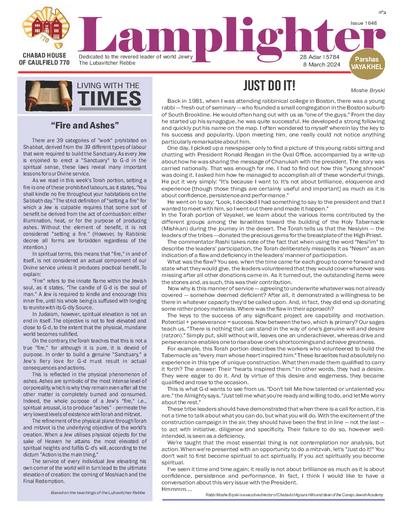
There are 39 categories of "work" prohibited on Shabbat, derived from the 39 different types of labour that were required to build the Sanctuary. As every Jew is enjoined to erect a "Sanctuary" to G-d in the spiritual sense, these laws reveal many important lessons for our Divine service.

As we read in this week's Torah portion, setting a fire is one of these prohibited labours, as it states, "You shall kindle no fire throughout your habitations on the Sabbath day." The strict definition of "setting a fire" for which a Jew is culpable requires that some sort of benefit be derived from the act of combustion: either illumination, heat, or for the purpose of producing ashes. Without the element of benefit, it is not considered "setting a fire." (However, by Rabbinic decree all forms are forbidden regardless of the intention.)

In spiritual terms, this means that "fire," in and of itself, is not considered an actual component of our Divine service unless it produces practical benefit. To explain:

"Fire" refers to the innate flame within the Jewish soul, as it states, "The candle of G-d is the soul of man." A Jew is required to kindle and encourage this inner fire, until his whole being is suffused with longing to reunite with its G-dly Source.

In Judaism, however, spiritual elevation is not an end in itself. The objective is not to feel elevated and close to G-d, to the extent that the physical, mundane world becomes nullified.

On the contrary, the Torah teaches that this is not a true "fire," for although it is pure, it is devoid of purpose. In order to build a genuine "Sanctuary," a Jew's fiery love for G-d must result in actual consequences and actions.

This is reflected in the physical phenomenon of ashes. Ashes are symbolic of the most intense level of corporeality, which is why they remain even after all the other matter is completely burned and consumed. Indeed, the whole purpose of a Jew's "fire," i.e., spiritual arousal, is to produce "ashes" - permeate the very lowest levels of existence with Torah and mitzvot.

The refinement of the physical plane through Torah and mitzvot is the underlying objective of the world's creation. When a Jew utilises physical objects for the sake of Heaven he attains the most elevated of spiritual heights and fulfils G-d's will, according to the dictum "Action is the main thing."

The service of every individual Jew elevating his own corner of the world will in turn lead to the ultimate elevation of creation: the coming of Moshiach and the Final Redemption.

Based on the teachings of the Lubavitcher Rebbe

PDF Preview


