Now You Know
מגדל אור | March 19, 2025
Print This Article
View Original PDF

Now You Know

מגדל אור | June 27, 2025

There are few Rashis in Parshas Vayakhel, but at the end, Rashi makes a lengthy comment, quoting the Midrash Tanchuma, about the copper used to make the kiyor, the laver.

The kiyor was a large copper basin with spouts from which the Kohanim would wash their hands and feet before performing the service in the Mishkan or Bais HaMikdash.

This procedure was so crucial that failure to wash would make the Kohain liable for death.

Rashi tells us the materials to make this laver came from the copper mirrors the Jewish women used to beautify themselves, and how Moshe thought they should be rejected, but Hashem found them very precious.

It was through these mirrors that the women in Egypt ensured the continuity of the Jewish People by having children. This showed their faith in Hashem and a brighter future.

In fact, no measurement is given for the kiyor, because it had to include whatever mirrors would be brought!

The kiyor strengthened Shalom Bayis, and it was from its water that a Sota would be given to drink.

Perhaps the message of the mirrors for Shalom Bayis was that we must look at fixing up ourselves, not others, and similarly, the Kohanim were to take a hard look in the mirror to be sure they were worthy of serving as Hashem’s emissaries.

Thought of the week:
Living a Torah life is more about the journey than the destination. (Discuss!)
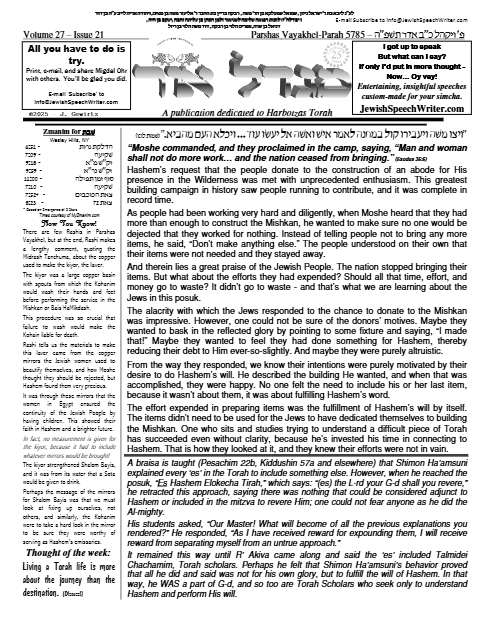

There are few Rashis in Parshas Vayakhel, but at the end, Rashi makes a lengthy comment, quoting the Midrash Tanchuma, about the copper used to make the kiyor, the laver.

The kiyor was a large copper basin with spouts from which the Kohanim would wash their hands and feet before performing the service in the Mishkan or Bais HaMikdash.

This procedure was so crucial that failure to wash would make the Kohain liable for death.

Rashi tells us the materials to make this laver came from the copper mirrors the Jewish women used to beautify themselves, and how Moshe thought they should be rejected, but Hashem found them very precious.

It was through these mirrors that the women in Egypt ensured the continuity of the Jewish People by having children. This showed their faith in Hashem and a brighter future.

In fact, no measurement is given for the kiyor, because it had to include whatever mirrors would be brought!

The kiyor strengthened Shalom Bayis, and it was from its water that a Sota would be given to drink.

Perhaps the message of the mirrors for Shalom Bayis was that we must look at fixing up ourselves, not others, and similarly, the Kohanim were to take a hard look in the mirror to be sure they were worthy of serving as Hashem’s emissaries.

Thought of the week:
Living a Torah life is more about the journey than the destination. (Discuss!)

PDF Preview