Shabbos and Mikdash
Questions on the Sidra | March 06, 2024
Print This Article
View Original PDF

Shabbos and Mikdash

Questions on the Sidra | June 27, 2025

The Sidros of Terumah and Tetzaveh comprise HaShem’s instructions concerning the making of the Mishkan (the Sanctuary) with its sacred furniture and appurtenances and the splendid garments for the Kohannim. The Torah tells how the young Betzallel ben Uri ben Chur of the Tribe of Yehuda, a genius pure in heart and mind, was singled out by HaShem and was endowed with His Divine Spirit of wisdom and understanding to oversee the holy work. Together with Oholi’ov ben Achisommoch of the Tribe of Don and assisted by other men and women similarly blessed by HaShem with special talents, the holy work was carried out to perfection.

But at the outset, Mosheh our Teacher tells us that none of this work may be done on the Shabbos, for so has HaShem commanded. Holy though the making of the Mishkan is, it cannot transcend the Shabbos, that other Sanctuary. For in the same way that the Mishkan is to be a Sanctuary to HaShem in space, the Shabbos is to be a Sanctuary to HaShem in time. That is, in the same way that the Mishkan represents the holy Abode of HaShem in the midst of man’s living-space, so is the Shabbos an oasis of spiritual uplift in the midst of man’s timetable of his everyday activities and in his busy timetable of activity the Shabbos is to be a Sanctuary to HaShem in time. And the holiness of the Shabbos, says HaShem, is even greater than that of the Mishkan.

Both, the Mishkan (and, later, the Beis HaMikdash) and the Shabbos complement each other and teach us the same lesson. The Mikdash teaches that even though we are preoccupied in our own world with our mundane matters and even if it seems as if our welfare and progress are solely the result of our own efforts, we must never lose sight of the fact that HaShem is the true Provider and Master of the world: in our own world there must be a holy place, a Sanctuary, where the Presence of HaShem is manifest and where ordinary, everyday activities are subordinate to the overriding duty of worshipping HaShem as He has commanded. And this great teaching is to filter through to our everyday existence and influence us to be mindful of HaShem in all our undertakings.

The Shabbos teaches the same lesson, but from a different perspective. Even if we are so busy with our own affairs, quite legitimately exercising our intelligence and skills to develop the world and bring it under human control, we must never forget that we are only junior partners in this world. We must remember that HaShem is the Creator of all that exists. The Shabbos is our testimony that we indeed acknowledge that HaShem created the world in six days and on the seventh day He rested from creating anything further. By our observing the Shabbos as HaShem has commanded us, we bear witness that HaShem is the Master of the Universe. All week long, we work and do and perfect and control the world that He has given us to develop and master. But comes Shabbos, and we desist from exercising our mastery over the world and we say, in effect, “This day of the week is commanded by HaShem to be holy. It is separated from all the other days of the week and we desist from our own creative and masterly activities to testify that it is HaShem Who is the true Master of the Universe.” (That is why a Jew who desecrates the Shabbos is considered as if he denied HaShem and as if he worshipped idols.) The Shabbos is that day of the week when we put out of mind our own worldly plans and we acknowledge that the world belongs to HaShem. The person who observes the Shabbos in the proper spirit allows this holy day to cast its radiance upon the whole week, and all the days of his life are thus ennobled and hallowed by a constant awareness of HaShem and His Torah. Thus, the holy Shabbos is a Sanctuary in time.

Because these two, the Mikdash and the Shabbos, both serve to remind us that HaShem is Master of the world, therefore they are both linked together. (Even though the holiness of the Shabbos is greater, once the Mishkan was completed and served as the focal point for the pure worship of HaShem, the observance of the Shabbos in the Mikdash does not apply in all its stringency, for the lesson of the Shabbos is superfluous in the Mishkan of HaShem. Hence the rule: "In the Sanctuary there are no Shabbos prohibitions.") Because the effect of Shabbos upon man is greater than the Mikdash — firstly, because the Shabbos is not confined to any one place and secondly, because it recurs each week — therefore of the two Sanctuaries, HaShem has commanded that the Shabbos is the more important and indeed the Mikdash helps to define Shabbos, as follows:

Concerning the Shabbos, HaShem commands that we are not to do “any manner of Melachah.” The true definition of Melachah is, not as is so commonly mistranslated, “labour” or “work” but as follows: “Any activity which shows man’s mastery over the world by the constructive exercise of his intelligence and skill.” It is a Halachah taught to Mosheh our Teacher by HaShem at Sinai that all the various activities which are forbidden to be done on Shabbos divide into 39 different categories with each of these categories referring to a particular sphere of activity. Each category is distinct from all the others, without duplication or overlapping and all together these “39 Melachos of Shabbos” cover the whole range of human activity. Our Chachommim, of blessed memory, transmitted to us the pattern and scheme behind these 39 categories. They showed how the Melachos that are forbidden on Shabbos are in essence the same as those activities that were required in the making of the Mishkan. In other words, the 39 categories of Melachah forbidden on Shabbos are the same as those kinds of work needed in the making of the Mishkan. Each of these lists of categories comprise the full range of human activity in the service of HaShem, the one, desisting from activity on Shabbos because HaShem so commands it and the other utilising our talents and skills to make the Mikdash to HaShem. It is out of respect to that other Sanctuary, the Mishkan, that our Chachommim listed the 39 Melachos forbidden on Shabbos in the order that those activities would have been used (even remotely) in the making of the Mishkan. Thus it is our desisting from the Melachos, needed in the making of the Sanctuary (the Mishkan) that defines that other Sanctuary, which is the Shabbos.

And so the two Sanctuaries become one: "Hashem is One."
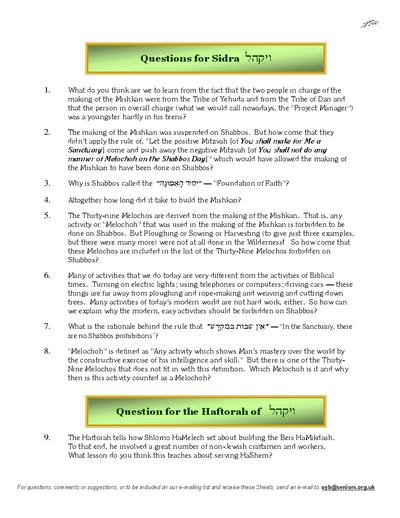
The Sidros of Terumah and Tetzaveh comprise HaShem’s instructions concerning the making of the Mishkan (the Sanctuary) with its sacred furniture and appurtenances and the splendid garments for the Kohannim. The Torah tells how the young Betzallel ben Uri ben Chur of the Tribe of Yehuda, a genius pure in heart and mind, was singled out by HaShem and was endowed with His Divine Spirit of wisdom and understanding to oversee the holy work. Together with Oholi’ov ben Achisommoch of the Tribe of Don and assisted by other men and women similarly blessed by HaShem with special talents, the holy work was carried out to perfection.

But at the outset, Mosheh our Teacher tells us that none of this work may be done on the Shabbos, for so has HaShem commanded. Holy though the making of the Mishkan is, it cannot transcend the Shabbos, that other Sanctuary. For in the same way that the Mishkan is to be a Sanctuary to HaShem in space, the Shabbos is to be a Sanctuary to HaShem in time. That is, in the same way that the Mishkan represents the holy Abode of HaShem in the midst of man’s living-space, so is the Shabbos an oasis of spiritual uplift in the midst of man’s timetable of his everyday activities and in his busy timetable of activity the Shabbos is to be a Sanctuary to HaShem in time. And the holiness of the Shabbos, says HaShem, is even greater than that of the Mishkan.

Both, the Mishkan (and, later, the Beis HaMikdash) and the Shabbos complement each other and teach us the same lesson. The Mikdash teaches that even though we are preoccupied in our own world with our mundane matters and even if it seems as if our welfare and progress are solely the result of our own efforts, we must never lose sight of the fact that HaShem is the true Provider and Master of the world: in our own world there must be a holy place, a Sanctuary, where the Presence of HaShem is manifest and where ordinary, everyday activities are subordinate to the overriding duty of worshipping HaShem as He has commanded. And this great teaching is to filter through to our everyday existence and influence us to be mindful of HaShem in all our undertakings.

The Shabbos teaches the same lesson, but from a different perspective. Even if we are so busy with our own affairs, quite legitimately exercising our intelligence and skills to develop the world and bring it under human control, we must never forget that we are only junior partners in this world. We must remember that HaShem is the Creator of all that exists. The Shabbos is our testimony that we indeed acknowledge that HaShem created the world in six days and on the seventh day He rested from creating anything further. By our observing the Shabbos as HaShem has commanded us, we bear witness that HaShem is the Master of the Universe. All week long, we work and do and perfect and control the world that He has given us to develop and master. But comes Shabbos, and we desist from exercising our mastery over the world and we say, in effect, “This day of the week is commanded by HaShem to be holy. It is separated from all the other days of the week and we desist from our own creative and masterly activities to testify that it is HaShem Who is the true Master of the Universe.” (That is why a Jew who desecrates the Shabbos is considered as if he denied HaShem and as if he worshipped idols.) The Shabbos is that day of the week when we put out of mind our own worldly plans and we acknowledge that the world belongs to HaShem. The person who observes the Shabbos in the proper spirit allows this holy day to cast its radiance upon the whole week, and all the days of his life are thus ennobled and hallowed by a constant awareness of HaShem and His Torah. Thus, the holy Shabbos is a Sanctuary in time.

Because these two, the Mikdash and the Shabbos, both serve to remind us that HaShem is Master of the world, therefore they are both linked together. (Even though the holiness of the Shabbos is greater, once the Mishkan was completed and served as the focal point for the pure worship of HaShem, the observance of the Shabbos in the Mikdash does not apply in all its stringency, for the lesson of the Shabbos is superfluous in the Mishkan of HaShem. Hence the rule: "In the Sanctuary there are no Shabbos prohibitions.") Because the effect of Shabbos upon man is greater than the Mikdash — firstly, because the Shabbos is not confined to any one place and secondly, because it recurs each week — therefore of the two Sanctuaries, HaShem has commanded that the Shabbos is the more important and indeed the Mikdash helps to define Shabbos, as follows:

Concerning the Shabbos, HaShem commands that we are not to do “any manner of Melachah.” The true definition of Melachah is, not as is so commonly mistranslated, “labour” or “work” but as follows: “Any activity which shows man’s mastery over the world by the constructive exercise of his intelligence and skill.” It is a Halachah taught to Mosheh our Teacher by HaShem at Sinai that all the various activities which are forbidden to be done on Shabbos divide into 39 different categories with each of these categories referring to a particular sphere of activity. Each category is distinct from all the others, without duplication or overlapping and all together these “39 Melachos of Shabbos” cover the whole range of human activity. Our Chachommim, of blessed memory, transmitted to us the pattern and scheme behind these 39 categories. They showed how the Melachos that are forbidden on Shabbos are in essence the same as those activities that were required in the making of the Mishkan. In other words, the 39 categories of Melachah forbidden on Shabbos are the same as those kinds of work needed in the making of the Mishkan. Each of these lists of categories comprise the full range of human activity in the service of HaShem, the one, desisting from activity on Shabbos because HaShem so commands it and the other utilising our talents and skills to make the Mikdash to HaShem. It is out of respect to that other Sanctuary, the Mishkan, that our Chachommim listed the 39 Melachos forbidden on Shabbos in the order that those activities would have been used (even remotely) in the making of the Mishkan. Thus it is our desisting from the Melachos, needed in the making of the Sanctuary (the Mishkan) that defines that other Sanctuary, which is the Shabbos.

And so the two Sanctuaries become one: "Hashem is One."

PDF Preview