Shekalim and the Power of Unity
L’Chaim | March 03, 2024
Print This Article
View Original PDF

Shekalim and the Power of Unity

L’Chaim | June 27, 2025

This Shabbat we read a special portion known as Shekalim.

In connection with the commandment of giving a half-shekel during the time of the Holy Temple for the public sacrifices, we find that the Torah explicitly commands that “the rich shall not give more...than a half-shekel.”

On the surface, this is difficult to understand: All the offerings in the Holy Temple were required to be perfect and complete. Why then, in this instance, was it forbidden to give no more than a half-shekel?

Also, since the donation required was only a half-shekel, why does the Torah tell us that an entire shekel is equivalent to twenty geira? Why doesn’t it just tell us that a half-shekel is equal to ten geira?

In resolution: This command teaches us that a Jew cannot become a complete entity, a “holy shekel,” unless he joins together with another Jew. Every Jew by himself is ten geira, a half-shekel. When, however, he joins together with another Jew, they comprise twenty geira, a complete entity.

That the portion of Vayakhel and Shekalim are read on the same Shabbat emphasizes the need for establishing unity within oneself, making it possible to then establish bonds of unity with other Jews.

A Jew’s service begins with gathering together and synthesizing the various aspects of his own being, after which he joins together with the entire Jewish people. Only then can he gather together every element of the world and show how its entire existence is intended solely to carry out G-d’s will.

This will lead to the ultimate process of ingathering, the ingathering of the dispersed Jewish people, when G-d will “sound the great shofar...and bring us together from the four corners of the earth to our land.”
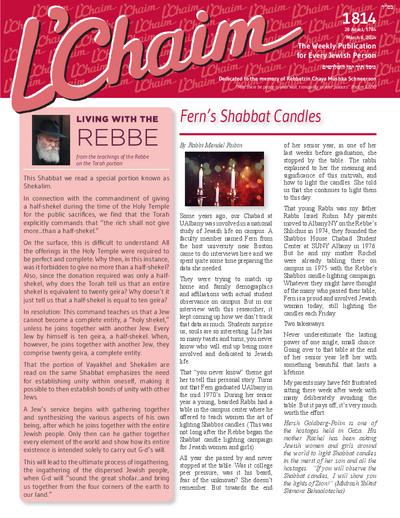

This Shabbat we read a special portion known as Shekalim.

In connection with the commandment of giving a half-shekel during the time of the Holy Temple for the public sacrifices, we find that the Torah explicitly commands that “the rich shall not give more...than a half-shekel.”

On the surface, this is difficult to understand: All the offerings in the Holy Temple were required to be perfect and complete. Why then, in this instance, was it forbidden to give no more than a half-shekel?

Also, since the donation required was only a half-shekel, why does the Torah tell us that an entire shekel is equivalent to twenty geira? Why doesn’t it just tell us that a half-shekel is equal to ten geira?

In resolution: This command teaches us that a Jew cannot become a complete entity, a “holy shekel,” unless he joins together with another Jew. Every Jew by himself is ten geira, a half-shekel. When, however, he joins together with another Jew, they comprise twenty geira, a complete entity.

That the portion of Vayakhel and Shekalim are read on the same Shabbat emphasizes the need for establishing unity within oneself, making it possible to then establish bonds of unity with other Jews.

A Jew’s service begins with gathering together and synthesizing the various aspects of his own being, after which he joins together with the entire Jewish people. Only then can he gather together every element of the world and show how its entire existence is intended solely to carry out G-d’s will.

This will lead to the ultimate process of ingathering, the ingathering of the dispersed Jewish people, when G-d will “sound the great shofar...and bring us together from the four corners of the earth to our land.”

PDF Preview