Study the Laws of Korban Pesach
Hama'aseh Hu Haikar | March 22, 2025
Print This Article
View Original PDF

Study the Laws of Korban Pesach

Hama'aseh Hu Haikar | June 27, 2025

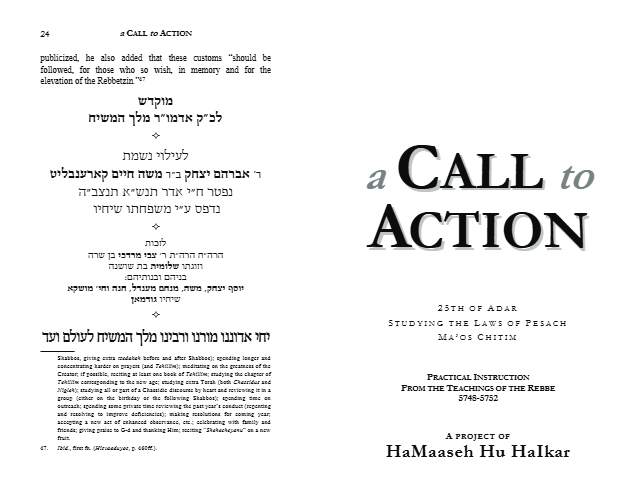
We are commanded to bring a lamb or kid goat to the Beis HaMikdash on erev Pesach as a Pesach sacrifice, an activity that entails advance preparation. In anticipation of the Third Beis HaMikdash, we should begin our preparations for the Pesach sacrifice by studying its laws.

For a start, we should study the Seder Korban Pesach—Order of Offering the Pesach Sacrifice, that is printed in Tehillat HaShem, the Siddur designed to be used by every Jew.

Offering a Spiritual Korban Pesach

We also express the theme of the Pesach sacrifice in our spiritual service.

In detailing the process of selecting the Pesach sacrifice, the Torah commands: “Draw and take for yourselves [a lamb or kid goat for the Pesach sacrifice].” On this, our Sages explain: “Draw your hands away from idol-worship, and take for yourselves a lamb for a mitzvah,” i.e., the worship of G-d.

In terms of our Divine service, this means that we should “draw” ourselves away, turn aside, and shake ourselves off from anything that smacks of avodah zarah (“a foreign service”)—anything that is “foreign” to our service of observing Torah and mitzvos—“and take” upon ourselves matters of Torah and mitzvos in greater abundance and depth than observed previously.

Similarly, in our Divine service, we should apply the message alluded to in the method of offering the Pesach sacrifice.

The Torah commands that the Pesach sacrifice be “roasted over fire, its head with its knees and innards.” In relation to our Divine service, this means that we should engage all of our various faculties, from our very highest faculty, i.e., our intellect (represented by the korban’s “head”), down to and including all our lower faculties (represented by the korban’s “knees and innards”). We should transform all of these faculties into “a sacrifice for G-d,” so they are permeated with the fire of holiness and the “love of G-d that burns as a raging fire within his heart, like leaping flames” that blaze throughout our entire being.
We are commanded to bring a lamb or kid goat to the Beis HaMikdash on erev Pesach as a Pesach sacrifice, an activity that entails advance preparation. In anticipation of the Third Beis HaMikdash, we should begin our preparations for the Pesach sacrifice by studying its laws.

For a start, we should study the Seder Korban Pesach—Order of Offering the Pesach Sacrifice, that is printed in Tehillat HaShem, the Siddur designed to be used by every Jew.

Offering a Spiritual Korban Pesach

We also express the theme of the Pesach sacrifice in our spiritual service.

In detailing the process of selecting the Pesach sacrifice, the Torah commands: “Draw and take for yourselves [a lamb or kid goat for the Pesach sacrifice].” On this, our Sages explain: “Draw your hands away from idol-worship, and take for yourselves a lamb for a mitzvah,” i.e., the worship of G-d.

In terms of our Divine service, this means that we should “draw” ourselves away, turn aside, and shake ourselves off from anything that smacks of avodah zarah (“a foreign service”)—anything that is “foreign” to our service of observing Torah and mitzvos—“and take” upon ourselves matters of Torah and mitzvos in greater abundance and depth than observed previously.

Similarly, in our Divine service, we should apply the message alluded to in the method of offering the Pesach sacrifice.

The Torah commands that the Pesach sacrifice be “roasted over fire, its head with its knees and innards.” In relation to our Divine service, this means that we should engage all of our various faculties, from our very highest faculty, i.e., our intellect (represented by the korban’s “head”), down to and including all our lower faculties (represented by the korban’s “knees and innards”). We should transform all of these faculties into “a sacrifice for G-d,” so they are permeated with the fire of holiness and the “love of G-d that burns as a raging fire within his heart, like leaping flames” that blaze throughout our entire being.

PDF Preview