The Lesson of the Nesiim and the Mishkan
Print This Article
View Original PDF

The Lesson of the Nesiim and the Mishkan

Facebuker Shabbos Table Talk | June 27, 2025

The Nesi’im, the Tribal Princes, brought precious stones used for representing Klal Yisrael on the breastplate and epaulets of the Kohain Gadol. Rashi explains why they took a primary role in the dedication of the Mishkan – because when it came to building it, they miscalculated.

They figured the people would not fully appreciate what the Mishkan represented, and would likely not exert themselves so much. They magnanimously offered to close the gap between what the Jews brought and what was needed. They were stunned when the Jews brought MORE than was necessary, and the only thing left for them to bring was the stones needed to complete Aharon’s uniform. The Midrash relates that these stones fell with the Mon for the princes, so they didn’t even get to exert themselves to obtain them.

Then, we find that they provided the spices and oil necessary for the anointing oil and ketores, which anyone else could have done. Why did they give such a pedestrian gift? Why not leave that for someone else?

When the princes offered to make the Mishkan whole, it seems they were intending to be generous. They would do whatever was needed to complete the task. However, their good intentions backfired when the enthusiastic people brought more than was needed. The princes were being taught a lesson.

Rachmona liba boi, Hashem wants our hearts, our desire. The idea of building the Mishkan was not that there be a physical place for the Shechina, Hashem’s presence, to dwell. Rather, it was that there be a place for Hashem’s Shechina built from the love and affection of the Jewish People. The people were given the opportunity to give physical expression to their feelings, and they did so with overwhelming results.

For their part, the Nesi’im learned the lesson, and the next thing they brought was the oil which could have been provided by anyone. They brought something that wasn’t expensive or difficult, because they just wanted to be part of it. And this oil was used to anoint the Kohanim and the vessels, making other things holy. Not only that, but the Talmud tells us a miracle occurred with this oil that it was used on so many objects yet there still remained oil for future use.

This is the power of using our hearts and passions to serve Hashem. When we focus on that, it can uplift the mundane and “regular” and make them special and wondrous.

Not only that, but when we use this passion in all our actions, seeking to serve Hashem in any way possible - regardless of whether people will be impressed - then we will transform ourselves into wondrous creations, suitable dwelling places for Hashem’s Shechina.
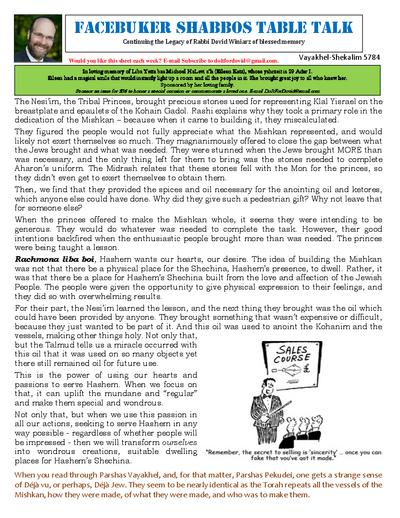

The Nesi’im, the Tribal Princes, brought precious stones used for representing Klal Yisrael on the breastplate and epaulets of the Kohain Gadol. Rashi explains why they took a primary role in the dedication of the Mishkan – because when it came to building it, they miscalculated.

They figured the people would not fully appreciate what the Mishkan represented, and would likely not exert themselves so much. They magnanimously offered to close the gap between what the Jews brought and what was needed. They were stunned when the Jews brought MORE than was necessary, and the only thing left for them to bring was the stones needed to complete Aharon’s uniform. The Midrash relates that these stones fell with the Mon for the princes, so they didn’t even get to exert themselves to obtain them.

Then, we find that they provided the spices and oil necessary for the anointing oil and ketores, which anyone else could have done. Why did they give such a pedestrian gift? Why not leave that for someone else?

When the princes offered to make the Mishkan whole, it seems they were intending to be generous. They would do whatever was needed to complete the task. However, their good intentions backfired when the enthusiastic people brought more than was needed. The princes were being taught a lesson.

Rachmona liba boi, Hashem wants our hearts, our desire. The idea of building the Mishkan was not that there be a physical place for the Shechina, Hashem’s presence, to dwell. Rather, it was that there be a place for Hashem’s Shechina built from the love and affection of the Jewish People. The people were given the opportunity to give physical expression to their feelings, and they did so with overwhelming results.

For their part, the Nesi’im learned the lesson, and the next thing they brought was the oil which could have been provided by anyone. They brought something that wasn’t expensive or difficult, because they just wanted to be part of it. And this oil was used to anoint the Kohanim and the vessels, making other things holy. Not only that, but the Talmud tells us a miracle occurred with this oil that it was used on so many objects yet there still remained oil for future use.

This is the power of using our hearts and passions to serve Hashem. When we focus on that, it can uplift the mundane and “regular” and make them special and wondrous.

Not only that, but when we use this passion in all our actions, seeking to serve Hashem in any way possible - regardless of whether people will be impressed - then we will transform ourselves into wondrous creations, suitable dwelling places for Hashem’s Shechina.

PDF Preview