The Value of Mirrors and Lessons from the Mishkan
Torah Papers | March 08, 2024
Print This Article
View Original PDF

The Value of Mirrors and Lessons from the Mishkan

Torah Papers | June 27, 2025

The above Gemara in Nedarim tells us that Shimon HaTzaddik was confronted by the Yetzer Hara, who wanted to expel him from the world. The Maharsha says, the Yetzer Hara told him he was a very important person – the Rosh Yeshiva of five hundred talmidim – and it was not fitting for him to wander around with his father’s sheep playing tunes for them. The Yetzer Hara pushed him to disobey the wishes of his father, and if כִּבּוּד אָ ב וָאֵ ם leads to עַל הָאֲדָמָה לְמַעַן יַאֲרִכוּן יָמֶיך, then going against one’s parents results in the opposite.

Given we read Parshat Shekalim this week, let’s learn something about this special Shabbat along the way. We read וְנָתְנוּ אִישׁ כֹּפֶר נַפְשׁ וֹ, and the Ba’al HaTurim points out that וְנָתְנוּ is a word that can be read from both directions, because as much as you give, you receive in return. I have a friend who told me this is tried and tested – he sends an unsigned check, and it always returns! Rav Chaim Kanievsky writes that what one does with their parents, they’ll receive exactly in return. Honor, proper treatment, dedication, etc. will all come back to the child in the future. He was once sitting with his brother-in-law, Rav Yitzchak Zilberstein, and the latter asked if there’s a hint to this principle anywhere in the Torah. In the Midrash, there are many, but he was looking for a Torah source. Rav Chaim thought for a split second, and answered that Chazal say Eisav was Number One when it came to kibbud av. After being sent by his father to prepare food, we are told: וַיַּעַשׂ גַּם־הוּא מַטְעַמִּים וַיָּבֵא לְאָבִיו. Combing the two final words in that verse, וַיָּבֵא לְאָבִיו, also results in a combination that can be read from both directions: ויבא לאביו. What one gives to their parents they will receive back in return.

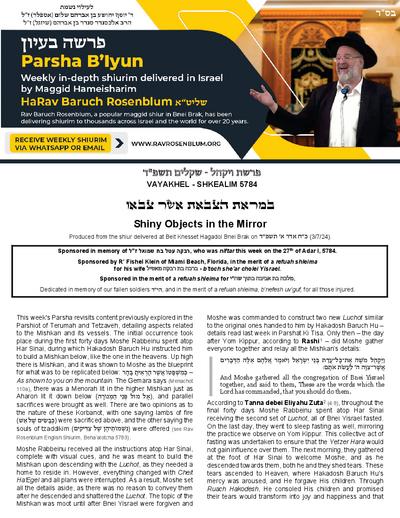
Let’s return to the mirrors brought for the וֹר כִּי, and Moshe’s reluctance to accept them due to their connection with the Yetzer Hara. Hakadosh Baruch Hu, according to Rashi (Shemot 38:8) and the Midrash (Tanchuma Pekudei 9) responded that he should accept them because they were the most valuable gift: Accept them; these are dearer to Me than all the other contributions, because through them the women reared those huge hosts in Egypt!” For when their husbands were tired through the crushing labor, they used to bring them food and drink and induced them to eat. Then they would take the mirrors, and each gazed at herself in her mirror together with her husband, saying endearingly to him, “See, I am handsomer than you!” Thus, they awakened their husbands’ affection and subsequently became the mothers of many children. This is what מראות הצבאת refers to – the mirrors of the women who reared the hosts (צבאות).

Rashi goes on to say it was for this reason the וֹר כִּי was made of the mirrors – because it served the purpose of promoting peace between man and wife (in reference to the topic of Sotah and giving of waters to be drunk by a woman whose husband had shown himself jealous of her and suspected her of associating with another.) He closes his commentary by saying the מראות mentioned in the text were really mirrors, and not another form of bronze that was not reflective.

The Ramban asks why Moshe was reluctant to accept these mirrors. At the start of our Parsha, we’re told that the women brought all their gold jewels, including the כוּמָ ז, an ornament worn by women in a private (צָנוּעַ) place. How could Moshe accept that piece of jewelry but not a mirror, he asks. Siftei Chachamim answers the question, saying that all the jewelry brought was combined in a pot and melted down to the point of no trace to the original piece. The mirror, on the other hand, was not handled in that way. It was not melted down and could still be identified on the וֹר כִּי. This represents not a Yetzer Hara derivative, but the Yetzer Hara itself. For this reason, Moshe awaited instructions to accept the mirrors.

Regarding the מַרְאוֹת הַצֹבְאוֹת, the Ibn Ezra says:
וטעם הצובאות. כי משפט כל הנשים להתיפות לראות פניהם בכל בקר במראות נחשת או זכוכית לתקן הפארות שעל ראשיהם. הם הנזכרים בספר ישעיה כי מנהג ישראל היה כמנהג ישמעאל עד היום. והנה היו בישראל נשים עובדות השם שסרו מתאות זה העולם ונתנו מראותיהן נדבה כי אין להם צורך עוד להתיפות. רק באות יום יום אל פתח אוהל מועד להתפלל ולשמוע דברי המצות. וזהו אשר צבאו פתח אוהל מועד. כי היו רבות.
The Torah states this because it is the custom of all women to beautify themselves. They look at their faces in brass or glass mirrors every morning to arrange the head coverings upon their heads. These head coverings are mentioned in the Book of Yeshaya. The custom of Israel was the same as the Muslim practice unto this very day. Now there were in Israel women who served G-d and removed themselves from the pleasures of this world. These women gave their mirrors as a free-will offering because they had no need to beautify themselves. They rather came daily to the door of the tent of meeting to pray and to hear the words of the commandments. There were many such women.

Moshav Zekainim provides an amazing reason why Moshe did not want to accept the mirrors. Two reasons in fact. Firstly, because someone standing outside in the courtyard would be able to see, via reflection, the work of the Kohen Gadol in the Ohel Moed and this was something seemingly prohibited: בְּאֹהֶל מוֹעֵד בְּבֹאוֹ לְכַפֵּר בַּקֹּדֶשׁ עַד צֵאתוֹ וְכָל-אָדָם לֹא יִהְיֶה. The second reason is that the Kohen coming to wash needs to bend down to wash his feet, and if he saw his own reflection upon doing so, he’d essentially be bowing to himself, which is prohibited.

Another reason is provided in Panim Yafos, where Rav Pinchas Halevi Horowitz says Moshe did not want to accept the mirrors because men are not to look in mirrors. Doing so is a violation of the commandment: יִלְבַּשׁ גֶּבֶר שִׂמְלַת אִשָּׁהוְלֹא – A man is not to wear a woman’s garment. He says a mirror is no different than a skirt.
The above Gemara in Nedarim tells us that Shimon HaTzaddik was confronted by the Yetzer Hara, who wanted to expel him from the world. The Maharsha says, the Yetzer Hara told him he was a very important person – the Rosh Yeshiva of five hundred talmidim – and it was not fitting for him to wander around with his father’s sheep playing tunes for them. The Yetzer Hara pushed him to disobey the wishes of his father, and if כִּבּוּד אָ ב וָאֵ ם leads to עַל הָאֲדָמָה לְמַעַן יַאֲרִכוּן יָמֶיך, then going against one’s parents results in the opposite.

Given we read Parshat Shekalim this week, let’s learn something about this special Shabbat along the way. We read וְנָתְנוּ אִישׁ כֹּפֶר נַפְשׁ וֹ, and the Ba’al HaTurim points out that וְנָתְנוּ is a word that can be read from both directions, because as much as you give, you receive in return. I have a friend who told me this is tried and tested – he sends an unsigned check, and it always returns! Rav Chaim Kanievsky writes that what one does with their parents, they’ll receive exactly in return. Honor, proper treatment, dedication, etc. will all come back to the child in the future. He was once sitting with his brother-in-law, Rav Yitzchak Zilberstein, and the latter asked if there’s a hint to this principle anywhere in the Torah. In the Midrash, there are many, but he was looking for a Torah source. Rav Chaim thought for a split second, and answered that Chazal say Eisav was Number One when it came to kibbud av. After being sent by his father to prepare food, we are told: וַיַּעַשׂ גַּם־הוּא מַטְעַמִּים וַיָּבֵא לְאָבִיו. Combing the two final words in that verse, וַיָּבֵא לְאָבִיו, also results in a combination that can be read from both directions: ויבא לאביו. What one gives to their parents they will receive back in return.

Let’s return to the mirrors brought for the וֹר כִּי, and Moshe’s reluctance to accept them due to their connection with the Yetzer Hara. Hakadosh Baruch Hu, according to Rashi (Shemot 38:8) and the Midrash (Tanchuma Pekudei 9) responded that he should accept them because they were the most valuable gift: Accept them; these are dearer to Me than all the other contributions, because through them the women reared those huge hosts in Egypt!” For when their husbands were tired through the crushing labor, they used to bring them food and drink and induced them to eat. Then they would take the mirrors, and each gazed at herself in her mirror together with her husband, saying endearingly to him, “See, I am handsomer than you!” Thus, they awakened their husbands’ affection and subsequently became the mothers of many children. This is what מראות הצבאת refers to – the mirrors of the women who reared the hosts (צבאות).

Rashi goes on to say it was for this reason the וֹר כִּי was made of the mirrors – because it served the purpose of promoting peace between man and wife (in reference to the topic of Sotah and giving of waters to be drunk by a woman whose husband had shown himself jealous of her and suspected her of associating with another.) He closes his commentary by saying the מראות mentioned in the text were really mirrors, and not another form of bronze that was not reflective.

The Ramban asks why Moshe was reluctant to accept these mirrors. At the start of our Parsha, we’re told that the women brought all their gold jewels, including the כוּמָ ז, an ornament worn by women in a private (צָנוּעַ) place. How could Moshe accept that piece of jewelry but not a mirror, he asks. Siftei Chachamim answers the question, saying that all the jewelry brought was combined in a pot and melted down to the point of no trace to the original piece. The mirror, on the other hand, was not handled in that way. It was not melted down and could still be identified on the וֹר כִּי. This represents not a Yetzer Hara derivative, but the Yetzer Hara itself. For this reason, Moshe awaited instructions to accept the mirrors.

Regarding the מַרְאוֹת הַצֹבְאוֹת, the Ibn Ezra says:
וטעם הצובאות. כי משפט כל הנשים להתיפות לראות פניהם בכל בקר במראות נחשת או זכוכית לתקן הפארות שעל ראשיהם. הם הנזכרים בספר ישעיה כי מנהג ישראל היה כמנהג ישמעאל עד היום. והנה היו בישראל נשים עובדות השם שסרו מתאות זה העולם ונתנו מראותיהן נדבה כי אין להם צורך עוד להתיפות. רק באות יום יום אל פתח אוהל מועד להתפלל ולשמוע דברי המצות. וזהו אשר צבאו פתח אוהל מועד. כי היו רבות.
The Torah states this because it is the custom of all women to beautify themselves. They look at their faces in brass or glass mirrors every morning to arrange the head coverings upon their heads. These head coverings are mentioned in the Book of Yeshaya. The custom of Israel was the same as the Muslim practice unto this very day. Now there were in Israel women who served G-d and removed themselves from the pleasures of this world. These women gave their mirrors as a free-will offering because they had no need to beautify themselves. They rather came daily to the door of the tent of meeting to pray and to hear the words of the commandments. There were many such women.

Moshav Zekainim provides an amazing reason why Moshe did not want to accept the mirrors. Two reasons in fact. Firstly, because someone standing outside in the courtyard would be able to see, via reflection, the work of the Kohen Gadol in the Ohel Moed and this was something seemingly prohibited: בְּאֹהֶל מוֹעֵד בְּבֹאוֹ לְכַפֵּר בַּקֹּדֶשׁ עַד צֵאתוֹ וְכָל-אָדָם לֹא יִהְיֶה. The second reason is that the Kohen coming to wash needs to bend down to wash his feet, and if he saw his own reflection upon doing so, he’d essentially be bowing to himself, which is prohibited.

Another reason is provided in Panim Yafos, where Rav Pinchas Halevi Horowitz says Moshe did not want to accept the mirrors because men are not to look in mirrors. Doing so is a violation of the commandment: יִלְבַּשׁ גֶּבֶר שִׂמְלַת אִשָּׁהוְלֹא – A man is not to wear a woman’s garment. He says a mirror is no different than a skirt.

PDF Preview