Bagels And Lox
L’Chaim | December 24, 2023
Print This Article
View Original PDF

Bagels And Lox

L’Chaim | December 31, 2025

With this week’s Torah portion, Vayechi, we conclude the Book of Genesis. “So Joseph died, being one hundred and ten years old... and he was put into a coffin in Egypt” is its final verse.

This conclusion to the entire Book is somewhat surprising, in light of the principle that “one should always end on a positive note.” Why couldn’t Genesis have concluded a few verses back, when we learn that Joseph lived a long life and merited to see grandchildren and great-grandchildren?

Why couldn’t the description of Joseph’s death have waited until the Book of Exodus?

We must therefore conclude that Joseph’s passing is somehow related to the theme of Genesis itself.

The Book of Genesis begins with an account of the creation of the world.

The Sage, Rabbi Yitzchak, explained that although the Torah should have begun with a practical mitzva, G-d chose to commence with the Creation to refute the arguments of the Gentiles, who would one day claim that the Jews had stolen the land of Israel from the seven nations who lived there prior to its conquest.

To counter their assertion, the Jews will say, “The entire world belongs to G-d; He created it and divided it as He saw fit. It was His will to give it to them [the seven nations], and it was His will to take it from them and give it to us.”

Surely G-d did not change the entire order of His Torah just to supply an answer to the arguments of the Gentiles. The comments of Rabbi Yitzchak must therefore contain a more fundamental teaching for the Jewish people as a whole.

The nations of the world are already cognizant of the Jew’s uniqueness and his special mission. Their claim, however, is that precisely because Jews are different, they should limit themselves to the spiritual service of G-d and not tie themselves down to a physical land.

Because Jews are a nation like no other, they have no right to claim ownership of a homeland. To the non-Jew, the spiritual and physical realms are incongruous and incompatible.

“The entire world belongs to G-d,” the Jew responds -- the worldly as well as the spiritual realm.

Both require sanctification through the light of holiness -- the sacred mission of the Jewish people.

With this concept the Book of Genesis begins, and on this note it concludes. Joseph’s coffin remained in Egypt in order to give strength and inspiration to the Children of Israel in their Egyptian exile. The power of Joseph is symbolic of the ability of the Jewish people to overcome even the most difficult of obstacles, imbuing even the coarsest of physical matter with holiness and bringing the full and complete Redemption.

Adapted from Likutei Sichot of the Rebbe, Vol. XXX

Have you ever wondered why so many Jewish celebrations and holidays are associated with food? And why something as popular as “bagels and lox” (you won’t find it listed as a traditional food in any book of Jewish observances) has become customary Jewish fare?

Consider the bagel. The empty space in the center, some would suggest, is there to remind us that being a gastronomic Jew is not enough. If our Jewish experiences are limited to eating bagels and lox, or even potato latkas on Chanuka and matza ball soup on Passover, there is a big hole in our Jewish living and learning.

Or, perhaps the hole is there to nudge us to make “space” for G-d and Judaism in our everyday lives. It can remind us that there is always “room” for improvement in our interpersonal and Divine relationships. And it is symbolic of the fact that mitzvot and rituals are anything but “empty.”

What of bagel’s sidekick, lox? Salmon, the fish from which lox is derived, are famous for swimming upstream and even leaping up waterfalls. They do this in order to return whence they came. Salmon attempt to do the impossible and are not only successful, but continue to flourish.

The journey of the salmon is related to the experience of the Jewish people as a whole and to every individual Jew. As a nation, we have always gone against the tide. We yearn to return to our roots. We have survived despite the fact that mightier and more powerful nations have attempted to annihilate us. And whereas the Jewish people, Jews, and Torah continue to endure and flourish, those nations that persecuted us no longer exist.

As Mark Twain stated so eloquently near the turn of the century: “... The Egyptian, the Babylonian and the Persian people rose and filled the planet with sound and splendor, then faded to dream-stuff and passed away; the Greek and the Roman followed, and made vast noise, and they are gone or have vanished. The Jew saw them all, beat them all, and is now what he always was, exhibiting no decadence, no infirmities of age, no weakening of his parts, no slowing of his energies, no dulling of his alert and aggressive mind. All things are mortal, but the Jew; all other forces pass, but he remains.”

There is, of course, a Chasidic spin on why we Jews are so “into” food:

The Baal Shem Tov, founder of Chasidism, interpreted a verse from King David’s Psalms, “Hungry and thirsty their soul prayerfully yearns within them” to mean that our hunger and thirst for food and drink is rooted in the fact that “the soul prayerfully yearns.” The soul, the Divine force within each of us, wishes to refine and return to its G-dly source the spark of holiness that lies trapped within the desired food and drink. Each soul is designated sparks which only she can set aright. In other words, although we experience physiological hunger, the true “hunger” is the longing of the soul for the sparks of sanctity in the food which are uniquely related to her and are her responsibility to redeem.

Similarly, when a Jew prays for material needs, although his prayers may appear to result from personal desires, the true, impelling force behind the outpouring of the soul is the hunger and thirst of the soul to fulfill G-d’s Divine plan-the creation of a “home” for Him in this physical world which will be fully expressed in the Messianic Era.

So, the next time you get a craving for bagels and lox, don’t feel bad. You just might be helping your soul fulfill her essential desire to transform the world into a perfect, peaceful, harmonious home for G-d and all of creation.
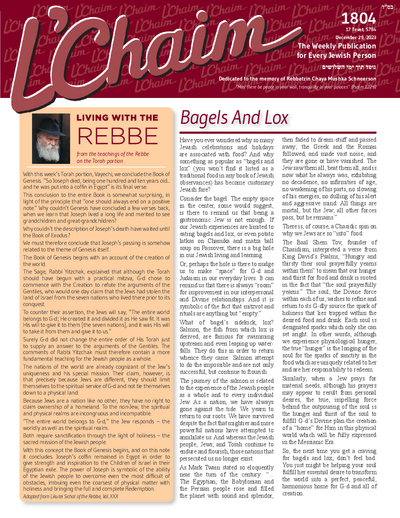
With this week’s Torah portion, Vayechi, we conclude the Book of Genesis. “So Joseph died, being one hundred and ten years old... and he was put into a coffin in Egypt” is its final verse.

This conclusion to the entire Book is somewhat surprising, in light of the principle that “one should always end on a positive note.” Why couldn’t Genesis have concluded a few verses back, when we learn that Joseph lived a long life and merited to see grandchildren and great-grandchildren?

Why couldn’t the description of Joseph’s death have waited until the Book of Exodus?

We must therefore conclude that Joseph’s passing is somehow related to the theme of Genesis itself.

The Book of Genesis begins with an account of the creation of the world.

The Sage, Rabbi Yitzchak, explained that although the Torah should have begun with a practical mitzva, G-d chose to commence with the Creation to refute the arguments of the Gentiles, who would one day claim that the Jews had stolen the land of Israel from the seven nations who lived there prior to its conquest.

To counter their assertion, the Jews will say, “The entire world belongs to G-d; He created it and divided it as He saw fit. It was His will to give it to them [the seven nations], and it was His will to take it from them and give it to us.”

Surely G-d did not change the entire order of His Torah just to supply an answer to the arguments of the Gentiles. The comments of Rabbi Yitzchak must therefore contain a more fundamental teaching for the Jewish people as a whole.

The nations of the world are already cognizant of the Jew’s uniqueness and his special mission. Their claim, however, is that precisely because Jews are different, they should limit themselves to the spiritual service of G-d and not tie themselves down to a physical land.

Because Jews are a nation like no other, they have no right to claim ownership of a homeland. To the non-Jew, the spiritual and physical realms are incongruous and incompatible.

“The entire world belongs to G-d,” the Jew responds -- the worldly as well as the spiritual realm.

Both require sanctification through the light of holiness -- the sacred mission of the Jewish people.

With this concept the Book of Genesis begins, and on this note it concludes. Joseph’s coffin remained in Egypt in order to give strength and inspiration to the Children of Israel in their Egyptian exile. The power of Joseph is symbolic of the ability of the Jewish people to overcome even the most difficult of obstacles, imbuing even the coarsest of physical matter with holiness and bringing the full and complete Redemption.

Adapted from Likutei Sichot of the Rebbe, Vol. XXX

Have you ever wondered why so many Jewish celebrations and holidays are associated with food? And why something as popular as “bagels and lox” (you won’t find it listed as a traditional food in any book of Jewish observances) has become customary Jewish fare?

Consider the bagel. The empty space in the center, some would suggest, is there to remind us that being a gastronomic Jew is not enough. If our Jewish experiences are limited to eating bagels and lox, or even potato latkas on Chanuka and matza ball soup on Passover, there is a big hole in our Jewish living and learning.

Or, perhaps the hole is there to nudge us to make “space” for G-d and Judaism in our everyday lives. It can remind us that there is always “room” for improvement in our interpersonal and Divine relationships. And it is symbolic of the fact that mitzvot and rituals are anything but “empty.”

What of bagel’s sidekick, lox? Salmon, the fish from which lox is derived, are famous for swimming upstream and even leaping up waterfalls. They do this in order to return whence they came. Salmon attempt to do the impossible and are not only successful, but continue to flourish.

The journey of the salmon is related to the experience of the Jewish people as a whole and to every individual Jew. As a nation, we have always gone against the tide. We yearn to return to our roots. We have survived despite the fact that mightier and more powerful nations have attempted to annihilate us. And whereas the Jewish people, Jews, and Torah continue to endure and flourish, those nations that persecuted us no longer exist.

As Mark Twain stated so eloquently near the turn of the century: “... The Egyptian, the Babylonian and the Persian people rose and filled the planet with sound and splendor, then faded to dream-stuff and passed away; the Greek and the Roman followed, and made vast noise, and they are gone or have vanished. The Jew saw them all, beat them all, and is now what he always was, exhibiting no decadence, no infirmities of age, no weakening of his parts, no slowing of his energies, no dulling of his alert and aggressive mind. All things are mortal, but the Jew; all other forces pass, but he remains.”

There is, of course, a Chasidic spin on why we Jews are so “into” food:

The Baal Shem Tov, founder of Chasidism, interpreted a verse from King David’s Psalms, “Hungry and thirsty their soul prayerfully yearns within them” to mean that our hunger and thirst for food and drink is rooted in the fact that “the soul prayerfully yearns.” The soul, the Divine force within each of us, wishes to refine and return to its G-dly source the spark of holiness that lies trapped within the desired food and drink. Each soul is designated sparks which only she can set aright. In other words, although we experience physiological hunger, the true “hunger” is the longing of the soul for the sparks of sanctity in the food which are uniquely related to her and are her responsibility to redeem.

Similarly, when a Jew prays for material needs, although his prayers may appear to result from personal desires, the true, impelling force behind the outpouring of the soul is the hunger and thirst of the soul to fulfill G-d’s Divine plan-the creation of a “home” for Him in this physical world which will be fully expressed in the Messianic Era.

So, the next time you get a craving for bagels and lox, don’t feel bad. You just might be helping your soul fulfill her essential desire to transform the world into a perfect, peaceful, harmonious home for G-d and all of creation.

PDF Preview