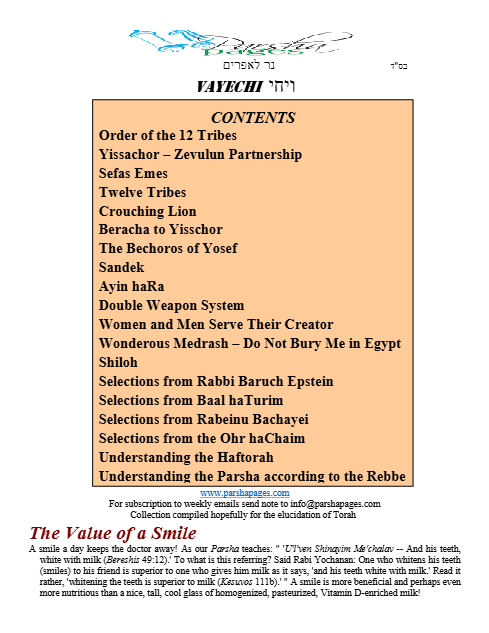
Double Weapons System
Parsha Pages | January 09, 2025
Print This Article
View Original PDF

Double Weapons System

Parsha Pages | June 27, 2025

בראשית פרק מח פסוק כב וַאֲנִי נָּׂתַתי לְׁךָ שכֶם אַחַד עַל אַחֶיךָ אֲשר לָּׂקַחְׁתי מִיד הָּׂאֱמֹרִ י בחַרְ בי וּבְקַשתי:

''And I am giving you an extra portion (''שכם אחד'') of the Land over your brothers that I've acquired from the Emorite nation by sword and bow (''בחרבי ובקשתי'').''

The following commentators view the phrase, ''בחרבי ובקשתי'' (''with my sword and my bow''), in the literal military sense, while differing regarding the word, ''שכם'', found in this verse. Does it refer to the city of Shechem or is it simply a portion of the Land?

Rashbam maintains that Yosef is promised by his father an extra portion of the Land beyond the portions received by the other brothers. His two children, Ephraim and Menashe, will be treated as equals with the other sons of Yaakov. The Land referred to is the Land that will ultimately be conquered in the wars of Yehoshua.

Ibn Ezra suggests that the word, ''שכם'', refers to the city of Shechem which would ultimately be located in the territorial section of Yosef after being conquered later on.

Rashi states (first opinion) the word ''שכם'', refers to the double portion that Yosef was to receive in his newly-gained position as ''firstborn'' (''בכור''), that this refers the extra portion given to Yosef of the city of Shechem (Yosef’s burial place) that had already been taken by Yaakov’s girding the weapons of war after the actions of Shimon and Levi.

In contrast, Onkolus translates these words as the spiritual weapons employed by Yaakov, that of prayer and petition (''בצלותי ו בבעותי '' ). This interpretation is based upon the Talmudic expression (Baba Basra 123a) that help and salvation cannot be achieved by the sword or the bow (see also Tehillim 44,7). Yaakov most certainly must have been referring to prayer and petition. The reason the Torah chooses these phrases is that Yaakov was able to accomplish more with his voice than Esav did with his sword (as told by Yitzchak that Esav would live by the sword) or Yishmael with his bow (renowned as an archer, Bereshis 21,20). Thus, Yaakov secured Eretz Yisrael for his descendants in place of their descendants.

There is not necessarily a contradiction between the seemingly divergent views concerning ''בחרבי ובקשתי''. Our Sages have taught that in anticipation of Yaakov's meeting with his brother Esau, after a twenty-year absence, he prepared for the occasion on three levels. He would attempt to appease his brother by showering him with gifts; he would pray; and he would prepare for battle (Rashi Bereshis 32:9).

It is not only legitimate, but desirable not to rely exclusively upon prayer. Rather, a person – or a nation – must gear up to battle as well. Hence, Yaakov was teaching the lesson of the double weapon system – the military and the spiritual. Both interpretations of ''בחרבי ובקשתי'' are essentially correct.

This double weapon system became the hallmark of King Dovid. The brave warrior on the one hand and the Psalmist on the other, Dovid integrated and personified both interpretations of ''בחרבי ובקשתי''. It is in this spirit that we are to understand Dovid's words found in Psalm 20:8, אֵלה בָּׂרֶכֶב וְׁאֵלה בַסּוּסִים וַאֲנַחְׁנוּ בשם ה' אֱ -לֹקינוּ נַזְׁכיר:. There are those armies who rely exclusively upon their chariots and horses. However, we, the Jewish nation, who beseech G-d's help in battle, can be confident of success at the end of the day.

Meshech Chochmah notes the difference between בצלותי and בבעותי. בצלותי indicates an organized order ordained by the Great Assembly (for example, the siddur); בבעותי refers to spontaneous individual petition. Each has its advantage. בצלותי is a prescribed service and thus, is not rendered ineffective by lack of kavanah. Whereas, בבעותי, in which one composes one’s own supplications, is entirely dependent on one’s own kavanah. Thus, בצלותי is like a sharp sword that can cause injury even if not yielded with force. Whereas, בבעותי is like a bow and arrow which effectiveness is in direct proportion to the degree of spiritual exertion with which one propels them.

בראשית פרק מח פסוק כב וַאֲנִי נָּׂתַתי לְׁךָ שכֶם אַחַד עַל אַחֶיךָ אֲשר לָּׂקַחְׁתי מִיד הָּׂאֱמֹרִ י בחַרְ בי וּבְקַשתי:

''And I am giving you an extra portion (''שכם אחד'') of the Land over your brothers that I've acquired from the Emorite nation by sword and bow (''בחרבי ובקשתי'').''

The following commentators view the phrase, ''בחרבי ובקשתי'' (''with my sword and my bow''), in the literal military sense, while differing regarding the word, ''שכם'', found in this verse. Does it refer to the city of Shechem or is it simply a portion of the Land?

Rashbam maintains that Yosef is promised by his father an extra portion of the Land beyond the portions received by the other brothers. His two children, Ephraim and Menashe, will be treated as equals with the other sons of Yaakov. The Land referred to is the Land that will ultimately be conquered in the wars of Yehoshua.

Ibn Ezra suggests that the word, ''שכם'', refers to the city of Shechem which would ultimately be located in the territorial section of Yosef after being conquered later on.

Rashi states (first opinion) the word ''שכם'', refers to the double portion that Yosef was to receive in his newly-gained position as ''firstborn'' (''בכור''), that this refers the extra portion given to Yosef of the city of Shechem (Yosef’s burial place) that had already been taken by Yaakov’s girding the weapons of war after the actions of Shimon and Levi.

In contrast, Onkolus translates these words as the spiritual weapons employed by Yaakov, that of prayer and petition (''בצלותי ו בבעותי '' ). This interpretation is based upon the Talmudic expression (Baba Basra 123a) that help and salvation cannot be achieved by the sword or the bow (see also Tehillim 44,7). Yaakov most certainly must have been referring to prayer and petition. The reason the Torah chooses these phrases is that Yaakov was able to accomplish more with his voice than Esav did with his sword (as told by Yitzchak that Esav would live by the sword) or Yishmael with his bow (renowned as an archer, Bereshis 21,20). Thus, Yaakov secured Eretz Yisrael for his descendants in place of their descendants.

There is not necessarily a contradiction between the seemingly divergent views concerning ''בחרבי ובקשתי''. Our Sages have taught that in anticipation of Yaakov's meeting with his brother Esau, after a twenty-year absence, he prepared for the occasion on three levels. He would attempt to appease his brother by showering him with gifts; he would pray; and he would prepare for battle (Rashi Bereshis 32:9).

It is not only legitimate, but desirable not to rely exclusively upon prayer. Rather, a person – or a nation – must gear up to battle as well. Hence, Yaakov was teaching the lesson of the double weapon system – the military and the spiritual. Both interpretations of ''בחרבי ובקשתי'' are essentially correct.

This double weapon system became the hallmark of King Dovid. The brave warrior on the one hand and the Psalmist on the other, Dovid integrated and personified both interpretations of ''בחרבי ובקשתי''. It is in this spirit that we are to understand Dovid's words found in Psalm 20:8, אֵלה בָּׂרֶכֶב וְׁאֵלה בַסּוּסִים וַאֲנַחְׁנוּ בשם ה' אֱ -לֹקינוּ נַזְׁכיר:. There are those armies who rely exclusively upon their chariots and horses. However, we, the Jewish nation, who beseech G-d's help in battle, can be confident of success at the end of the day.

Meshech Chochmah notes the difference between בצלותי and בבעותי. בצלותי indicates an organized order ordained by the Great Assembly (for example, the siddur); בבעותי refers to spontaneous individual petition. Each has its advantage. בצלותי is a prescribed service and thus, is not rendered ineffective by lack of kavanah. Whereas, בבעותי, in which one composes one’s own supplications, is entirely dependent on one’s own kavanah. Thus, בצלותי is like a sharp sword that can cause injury even if not yielded with force. Whereas, בבעותי is like a bow and arrow which effectiveness is in direct proportion to the degree of spiritual exertion with which one propels them.

PDF Preview