IT CAN THUS BE SETTLED
יש לתמוה | January 01, 2024
Print This Article
View Original PDF

IT CAN THUS BE SETTLED

יש לתמוה | December 10, 2025

1. Krias Shema can be said either standing or sitting. However, in the morning, if you were sitting beforehand, you may not stand to say it (as that would make it appear as if you are following the opinion of Beis Shamai). (Alter Rebbe’s Shulchan Aruch 63:2)

2. (1) When reading the megillah, men say “al mikra megillah” and women say “lishmoa megillah.” (2) A father redeeming his firstborn son says “al pidyon haben,” but if a first-born son was not redeemed by his father and redeems himself when he grows up, he says “al pidyon bechor.” (3) A mohel says “al hamilah,” and a father circumcising his own son says “lamul es haben.” (4) When saying Hallel, Ashkenazim say “likro es hahallel” and Sephardim say “ligmor es hahallel.” (5) When making a brachah on a tallis katan, Ashkenazim say “al mitzvas tzitzis” and Sephardim say “lehisatef betzitzis.”

3. It is forbidden to derive benefit from a mixture of milk and meat, but if the meat is not kosher, you may derive benefit from the mixture.

4. It is sometimes permitted for a non-Jewish contractor to do work for a Jew on Yom Tov, provided there are no Jews in the area so there is no issue of maris ayin. On Chol Hamoed, however, he must stop, as Jews may travel through the area and will see him doing work for a Jew.

5. It is forbidden to read by candlelight on Shabbos, as we are concerned you might adjust the flame to help you read better. However, if your hands are tied, you may read by candlelight, as there is no concern.

6. If Yom Kippur occurs on Shabbos and she is not fasting, she must make kiddush before eating. In such a case, her husband who is fasting may not make kiddush for her.

7. It is forbidden to walk past the door of a shul without entering, but if you are wearing tefillin it is permitted. (Alter Rebbe’s Shulchan Aruch 90:9—see there for the details of this halachah)

8. Yud-tes Kislev, Yud Shevat, and Purim.

9. A sticker with Hareini Mekabel, Ach Tzaddikim, and the Tzivos Hashem symbol (issued on Chanukah, 5744).

10. The night of 7 Teves, 5747.
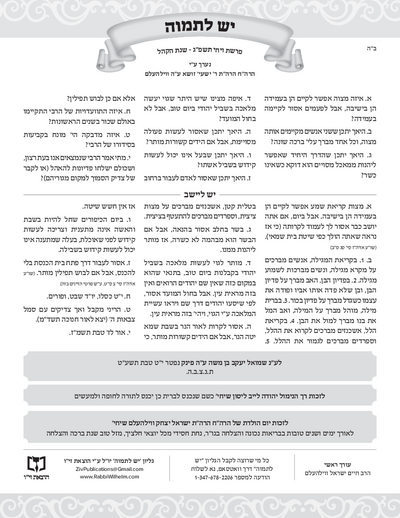
1. Krias Shema can be said either standing or sitting. However, in the morning, if you were sitting beforehand, you may not stand to say it (as that would make it appear as if you are following the opinion of Beis Shamai). (Alter Rebbe’s Shulchan Aruch 63:2)

2. (1) When reading the megillah, men say “al mikra megillah” and women say “lishmoa megillah.” (2) A father redeeming his firstborn son says “al pidyon haben,” but if a first-born son was not redeemed by his father and redeems himself when he grows up, he says “al pidyon bechor.” (3) A mohel says “al hamilah,” and a father circumcising his own son says “lamul es haben.” (4) When saying Hallel, Ashkenazim say “likro es hahallel” and Sephardim say “ligmor es hahallel.” (5) When making a brachah on a tallis katan, Ashkenazim say “al mitzvas tzitzis” and Sephardim say “lehisatef betzitzis.”

3. It is forbidden to derive benefit from a mixture of milk and meat, but if the meat is not kosher, you may derive benefit from the mixture.

4. It is sometimes permitted for a non-Jewish contractor to do work for a Jew on Yom Tov, provided there are no Jews in the area so there is no issue of maris ayin. On Chol Hamoed, however, he must stop, as Jews may travel through the area and will see him doing work for a Jew.

5. It is forbidden to read by candlelight on Shabbos, as we are concerned you might adjust the flame to help you read better. However, if your hands are tied, you may read by candlelight, as there is no concern.

6. If Yom Kippur occurs on Shabbos and she is not fasting, she must make kiddush before eating. In such a case, her husband who is fasting may not make kiddush for her.

7. It is forbidden to walk past the door of a shul without entering, but if you are wearing tefillin it is permitted. (Alter Rebbe’s Shulchan Aruch 90:9—see there for the details of this halachah)

8. Yud-tes Kislev, Yud Shevat, and Purim.

9. A sticker with Hareini Mekabel, Ach Tzaddikim, and the Tzivos Hashem symbol (issued on Chanukah, 5744).

10. The night of 7 Teves, 5747.

PDF Preview