The Burial of Yaakov and the Roles of Yosef and Levi
Project Likkutei Sichos | January 08, 2025
Print This Article
View Original PDF

The Burial of Yaakov and the Roles of Yosef and Levi

Project Likkutei Sichos | June 27, 2025

The Context:
When Yaakov passed away, his children carried his coffin into the Land of Canaan to bury him in the Cave of Machpela, where his ancestors rested. (Bereishis 50:13) Rashi notes, however, that even though the verse states “his children” carried him, Yosef and Levi did not actually participate in bearing the coffin—Yosef, because he was king, and Levi, because his descendants were destined to carry the holy ark. Menashe and Efraim, Yosef’s sons, carried the coffin in their place.

The Question:
How could Yosef not fulfill the oath his father made him take, “you shall carry me out of Egypt?” (Ibid, 47:30) And how could Levi not partake of this powerful mitzvah because of a distant eventuality concerning his descendants?

The Explanation:
Yaakov’s passing, and therefore his burial as well, was a significant milestone in the onset of the Jewish people’s subjugation. Although the actual slavery did not yet begin, the conditions for its implementation were set in motion with his passing. Yosef and Levi represent resistance to the Egyptian slavery. Being king of Egypt, Yosef was impervious to subjugation. And the sages taught that the slavery did not actually begin until Levi passed away, thus alluding to Levi’s incompatibility with slavery. Furthermore, during the slavery itself, the tribe of Levi was not subject to labor, they served as the leaders, guides, and teachers of the people throughout their ordeal.

Thus, Yosef and Levi, who embody the resistance to slavery, could not partake in Yaakov’s burial, which represents the first significant step towards that slavery. Menashe and Efraim represented Yosef and Levi so that it was as if they carried their father themselves, through their emissaries. But if Yosef and Levi can have no part in the onset of exile, why would they participate through their emissaries?

Further Explanation:

Even though the tribe of Levi was not enslaved, that does not mean they were totally divorced from the slavery. They, too, were part of the enslaved people, but they played a different role. Egyptian slavery was intended to be a crucible preparing the Jewish people to fulfill their role in transforming the darkness of the world through the Torah and mitzvos. But the risk of that crucible was that the people would be so downtrodden that they would lose their identity. Levi’s role was to fan the flames of the Jewish people’s faith so that they could eventually leave exile and be prepared to receive their mandate at Sinai.

Yosef, however, represents a different way of surviving the exile. As king, he had no semblance of slavery, he was totally disconnected from that experience.

Thus, Yosef and Levi point to two forms of resisting exile: Yosef is the power to disregard external constraints entirely. And Levi is the power of maintaining faith within the exile itself, even transforming it.

This is why even though Levi and Yosef could not directly contribute to Yaakov’s internment, they still participated through Menashe and Efraim, because they need to lend their influence to the rest of the people, ensuring that they have the tools to resist and remake the exile.

Menashe and Efraim correspond to both these roles: Menashe means “G-d has made me forget the land of my fathers,” which is a mode of nostalgia, of resisting the environment that makes us forget who we are and clinging to the essential freedom of our souls. Efraim means “for I have multiplied in the land of my oppression” which is a mode of remaking the exile into a fruitful experience. Thus, these grandchildren of Yaakov were fit to represent Yosef and Levi in burying him, by allowing Yosef and Levi to be above the exile, but still lend their power to fortify the people in the exile that would soon begin.
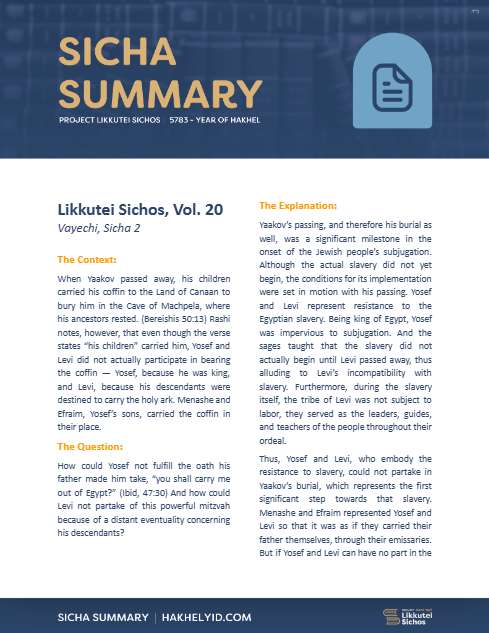
The Context:
When Yaakov passed away, his children carried his coffin into the Land of Canaan to bury him in the Cave of Machpela, where his ancestors rested. (Bereishis 50:13) Rashi notes, however, that even though the verse states “his children” carried him, Yosef and Levi did not actually participate in bearing the coffin—Yosef, because he was king, and Levi, because his descendants were destined to carry the holy ark. Menashe and Efraim, Yosef’s sons, carried the coffin in their place.

The Question:
How could Yosef not fulfill the oath his father made him take, “you shall carry me out of Egypt?” (Ibid, 47:30) And how could Levi not partake of this powerful mitzvah because of a distant eventuality concerning his descendants?

The Explanation:
Yaakov’s passing, and therefore his burial as well, was a significant milestone in the onset of the Jewish people’s subjugation. Although the actual slavery did not yet begin, the conditions for its implementation were set in motion with his passing. Yosef and Levi represent resistance to the Egyptian slavery. Being king of Egypt, Yosef was impervious to subjugation. And the sages taught that the slavery did not actually begin until Levi passed away, thus alluding to Levi’s incompatibility with slavery. Furthermore, during the slavery itself, the tribe of Levi was not subject to labor, they served as the leaders, guides, and teachers of the people throughout their ordeal.

Thus, Yosef and Levi, who embody the resistance to slavery, could not partake in Yaakov’s burial, which represents the first significant step towards that slavery. Menashe and Efraim represented Yosef and Levi so that it was as if they carried their father themselves, through their emissaries. But if Yosef and Levi can have no part in the onset of exile, why would they participate through their emissaries?

Further Explanation:

Even though the tribe of Levi was not enslaved, that does not mean they were totally divorced from the slavery. They, too, were part of the enslaved people, but they played a different role. Egyptian slavery was intended to be a crucible preparing the Jewish people to fulfill their role in transforming the darkness of the world through the Torah and mitzvos. But the risk of that crucible was that the people would be so downtrodden that they would lose their identity. Levi’s role was to fan the flames of the Jewish people’s faith so that they could eventually leave exile and be prepared to receive their mandate at Sinai.

Yosef, however, represents a different way of surviving the exile. As king, he had no semblance of slavery, he was totally disconnected from that experience.

Thus, Yosef and Levi point to two forms of resisting exile: Yosef is the power to disregard external constraints entirely. And Levi is the power of maintaining faith within the exile itself, even transforming it.

This is why even though Levi and Yosef could not directly contribute to Yaakov’s internment, they still participated through Menashe and Efraim, because they need to lend their influence to the rest of the people, ensuring that they have the tools to resist and remake the exile.

Menashe and Efraim correspond to both these roles: Menashe means “G-d has made me forget the land of my fathers,” which is a mode of nostalgia, of resisting the environment that makes us forget who we are and clinging to the essential freedom of our souls. Efraim means “for I have multiplied in the land of my oppression” which is a mode of remaking the exile into a fruitful experience. Thus, these grandchildren of Yaakov were fit to represent Yosef and Levi in burying him, by allowing Yosef and Levi to be above the exile, but still lend their power to fortify the people in the exile that would soon begin.

PDF Preview